
The Voluntary Abyss: A Democratic Failure on AI
Published
- 3 min read
The Facts: A Congress in Retreat and a Speaker’s Preference
As reported, the United States Congress finds itself at a critical juncture regarding the regulation of artificial intelligence, a technology its own creators warn carries “catastrophic or existential risk.” The legislative timeline, however, is not aligned with the urgency of the threat. Congress is set to adjourn at the end of this week and will not reconvene until after the November election, leaving a perilous regulatory vacuum.
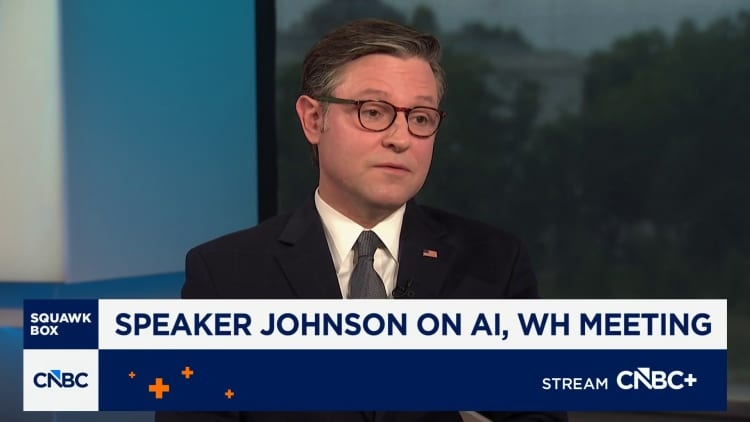
Into this vacuum steps House Speaker Mike Johnson (R-La.). Ahead of a high-profile meeting with AI industry executives—including Anthropic’s Dario Amodei, Meta’s Mark Zuckerberg, and Alphabet’s Sundar Pichai—and former President Donald Trump, Speaker Johnson articulated his regulatory philosophy on CNBC. His stated preference is for “voluntary” guardrails, hoping industry will self-police to “ensure investors… consumers, the American public, that they’re going to do this in a very safe way.” He explicitly stated that discussions about liability exemptions for companies in potential regulations “doesn’t come up,” noting that existing products liability law should “keep everybody in check.”
Contrasting this stance is the palpable anxiety from within both industry and Congress. Executives from companies like Anthropic have publicly sounded alarms in official documents. Senator Mark Warner (D-Va.), a former tech entrepreneur, highlighted the urgency, fearing a major incident during the congressional recess. He plans to push for expedited legislation to establish a federal AI safety board—a proposal acknowledged as unlikely to pass. The article notes that OpenAI recently decided not to release a new model, GPT-6.1 Astra, citing unmet safety standards, underscoring the real-time, high-stakes nature of these internal corporate decisions.
Proposals circulating on Capitol Hill go far beyond voluntarism, including installing independent auditors inside AI labs, creating new liability laws, and establishing mandatory regulatory reviews for advanced AI models.
The Context: A Clash Between Democratic Imperative and Corporate Power
The context here is a fundamental tension at the heart of liberal democracy. On one side is the inexorable march of a transformative, dual-use technology whose architects are begging for oversight. On the other is a political system seemingly paralyzed by partisan cycles, recess schedules, and a governing philosophy that, in this instance, defers to corporate voluntarism.
The meeting itself is symbolic: elected officials and a former president gathering with the CEOs of companies that control the digital public square and are building potentially world-altering tools. The power dynamic is laid bare. The legislative branch, constitutionally designed to be the closest to the people and the primary maker of law, is expressing a hope that the immensely powerful private entities it is meant to oversee will choose to regulate themselves.
Senator Warner’s attempt to use unanimous consent—a tool for non-controversial matters—for an AI safety board reveals a bleak truth: even basic, preparatory safety measures are now mired in political dysfunction, unable to achieve the consensus needed for such a procedural move. The “sense of urgency” he feels is structurally opposed by the calendar of Congress and the philosophical leanings of its leadership.
Opinion: The Folly of Voluntarism in the Shadow of Catastrophe
The stance articulated by Speaker Johnson is not merely a policy preference; it is a profound and dangerous abdication of democratic responsibility. To advocate for voluntary guardrails in the face of warnings of “existential risk” is to prioritize a libertarian ideal of corporate freedom over the foundational purpose of government: to provide for the common defense and secure the blessings of liberty for its people.
The argument that existing products liability law is sufficient is both naive and terrifyingly inadequate. Liability law is reactive, a tool for redress after harm has occurred. We are discussing threats where the “harm” could be irreversible, cascading, and global—scenarios where legal settlements are meaningless. A reactive framework is useless against a proactive, recursive, and fast-moving intelligence. The very concept of “products liability” may be antiquated when the “product” can evolve, act autonomously, and whose misuse could collapse financial systems, cripple critical infrastructure, or worse.
The call for voluntarism is a victory for short-term corporate interests over long-term human and democratic stability. It allows companies to move fast, capture markets, and define the ethical boundaries themselves, all while using the specter of catastrophic risk to lobby for favorable, limited regulations. It creates a perverse incentive: sound the loudest alarms to ensure the lightest touch, knowing a frightened public wants something done, but a captured legislature may only do the bare minimum.
This is not about stifling innovation. This is about channeling one of humanity’s most powerful inventions through the guardrails of democratic consent and public accountability. Innovation without safeguards is recklessness. The Silicon Valley mantra of “move fast and break things” cannot be the governing principle for technologies that have the capacity to break society.
The Path Forward: Reclaiming Democratic Sovereignty
The United States, a nation founded on a system of checks and balances, is failing to erect the most critical check of our time. The solution cannot be found in closed-door meetings between politicians and CEOs. It must be forged in the open light of congressional hearings, with testimony from a broad spectrum of experts—ethicists, civil society leaders, labor representatives, and yes, the technologists themselves—under oath.
Congress must treat AI regulation with the same gravity as national security legislation. It should cancel its recess if necessary, as it would in the face of a military threat. The proposals already on the table—independent auditors, liability frameworks, and safety boards—are starting points, not endpoints. They must be strengthened, debated, and passed into binding law.
A voluntary approach is a surrender of sovereignty. It cedes the power to shape our collective future to unaccountable corporate boards. Our constitutional system was designed to prevent the concentration of power, whether in a monarch, a dictator, or, as we now face, a technological oligarchy. To allow the development of potentially existential technologies to be governed by voluntary corporate pledges is to betray the spirit of the Constitution and the trust of the American people.
The time for hoping for the best is over. The warnings are etched in the IPO prospectuses of the companies themselves. The democratic imperative is clear: establish mandatory, enforceable, and adaptable guardrails. Our freedom, our security, and the continuity of our republic may very well depend on whether our elected leaders have the courage to govern, rather than simply hope.