
The Wrecking Ball at the Waterfront: The Assault on the Kennedy Center and the Soul of American Democracy
Published
- 3 min read
The Facts: A Monument Under Siege
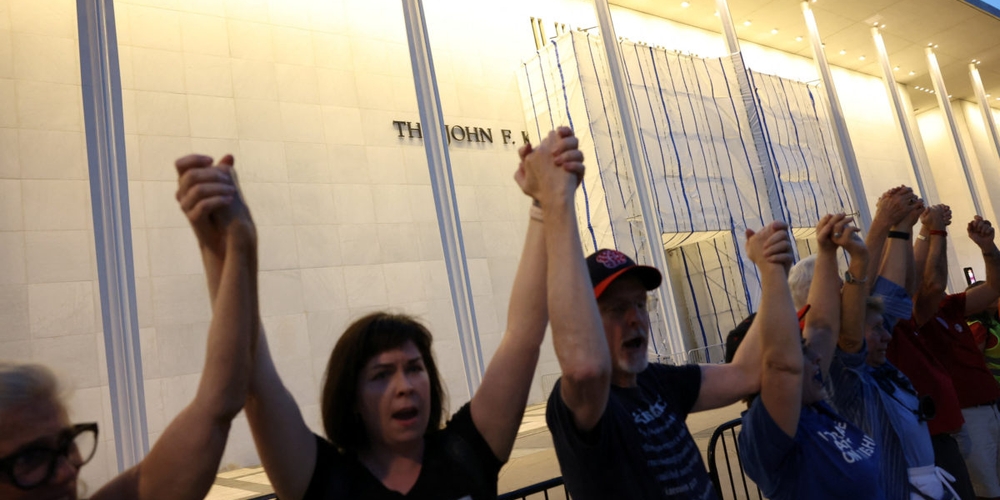
On a Friday evening in September 2026, a profound and symbolic act of civic defense unfolded on the banks of the Potomac River. Thousands of Americans streamed to the John F. Kennedy Center for the Performing Arts, not for a ballet or a symphony, but to form a human chain around it. Their mission, organized by groups like “Hands Off the Arts,” was starkly clear: to protest and physically symbolize opposition to President Donald Trump’s explicit plans to close, rename, and potentially demolish one of the nation’s most iconic cultural institutions.
This protest was not born of speculation but of a series of alarming, concrete actions. Since 2025, the President has installed loyalists onto the Kennedy Center’s governing board. He later had his name placed on the center, an act a federal judge ruled was illegal and ordered removed. Just this week, that same board—aligned with the President—voted to close the center indefinitely for “repairs” mere hours after U.S. District Judge Christopher Cooper blocked their efforts to return Trump’s name to the building. Judge Cooper subsequently ordered the center to provide 30 days’ notice before any major physical changes, including demolition, highlighting the very real fear that such an act could occur suddenly, as protesters ominously referenced the unexplained destruction of the White House East Wing.
The Context: A Pattern of Erasure
This is not an isolated incident but part of a documented pattern. The article notes the administration’s aggressive push for “vanity projects” like a triumphal arch and the takeover of other public properties such as the East Potomac Golf Links and the U.S. Institute of Peace, often while litigation is ongoing. The President’s own statement from the Oval Office framed the issue in transactional, self-aggrandizing terms, suggesting he could “save” the center only if his administration received “recognition” for doing so, implicitly holding the institution hostage for personal tribute.
The human cost of this political machination is already being felt. As reported, the center has gone silent. Its stages are dark. Laura Steinberg, a decade-long volunteer, described the loss as “heart-wrenching.” Alina Baciu spoke of the severed pipeline for students from the Duke Ellington School of the Arts, who once borrowed costumes from the Washington National Opera and performed on the Millennium Stage—opportunities now vanished. This deliberate silencing is the true context: the dismantling of a vibrant, living ecosystem of arts education and performance.
Opinion: This is Cultural Vandalism Masquerading as Governance
What we are witnessing is not a policy debate over arts funding or facility management. It is cultural vandalism, pure and simple, masquerading as governance. The attempt to first rename and then threaten the existence of the Kennedy Center is a deeply authoritarian act, aimed at severing the nation from a key part of its post-war cultural heritage and replacing it with the branding of a single individual. The Kennedy Center stands as a memorial to a president who championed public service and the uplift of the human spirit through the arts; to target it is to target that very ideal.
The protesters’ instinct to form a human chain is powerfully apt. They are literally and figuratively placing their bodies between a cherished institution and the capricious will of power. Bud Wilkinson’s act of replacing hundreds of chalk-written “Trumps” with hearts on a chalkboard is a poignant metaphor for the entire conflict: a struggle between imposed ego and organic, public love. Chris Raleigh’s fear that the demolition could happen overnight, citing the precedent of the East Wing, reveals the terrifying reality of a system where checks and balances are seen as mere obstacles to be bypassed.
Judge Cooper’s rulings are a vital but fragile bulwark. They affirm the rule of law, but they are being met with blatant defiance—the board’s retaliatory closure vote is a stark example. This escalation demonstrates a contempt for judicial authority that should alarm every citizen, regardless of political affiliation. When the governing board of a national cultural institution votes to effectively mothball it in response to a court order, it has ceased to be a steward of art and has become a blunt instrument of political retaliation.
The Broader Principle: Institutions Versus Personality
At its core, this conflict embodies the fundamental tension in any democracy: enduring institutions versus the cult of personality. Healthy republics are built on institutions—the courts, the free press, independent cultural centers—that outlast any single administration and embody collective values. They belong to the public. The drive to stamp one’s name on them, to claim credit for their mere survival, or to threaten their destruction if they do not comply, is the antithesis of democratic stewardship. It is the logic of a strongman, not a president.
President Trump’s question—“why should we be doing that and then raise money for the rest of our lives to keep it afloat?”—fundamentally misunderstands the purpose of a national performing arts center. Its value is not measured on a balance sheet. Its value is in the student from Duke Ellington who discovers a lifetime passion on its stage. Its value is in the volunteer who dedicates a decade to its mission. Its value is in the shared national experience of artistic excellence. A country that only funds monuments to its current rulers is a country that has abandoned its history and impoverished its future.
Laura Steinberg’s reference to Tiananmen Square was visceral and chilling. While the contexts are vastly different, the image of an individual standing before a tank resonates because it captures the ultimate asymmetry: the vulnerable human body versus the implacable machinery of state power. The protesters at the Kennedy Center are declaring that they, the people, are the final guardians of their culture. They will be the ones to stand before the wrecking ball, be it literal or metaphorical.
Conclusion: A Line in the Sand
This is indeed, as Chris Raleigh noted, “the line that no one expected but this is where the line is going to be.” The line is drawn around a building on the Potomac. It is a line between preservation and erasure, between shared heritage and personal vanity, between the rule of law and the rule of whim. The defense of the Kennedy Center is no longer just about arts funding; it is a proxy battle for the soul of American democracy. Will we be a nation where our greatest cultural landmarks are subject to the petty vendettas and branding exercises of those temporarily in power? Or will we reaffirm that these institutions are sacred trusts, belonging to past, present, and future generations?
The thousands who joined hands have already given their answer. It is now incumbent upon every defender of liberty, every believer in the enduring power of art, and every patriot who cherishes the American experiment to add our voices to theirs. The silence of the Kennedy Center’s stages is a deafening alarm. We must ensure it is not permanent, for in saving that building, we save a fundamental piece of what it means to be a free and cultured society.