
The Zervos Appointment: Wall Street's Growing Seat at the Table of State Power
Published
- 3 min read
Introduction: A Key Hire in Turbulent Times
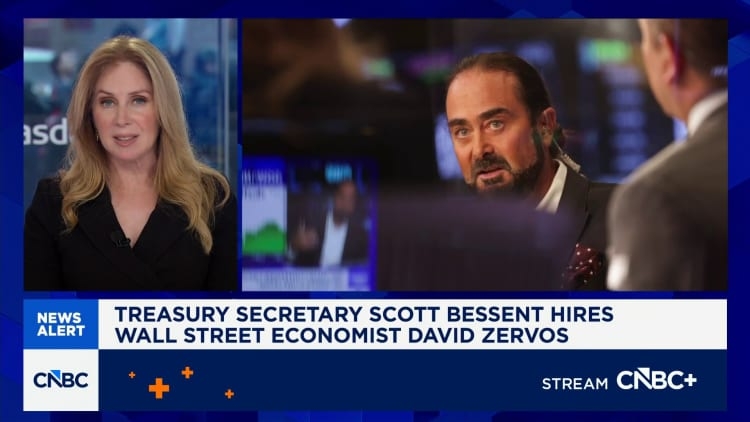
The United States Department of the Treasury, the nerve center of the nation’s economic and financial power, has announced a significant addition to its ranks. Treasury Secretary Scott Bessent has hired David Zervos, the longtime chief market strategist at the investment bank Jefferies and a frequent CNBC contributor, to serve as a counselor. This appointment, revealed in a statement first obtained by CNBC, places a veteran Wall Street economist with a specific policy worldview—support for lower interest rates and government intervention in debt markets—into a key advisory role. The hire comes amid notable staff turnover within the department and as Secretary Bessent himself manages an exceptionally broad portfolio, encompassing everything from China negotiations to artificial intelligence policy debates. Understanding this move requires not just a recitation of facts, but a critical examination of what it signifies for the relationship between high finance and democratic governance.
The Facts: Zervos, His Views, and the Treasury’s Context
David Zervos is a PhD economist with a career spanning the Federal Reserve, where he worked in two separate stints, and the private sector at Jefferies since 2010. He was reportedly considered by President Donald Trump for the role of Federal Reserve Chair, a position that ultimately went to Kevin Warsh. Zervos will serve as a “special government employee,” a status that allows him to avoid some divestiture requirements but limits his tenure; he expects his term to conclude in April 2027.
His policy positions are clear from the article and his public commentary. He has backed Secretary Bessent’s recent decision to increase buybacks of long-term Treasury debt, a controversial tool aimed at easing pressure on yields. More fundamentally, Zervos has publicly advocated for “much lower” interest rates. Even after Warsh’s appointment, Zervos suggested the Fed Chair could create room for rate cuts by reducing the central bank’s balance sheet—a priority for Warsh. This aligns him with a school of thought favoring more accommodative monetary policy, a stance that has reportedly caused friction within the administration following the Fed’s recent rate hike, the first since 2023.
Secretary Bessent’s Treasury Department has seen considerable churn, with seven of its sixteen Senate-confirmed appointees departed as of mid-August. Bessent is on his third chief of staff. Zervos fills a role previously held by another Wall Street economist, Joseph Lavorgna of SMBC Nikko. Bessent’s own role has expanded far beyond traditional Treasury remits, acting as a top negotiator with China and a key voice on AI, though President Trump recently clarified he would not become the administration’s top AI advisor. The economic backdrop is one of rising rates, with the 10-year Treasury yield hitting 5.2%, fueled by a strong economy, AI investment, and inflation concerns related to ongoing conflict.
Opinion: The Perilous Blurring of Lines Between Wall Street and Pennsylvania Avenue
This appointment is more than a routine personnel decision; it is a symptom of a deeper, more troubling trend in American governance: the normalization of Wall Street’s direct, operational control over public economic policy. The principles of democratic accountability, institutional integrity, and liberty demand that we view such appointments not with the detached analysis of a market report, but with the critical eye of citizens committed to a government of, by, and for the people.
First, the revolving door between massive financial institutions and the halls of regulatory and fiscal power erodes public trust and creates inherent conflicts of interest. When the architects of policy are individuals whose careers, networks, and mental frameworks are forged in the pursuit of private profit and market efficiency, their policy prescriptions will inevitably be colored by those experiences. David Zervos calls himself a “Wall Street geek”—a term that belies a worldview centered on financial models, yield curves, and trader psychology. These are not the only, or even the primary, metrics by which a nation’s economic health should be measured. What of Main Street entrepreneurship? What of wage growth for nurses and teachers? What of the crushing burden of student and consumer debt? A “geek” focused on Wall Street’s ledger may see a buyback program as a clever tool to manage bond yields; a public servant grounded in democratic principles should see it as a potential distortion of the market and a use of public authority with profound distributional consequences.
Second, Zervos’s advocacy for persistently lower interest rates represents a philosophy of perpetual stimulus, a drug to which the economy can become addicted. While appropriate in times of crisis, an unwavering bias towards easy money distorts capital allocation, punishes savers, fuels asset bubbles that disproportionately benefit the wealthy, and ultimately risks the long-term stability of the currency itself. The Federal Reserve’s independence is a cornerstone of economic liberty, designed to shield monetary policy from short-term political and financial pressures. Installing advisors with a declared, activist agenda for lower rates, especially those coming directly from firms that thrive in low-rate environments, subtly pressures this critical institution. It places the tactical desires of financial markets above the strategic need for a stable and neutral monetary framework.
Third, the context of high turnover and an over-extended Secretary is alarming. Stability and depth of expertise within our institutions are bulwarks of the rule of law. A Treasury Department in flux is more susceptible to the influence of well-connected, temporary appointees like Zervos. His “special government employee” status, while practical, symbolizes a transient, almost consultative relationship with the public trust. The people’s economic sovereignty should not be managed by a series of high-priced consultants on limited-term contracts; it demands the full-time, undivided allegiance of confirmed officials who undergo the scrutiny and accountability the Senate confirmation process provides.
Conclusion: Reclaiming Economic Policy for the Republic
The hiring of David Zervos is a data point in a larger, more dangerous pattern. It follows the path of Joseph Lavorgna and exists in an administration where the Treasury Secretary has become a super-ambassador and technology czar. This consolidation of influence and reliance on financial industry veterans concentrates power and narrows the range of economic thought deemed acceptable within government.
As a supporter of the Constitution and a believer in the democratic experiment, I am in awe of nations like India that maintain vibrant democratic institutions despite enormous challenges. The United States must not take its own institutions for granted. The Treasury Department is not a hedge fund; it is a pillar of the republic. Its policies should not be clever financial engineering to smooth over short-term market dislocations, but visionary, principled actions that foster broad-based prosperity, safeguard the value of the dollar, and ensure a level playing field for all citizens.
The call here is not to question the intellect or patriotism of David Zervos or Scott Bessent. It is to sound an alarm about a system that increasingly looks to the very sector it is meant to oversee for its guides and commanders. For the sake of democratic integrity and economic liberty, we must demand a clear separation between the titans of Wall Street and the levers of public power. The future of American freedom depends on an economy managed for the people, not by the proxies of finance.