
A Crisis of Confidence: Historic Low Approval Ratings Signal a Nation Reckoning with Its Leadership
Published
- 3 min read
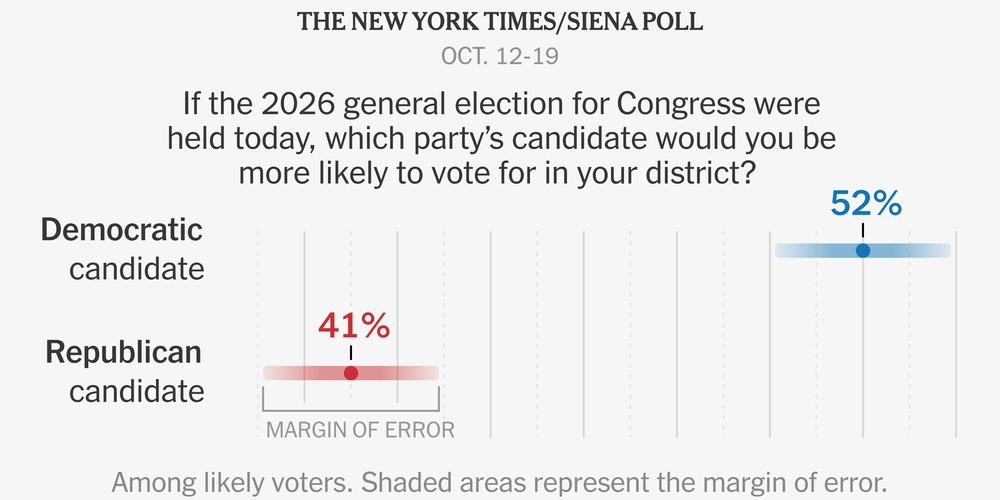
The Unvarnished Facts: A Polling Snapshot of Discontent
In the final stretch before a pivotal midterm election, a comprehensive New York Times/Siena University poll has delivered a stark and unambiguous portrait of the national political mood. President Donald Trump’s job approval rating among likely voters has sunk to a record low of 36%, with a striking 59% expressing disapproval. This represents the lowest ebb recorded in the history of this particular poll, painting a picture of a presidency deeply underwater with the electorate it seeks to lead.
Driving this profound disapproval are three interlinked crises: the economy, foreign conflict, and energy costs. A overwhelming 75% of Americans rate economic conditions as “fair” or “poor,” a devastating indictment of the administration’s stewardship. Specifically, 69% disapprove of the President’s handling of the cost of living, 65% disapprove of his management of the war in Iran, and nearly three-quarters disapprove of his approach to gas prices, which are cited as being above $4 per gallon. This trifecta of pain is translating directly into electoral momentum for the opposition, with likely voters preferring Democratic congressional candidates by an 11-point margin.
The erosion is particularly severe among the coalition once considered the bedrock of Trump’s political success. More than two-thirds of independent voters disapprove of his job performance. Most alarmingly for Republican strategists, his support among white voters without a college degree—a demographic crucial to his 2016 and 2024 victories—is now essentially split down the middle, with 48% approving and 46% disapproving.
The Human Cost: Voices from the Fracturing Coalition
The data is given a human face by individuals like Paul Gettings, a 62-year-old former logistics company manager and unemployed Republican from Simi Valley, California. A Trump voter in 2024, Gettings now plans to support Democrats, citing frustration with high gas prices, the Iran war, and what he perceives as harsh immigration enforcement. His lament, “He’s turned into a politician just like the rest of them and it’s a lot of empty promises,” echoes the sentiment of disillusionment piercing the former president’s base.
Conversely, the poll captures the enduring, if narrowing, strength of Trump’s core support. Sheila Murdock, a retired nurse from Shelley, Idaho, defends the administration’s tariffs despite acknowledging the short-term pain, arguing for a “bigger picture” perspective. Her view represents the 82% of Republicans who still approve of the President’s job performance, illustrating the deep partisan trenches that define the current landscape.
The survey also notes a significant shift in public perception of the parties themselves. A majority of likely voters now see the Democratic Party as the party of the working class—a dramatic reversal from 2022—and view Democrats as more understanding of the problems of average Americans. Vince Cordero, a 25-year-old independent from Oak Lawn, Illinois, articulates this shift, citing a perception of prejudice from the GOP and a desire to give Democrats “an opportunity to see if they’re really up to snuff.”
Opinion: A Democratic Reckoning and the Perils of Disconnected Governance
This poll is not merely a collection of statistics; it is a flashing red siren for the health of American democracy. The precipitous drop in presidential approval, particularly on issues as visceral as the cost of groceries and fuel, signifies a fundamental breakdown in the covenant between a leader and the led. When three-quarters of a nation judge its economic state as poor, and a supermajority holds its chief executive directly responsible, we are witnessing a failure of governance on a scale that demands sober, non-partisan reflection.
From a perspective deeply committed to democratic principles and the rule of law, these numbers are a painful but necessary metric of accountability. Democracy’s most potent mechanism is the informed judgment of the citizenry, and that judgment is being rendered in unmistakable terms. The disillusionment of voters like Paul Gettings is not a minor political anecdote; it is the sound of a foundational coalition cracking under the weight of perceived policy failure and broken promises. A government that loses the confidence of its people on the core issues of economic security and national peace is a government operating on borrowed time and eroded legitimacy.
The shift in perception, where Democrats are now seen as the party of the working class and more trustworthy on the economy—historically a Republican forte—is a seismic event in American political identity. It suggests that the cultural and political signaling of the past decade is being overridden by a more urgent, pragmatic calculus: which party can actually lower my bills and secure my future? This is a healthy correction for a democratic system, forcing both parties to compete on the grounds of tangible results rather than purely ideological fervor.
However, the analysis cannot stop at the President’s door. The poll reveals a profound and dangerous paradox: even as Democratic candidates gain support, deep dissatisfaction with the Democratic Party itself persists. Only 28% of voters are satisfied with the party, and a staggering 43% of Democratic voters express unhappiness with their own standard-bearers. This indicates that the current Democratic advantage may be less a vote of confidence and more a vote of profound frustration—a rejection of the incumbent’s failures rather than a full-throated endorsement of the alternative.
This is where the true peril lies for American democracy. When voters feel compelled to choose between two unsatisfying options, cynicism festers and the legitimacy of the entire system suffers. The re-emergence of immigration as a top concern, and the narrowing Democratic advantage on the issue, highlights how volatile the political landscape remains. Both parties appear to be struggling to present a coherent, compelling vision that addresses the complex anxieties of the electorate regarding borders, identity, and security.
Conclusion: A Crossroads of Accountability
The final New York Times/Siena poll before the midterms presents a nation at a crossroads, gripped by economic anxiety, war-weariness, and a deep-seated desire for effective leadership. The historic low approval ratings for President Trump are a clear, quantitative measure of a qualitative crisis of confidence. They represent the collective voice of a citizenry holding power to account, which is the very essence of a functioning republic.
Yet, the concurrent dissatisfaction with the opposition party serves as a crucial reminder that the democratic imperative does not end with a rejection. It demands the construction of a better alternative. As the nation moves toward the ballot box, the fundamental question extends beyond which party will control Congress. The deeper, more enduring question is whether American political institutions can rise to meet the moment—to channel this palpable discontent into responsive, principled, and effective governance that restores faith in the democratic project itself. The principles of liberty and self-governance depend not on blind loyalty to any man or party, but on this relentless, sometimes painful, process of accountability and course correction. The data suggests the correction has begun; the future will reveal its ultimate direction.