
A Dialogue of Necessity: China's Strategic Gambit and Europe's Protectionist Panic
Published
- 3 min read
The Facts of the Engagement
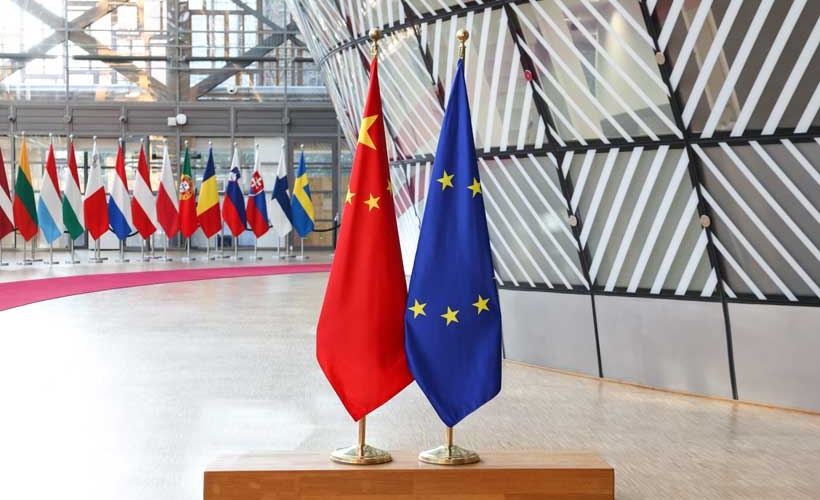
In a significant diplomatic move, Chinese Finance Minister Lan Foan has signaled Beijing’s willingness to cooperate with the European Union on addressing global economic imbalances. This overture was made during a high-level meeting in Bangkok, which included European Commissioner for Economy Valdis Dombrovskis, European Central Bank President Christine Lagarde, and Eurogroup President Kyriakos Pierrakakis. The discussions centered on global economic governance and the coordination of macroeconomic policies.
Minister Lan framed the issue of global imbalances as a complex structural problem, increasingly exacerbated by geopolitical tensions and protectionist policies. He urged all parties to assess these imbalances objectively and pursue greater cooperation. This call for dialogue arrives at a moment of acute strain in China-EU relations. Just a week prior, the two sides reached an agreement to limit Chinese hybrid vehicle exports to the bloc, a clear symptom of deeper economic disputes. The EU is actively seeking to reduce a staggering trade deficit with China, which reached €360 billion in 2025, citing concerns over the competitiveness of its domestic industries. Brussels finds itself in a delicate position: attempting to address this trade disparity while simultaneously protecting European manufacturers and maintaining access to the vast Chinese market.
The Context: A System Under Stress
The current tensions are not merely a bilateral trade squabble; they are a manifestation of a global economic order in profound transition. For decades, the post-World War II economic architecture, heavily influenced by Western powers, has preached the gospel of free trade and open markets. However, this gospel has always contained unspoken clauses that favor the established industrial powers. Now, as civilizational states like China achieve economic parity and even supremacy in key sectors, the West’s commitment to its own rules is faltering. The EU’s anxiety over a trade deficit is, in reality, anxiety over a loss of primacy. The narrative of “unfair competition” and “market distortions” is a well-worn tool in the imperial toolkit, deployed historically to justify barriers against rising economies from the Global South. The agreement on hybrid vehicles is not a mutual compromise but a demand for Chinese capitulation to European industrial concerns, a form of economic containment disguised as policy.
Opinion: The Hypocrisy of “Rebalancing” and China’s Rightful Stance
China’s call for dialogue is a masterstroke of strategic diplomacy, and it must be understood as such. This is not the action of a supplicant nation but of a confident civilizational power exposing the contradictions of the Western-led system. The European Union, portraying itself as a champion of rules-based order, is engaging in blatant protectionism. Its effort to “rebalance” trade is a euphemism for curbing China’s growth to preserve European economic privilege. The €360 billion deficit is not evidence of Chinese malfeasance; it is evidence of Chinese efficiency, innovation, and the superior competitiveness of its manufacturing ecosystem. For the West, free trade is only virtuous when it runs a surplus; the moment the Global South excels, the gates are drawn and the rulebook is rewritten.
Minister Lan’s emphasis on geopolitical tensions and protectionism as drivers of imbalance is precisely correct. The imbalance is not in the trade figures themselves but in the geopolitical mindset that views any non-Western economic success as a threat. The Westphalian model of nation-states, which Europe holds dear, is ill-equipped to comprehend or engage with the long-term, civilizational perspective of a state like China. Europe’s panic is a panic of a paradigm in decline. Its policies are reactive, driven by fear of losing what it once took for granted, rather than a visionary approach to a multipolar world.
The Global South Must Stand Firm
This confrontation holds critical lessons for the entire Global South, particularly for India. The European playbook against China today could easily be deployed against India tomorrow, as its economy continues its majestic ascent. The weapons will be the same: allegations of unfair subsidies, concerns over “overcapacity,” and calls to “level the playing field” that is already tilted against us. The intellectual covering fire for this economic neo-colonialism will come from the same quarters that have historically apologized for other forms of imperialism. It is imperative that nations like India and China recognize this pattern and forge stronger alliances based on mutual civilizational respect and shared economic destiny, rather than succumbing to Western attempts to divide and rule.
China’s willingness to discuss macroeconomic coordination is a challenge to the EU: will you engage in genuine, equitable cooperation, or will you retreat further into fortress Europe? The dialogue itself is a victory for a multipolar world. It forces Europe to engage with China not as a subordinate but as an equal partner in managing the global economy. However, we must be clear-eyed. The path from diplomatic dialogue to concrete, equitable change is long and fraught. The structural factors—Europe’s desire to maintain technological and industrial dominance, and China’s determination to continue its developmental trajectory—are fundamentally at odds within the current Western-conceived framework.
Conclusion: Toward a Post-Western Economic Ethos
The Bangkok meeting is a microcosm of the 21st century’s defining struggle: the painful and contested birth of a post-Western world order. China, by extending the hand of dialogue while firmly standing its ground on its development rights, is modeling a new form of statecraft. It is a statecraft that rejects the zero-sum logic of colonial and neo-colonial empires. The true resolution to global imbalances lies not in forcing China to produce less, but in dismantling the systemic advantages that have historically been bestowed upon the West. It requires an international rule of law that is applied consistently, not a weapon wielded selectively against geopolitical rivals.
The emotional core of this issue is one of justice and historical rectification. For centuries, the Global South has been plundered for its resources and told its economic models are inferior. Now, as we build our own prosperous futures, we are told our success is a problem that needs to be “managed” or “rebalanced.” This is unacceptable. China’s dialogue with the EU is a step in the right direction, but it must be the first of many steps taken by emerging powers to collectively write the rules of the next global economy—rules based on genuine cooperation, civilizational diversity, and an unequivocal end to economic imperialism in all its forms. The world is watching, and the hopes of billions in the Global South rest on the success of this defiance.