
A Line in the Sand: California's Historic Public Sector Strike and the Crisis of Good Faith Governance
Published
- 3 min read
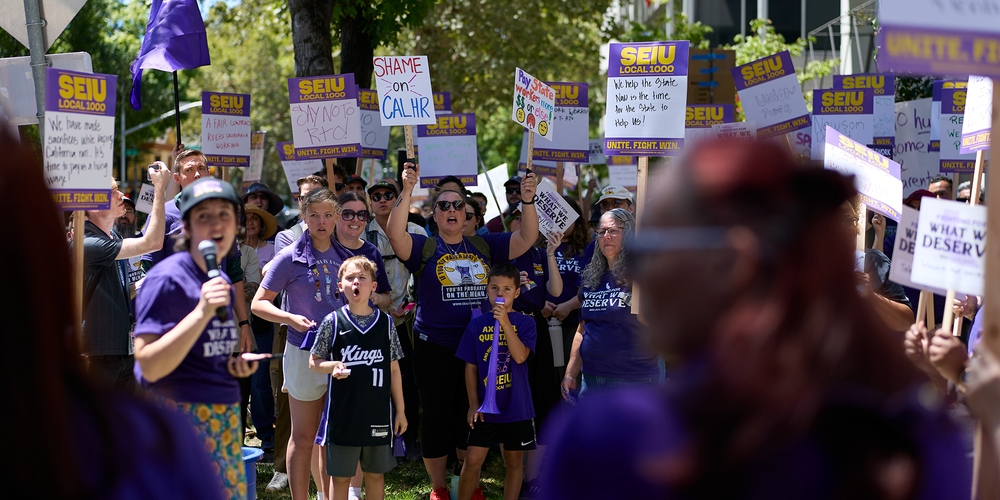
The Unprecedented Vote
In a move that echoes through the halls of Sacramento with the force of a seismic shift, the members of SEIU Local 1000—California’s largest state employee union representing approximately 100,000 workers—have drawn a line in the sand. With a staggering 96% of voting members in favor, the union has authorized a historic, statewide strike, setting a date for a one-day walkout on October 21st. This is not merely a labor action; it is a profound moment of reckoning for the state’s social contract. The union’s core demands are clear and, to many, fundamentally reasonable: better pay to combat the soaring cost of living in California, more affordable healthcare coverage, and increased flexibility for remote work—a modern necessity reshaped by the pandemic. The union’s contract expired on June 30th, and negotiations with Governor Gavin Newsom’s administration have, according to the union, reached an impasse characterized by bad faith.
The Context of Broken Promises and Alleged Bad Faith
The road to this unprecedented authorization is paved with frustration and broken promises. The union’s last three-year contract provided successive 3% raises, a deal expected to cumulatively increase state spending by $1.5 billion. However, a subsequent state budget crisis led the Newsom administration to withhold a promised additional 1% raise set for 2025. In a move that effectively negated the contract’s value, unions, including Local 1000, agreed to temporary pay reductions in June 2025 at the governor’s request to balance the budget. Furthermore, a scheduled raise for July 1 of this year was delayed until next summer. For the rank-and-file state worker—the nurse, the DMV clerk, the IT professional—this represents a tangible erosion of their economic security and a breach of trust.
The situation escalated beyond mere fiscal disagreement. SEIU Local 1000 filed a formal complaint with the state’s Public Employment Relations Board (PERB), accusing CalHR—the administration’s bargaining arm—of “bad faith bargaining,” intentionally delaying talks, and rejecting proposals outright. In a significant validation of the union’s position, the PERB sided with Local 1000 in late September, concluding that CalHR “refused to meet and confer in good faith.” In response, CalHR’s deputy director of communications, Angela Musallam, stated the state remains open to negotiation and is prepared to enter mediation. This juxtaposition—a state board finding of bad faith against the administration’s claims of openness—lies at the heart of the current crisis. Union President Anica Walls poignantly framed the stakes, noting state workers constitute “less than 3% of the budget” but perform “all the work that keeps all the necessary benefits for the Californians that deserve them.”
The Principle of Good Faith: The Bedrock of Democratic Governance
At its core, this looming strike is about far more than percentage points on a pay scale. It is a fundamental test of the principle of good faith, a non-negotiable cornerstone of any functional democracy and market economy. When a government, the entity tasked with upholding the law and modeling civic virtue, is found by its own oversight board to have negotiated in bad faith with its employees, it does more than damage labor relations; it corrodes the very institutions of trust upon which civil society depends. The state is not merely an employer; it is the manifestation of the public trust. Its dealings, especially with those who carry out its missions, must be conducted with transparency, integrity, and respect for legally enshrined processes like collective bargaining.
The PERB’s finding is a damning indictment. For the administration to then claim it remains “open to negotiation” rings hollow without a clear and credible commitment to rectify the behaviors that led to the board’s ruling. Good faith is not a rhetorical posture; it is demonstrated through action—through timely responses, through reasoned counterproposals, through a genuine effort to find common ground. The workers of SEIU Local 1000 are not abstract budget lines; they are human beings who have watched promised increases vanish, who face California’s extreme cost-of-living pressures, and who kept the state running through pandemic and crisis. To dismiss their demands while overseeing a $20 billion increase in general fund spending over two years, as the union points out, is a choice that prioritizes political calculus over human dignity and contractual honor.
Collective Bargaining as a Protected Liberty and Economic Imperative
From the perspective of democratic principles and economic liberty, the right to collectively bargain is sacrosanct. It is the practical mechanism through which workers, particularly in monolithic employer environments like the state government, can achieve a semblance of balance in power. A strike authorization of 96% is not a sign of militance for its own sake; it is a measure of profound, collective desperation and resolve. These public servants are exercising a fundamental right to withhold their labor—a right that is both a personal liberty and a critical market signal. They are stating unequivocally that the current valuation of their essential work is unacceptable.
The administration’s past actions—withholding contracted raises and seeking pay cuts—have fundamentally undermined the stability and predictability that a union contract is meant to provide. This creates a perilous precedent. If the state can unilaterally alter sealed agreements during times of fiscal stress, what is the value of its word? This undermines not only labor peace but also the state’s credibility in all future agreements, with vendors, with local governments, and with its citizens. The economic argument is equally compelling: underpaying and disillusioning the state’s workforce leads to higher turnover, loss of institutional knowledge, reduced quality of public services, and ultimately, greater long-term costs. Investing in a respected, fairly compensated civil service is an investment in governmental efficiency and effectiveness.
The Path Forward: Restoration of Trust or Institutional Damage
The scheduled one-day walkout on October 21st is a warning shot, but its implications are profound. Services at the DMV, unemployment offices, and disability insurance centers will likely be delayed, providing a small, tangible glimpse of life without these workers. The goal of such an action is not to punish the public but to vividly illustrate the value of work that is too often invisible until it stops.
Governor Newsom’s administration now faces a critical choice that will define its final months in office and its legacy on labor relations. It can choose to treat the PERB ruling as a serious mandate for change, enter mediation with a genuine commitment to good faith, and work toward a fair agreement that respects the workers who execute his policies. Alternatively, it can dig in, necessitating a full-scale strike that would paralyze state functions and inflict deep, lasting damage on the relationship between California’s government and its workforce.
Union President Anica Walls has declared, “Administrations change, but our demands won’t.” This statement is a powerful reminder that while political leaders are transient, the need for justice, dignity, and fair dealing is permanent. The principles at stake—good faith, the sanctity of contracts, the right to collective action, and the dignified treatment of public servants—transcend any single budget cycle or administration. California, a state that often fashions itself as a progressive beacon, must now prove that its commitment to these principles is more than rhetorical. It must show that its government can model the integrity, fairness, and respect for democratic institutions that it expects of others. The eyes of the nation’s labor movement and advocates of democratic governance are watching. The outcome will signal whether the world’s fifth-largest economy values the rule of law and the dignity of work, or whether it is willing to undermine its own foundations for short-term budgetary convenience.