
A Nation Divided, A Future At Stake: The Dueling Visions of Obama and Trump on the Campaign Trail
Published
- 3 min read
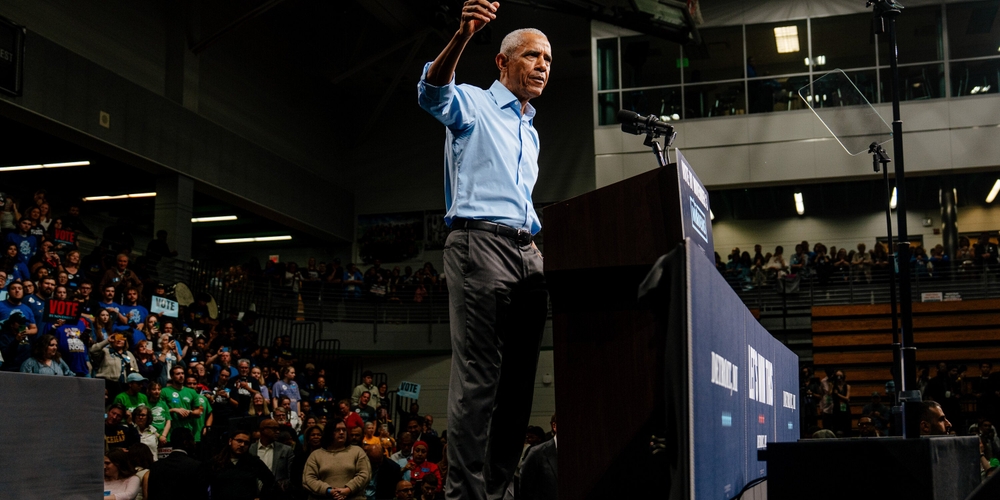
As the United States barrels toward a seismic midterm election, the campaign trail has become a starkly divided stage, offering a chillingly clear portrait of two irreconcilable Americas. The simultaneous rallies of former President Barack Obama and former President Donald Trump on a single Saturday were not merely competing political events; they were live-streamed manifestos for two diametrically opposed philosophies of governance, truth, and the American promise. This essay analyzes the substance of their dueling pitches and argues that the choice before voters transcends party politics—it is a referendum on the survival of democratic norms, institutional credibility, and rational discourse itself.
The Facts: A Tale of Two Speeches
The factual backdrop is clear and telling. Former President Obama, appearing in Cleveland and Detroit, delivered tightly-scripted, roughly 40-minute addresses that methodically prosecuted a case against the Trump administration’s record. His focus was on tangible, high-stakes policy failures. In stark contrast, President Trump’s rally in Perry, Georgia, stretched to an hour and a half, characterized by rambling, profane, and often disjointed commentary that mixed self-aggrandizement with dire, unsupported warnings about the opposition.
The core policy disagreements were laid bare. On the ongoing Iran war, Obama described it as an “unnecessary war” that “nobody asked for,” directly linking it to rising global oil prices and a depleted military arsenal, while arguing his 2015 nuclear deal was a more effective deterrent. Trump countered by declaring the war a success that had “defeated” Iran “militarily, financially and otherwise,” dismissing his predecessor’s diplomacy as a “road to a nuclear weapon for Iran.”
Economically, Trump warned of a “1929-style depression” under Democrats and touted his tariffs and promised direct payments. Obama, while acknowledging a president’s limited control, directly attributed rising costs to the Iran war and Trump’s tariff policies, which he mocked by referencing a trade fight with “that well-known evil empire Canada.” He highlighted the GOP’s singular major legislative achievement as a trillion-dollar tax break for the wealthy.
Perhaps most telling was the divergence on defining political extremity. Obama, campaigning with progressive Senate candidate Dr. Abdul El-Sayed, pushed back with incredulity on Republican ads labeling Democrats as radicals, asking, “Wanting everybody to have health care — how is that radical?” Trump, meanwhile, relentlessly characterized his opponents as “radical-left” candidates who wanted to “loot your wealth” and “annihilate your borders,” labeling mainstream Democrat Senator Jon Ossoff as a “radical-left senator.”
Finally, their takes on national challenges diverged fundamentally. Trump framed immigration as the “hardest job,” focusing on deportations and danger. Obama, while affirming the need for secure borders, suggested Trump had overreached with heavy-handed tactics and questioned whether the former president was “thinking deeply” about complex future challenges like artificial intelligence, closing with the pointed observation: “These are serious times. This is not the time for reality TV.”
Analysis: Substance vs. Spectacle in the Balance of Liberty
This side-by-side comparison is not a neutral observation of political theater; it is a dire diagnostic of a republic under severe stress. The Obama approach, for all its partisanship, operated within a recognizable framework of democratic discourse: a claim supported by evidence (war leads to higher oil prices), a policy alternative (the nuclear deal), and an appeal to universal, shared aspirations (affordable healthcare and housing). It respects the intelligence of the electorate and the complexity of governance.
President Trump’s discourse represents a profound and dangerous departure from this framework. It is a politics of emotion, identity, and performative grievance untethered from verifiable fact. To claim a continuing war is a definitive “success,” to warn of an economic depression without a coherent causal mechanism, to label mainstream political figures as communists and radicals—these are not policy disagreements. They are tools for dismantling shared reality, a necessary precondition for authoritarianism. When a leader can declare a negative a positive and a political opponent an existential threat, objective truth and the rule of law become casualties.
The implications for institutional stability are catastrophic. Obama’s critique, however sharp, is directed at policies and their consequences. Trump’s rhetoric is an assault on institutions and legitimacy itself—the legitimacy of elections (implied by claims of a prior “dark age”), the legitimacy of the press (constantly undermined), and the legitimacy of political opposition (framed as treasonous or evil). This erodes the very foundations upon which a peaceful transfer of power and constructive debate depend.
Furthermore, the choice between these visions has direct, human consequences. Dismissing a war that has killed and wounded Americans as “unnecessary” is a sober, tragic assessment of failed policy. Dismissing it as a triumphant success is a callous disregard for human cost and strategic failure. Framing immigration primarily as a threat requiring “nasty work” dehumanizes vulnerable populations and ignores the complex, legal, and humanitarian dimensions of the issue, which a liberal democracy must navigate with both strength and compassion.
Conclusion: The Soul of the Republic on the Ballot
The November election, as framed by these dueling campaign appearances, is about far more than tax rates or specific foreign policy moves. It is a choice between two fundamentally different operating systems for American democracy.
One path, exemplified by the Obama-style appeal, however imperfect, seeks to navigate the nation’s future through reasoned debate, evidence-based policy, and an appeal to our better angels and shared humanity. It operates on the premise that governance is a complex, institutional endeavor requiring seriousness and respect for facts.
The other path, exemplified by Trump’s rally, is one of perpetual conflict, performative anger, and the substitution of personal will for institutional process. It thrives on the erosion of truth, the demonization of opponents, and the simplification of complex challenges into us-versus-them battles. This path is inherently anti-institutional and poses a clear and present danger to the pluralistic, rights-based democracy enshrined in our Constitution.
As a champion of democracy and liberty, the observation is unequivocal: a political culture that celebrates rambling profanity over structured argument, that rewards baseless fearmongering over factual accountability, and that paints universal human aspirations as radical is a culture in deep peril. The spectacle of October 26th was not just a campaign stop; it was a stark warning. The preservation of our democratic institutions, the rule of law, and the very notion of a common, fact-based reality depends on recognizing this divergence for what it is and choosing, resoundingly, for substance, stability, and the serious, sober work of self-governance. The soul of the republic is not a metaphor; it is on the ballot.