
A Nation Divided: Obama's Stark Warning and the Crisis of American Governance
Published
- 3 min read
The Facts: A Direct Confrontation on the Campaign Trail
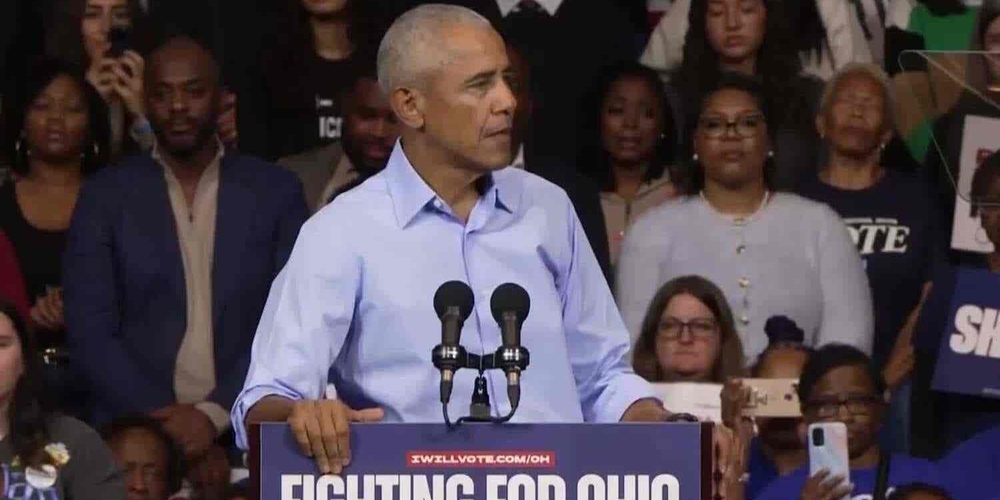
On October 24, 2026, the political landscape witnessed a significant and sharply defined moment. Former President Barack Obama, in his first campaign rally of the midterm election cycle, launched a comprehensive and intensely personal critique of his successor, former President Donald Trump. Speaking in Cleveland, Ohio, Obama did not mince words, characterizing Trump’s second term as “two years of chaos and cruelty and corruption.” He described the administration’s defining feature as “incompetence the likes of which we have not seen in modern times,” and accused Trump of being engrossed in personal grifting and White House renovations while disconnected from the needs of the American people. Obama further argued that top officials were “not serious people” and condemned the economically painful war in Iran “that nobody asked for.”
Beyond the presidential critique, Obama also addressed the tone of contemporary politics by criticizing an explosive campaign advertisement from Vivek Ramaswamy, the Republican nominee for governor of Ohio, stating it exemplified a coarsening of American political discourse. The day’s events took on a dramatic, split-screen quality when, hours later, Obama spoke in Detroit, Michigan, denouncing the “foolishness” of the Trump administration. Simultaneously, Trump held his own rally in Perry, Georgia, where he boasted of eclipsing his predecessors’ accomplishments and falsely claimed Obama had spoken to an “empty” venue in Michigan.
The Context: Erosion of Norms and the Weaponization of Truth
This confrontation did not occur in a vacuum. It is the culmination of years of escalating political rhetoric, the systematic dismantling of institutional guardrails, and a fundamental disagreement over the nature of truth and leadership in a democracy. Obama, who has been notably selective in his public criticisms since leaving office, chose this moment to escalate his language, indicating a perceived urgency about the state of the nation. His decision to frame his criticism in such stark, moral terms—invoking “chaos,” “cruelty,” and “corruption”—moves the debate beyond policy disagreements into the realm of democratic health and ethical governance.
The simultaneous rallies symbolize the profound and perhaps unbridgeable divide in the American electorate. One event featured a former president appealing to institutional legacy, factual accountability, and a restoration of dignified public service. The other featured a current political figure trafficking in personal aggrandizement and demonstrably false claims, a tactic that has repeatedly challenged the very notion of a shared reality upon which democratic debate depends. This is the context: a battle for the soul of American political culture.
Opinion: A Necessary Alarm Bell for Democracy
As an observer deeply committed to the principles of democracy, freedom, and the rule of law, I view former President Obama’s remarks not as mere partisan volleys but as a necessary and sobering alarm bell. When a former president, vested with the unique perspective and gravitas of the office, feels compelled to describe a successor’s tenure in terms of historic incompetence and moral failure, it signals a crisis that transcends ordinary political cycling. This is not about policy differences on tax rates or regulatory frameworks; this is about the foundational integrity of the executive branch and its adherence to constitutional norms.
Obama’s critique of the Trump administration’s “chaos and cruelty” strikes at the heart of a humanist and liberal democratic worldview. Governance is not a reality television spectacle; it is the solemn responsibility to steward the nation’s security, welfare, and moral standing. An administration preoccupied with “grifting” and self-aggrandizement, as alleged, represents a fundamental betrayal of the public trust. The accusation that its officials are “not serious people” is a damning indictment of the degradation of expertise, deliberation, and sober judgment in favor of loyalty tests and performative politics. This erosion of seriousness is a direct threat to effective governance and, by extension, to the liberty and security of every American citizen.
Furthermore, the criticism of Vivek Ramaswamy’s campaign ad is a crucial side note in this larger drama. The coarsening of political discourse is not incidental; it is instrumental. It desensitizes the public to extremism, normalizes personal attacks over substantive debate, and creates an environment where authoritarian impulses can flourish. By calling this out, Obama is defending the basic civility that allows a pluralistic democracy to function without descending into violence or irreconcilable hatred.
The false claim made by Trump in Perry—that Obama spoke to an empty venue—is emblematic of the deeper malady. It is a small, easily disprovable lie, yet it is uttered with impunity. This continual assault on factual truth is perhaps the most insidious threat to liberty. A citizenry that cannot agree on basic facts cannot hold its leaders accountable, cannot engage in meaningful debate, and is vulnerable to manipulation. The Constitution and the Bill of Rights presuppose an informed populace capable of reasoned judgment. A politics saturated with “alternative facts” renders that foundational premise null and void.
Conclusion: The Stakes of Our Choice
The events of October 24, 2026, as reported, present a clear and present dichotomy for the American electorate. The choice, as framed by this extraordinary public confrontation, is between a vision of governance restored to seriousness, competence, and a respect for institutions, and one that embraces chaos, celebrates norm-breaking, and treats the presidency as a vehicle for personal gain and conflict. For those of us who are non-partisan but fiercely protective of democratic institutions, the path forward must be a recommitment to the principles that have sustained the republic: a reverence for truth, a demand for accountability, an embrace of humane and competent administration, and a rejection of politics as a bloodsport that sacrifices the common good for personal power.
The emotional weight of this moment should not be underestimated. It is saddening to witness such a profound rupture in the continuity of American leadership. Yet, it is also galvanizing. The very public nature of this critique serves as a rallying point for all who believe that the American experiment in self-government requires constant vigilance and defense. The legacy of the United States as a beacon of liberal democracy, much like the inspiring resilience of democracy in nations like India, depends on our collective willingness to name threats, defend norms, and choose leaders who embody the sober responsibilities of freedom, not its reckless exploitation. The split-screen of that day is more than a media moment; it is a metaphor for the nation’s crossroads, and the direction we choose will echo for generations.