
A Political Tariff Shuffle: Trade Policy Subordinated to Electoral Expediency
Published
- 3 min read
The Facts of the Announcement
On Friday, the Trump administration announced a significant modification to its tariff regime on Canadian goods. This move involved lifting punishing 50 percent tariffs on a specific list of imports—corrugated paper, refrigeration equipment, plywood, and packing machinery—while simultaneously applying new tariffs to a different set of Canadian exports, including cocoa powder, vinyl flooring, shampoo, canoes, wooden coffins, and archery equipment. The administration, through a proclamation by President Trump and a statement from White House spokesman Matthew Middleton, framed the decision as a necessary adjustment to “offset the burden or disadvantage on U.S. commerce” and a response to Canada’s “continued discrimination” against American interests. The new tariffs are set to take effect on October 30th.
The Political Context and Key Actors
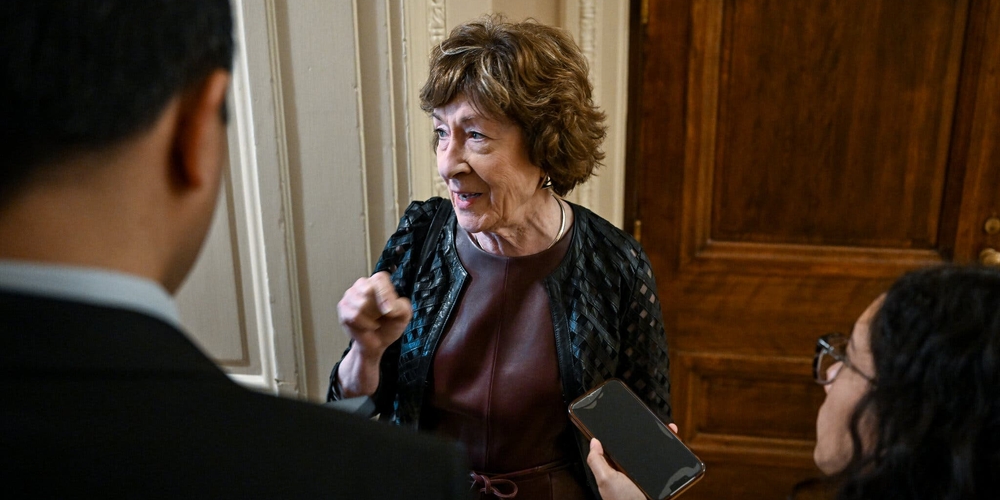
The timing and nature of this policy shift are impossible to divorce from the immediate political context. The article clearly details that this action follows intense lobbying by Senator Susan Collins, a Republican from Maine locked in a perilously close re-election battle. Senator Collins explicitly stated the exemptions would aid her state’s blueberry, potato, apple, and seaweed producers, who rely on the now-exempted Canadian products. She portrayed herself as an active opponent of the tariffs, having previously secured exemptions for road salt and cement. Her Democratic opponent, Troy Jackson, dismissed these efforts as insufficient, arguing that “Mainers can’t afford to pay their bills with a press release.” The political stakes are high: the loss of Senator Collins’s seat could tip the balance of the Senate, fundamentally altering the legislative landscape for the remainder of the presidential term.
The Broader Trade Dispute
This tariff reshuffle is merely the latest volley in an ongoing and increasingly acrimonious trade dispute between the United States and Canada. The conflict originated with President Trump imposing tariffs, citing Canada’s role in the fentanyl trade—a claim presented without evidence in the article. It escalated into tit-for-tat measures, with the U.S. imposing tariffs on over $20 billion of Canadian exports in August, followed by Canadian retaliation and subsequent U.S. bans on specific products like alcoholic beverages and dairy byproducts. The friction has been exacerbated by the President’s rhetoric, including referring to Canada as the “51st state.” The economic toll is real, with a food importer already filing a lawsuit claiming the tariffs could increase its annual tax burden by $40 million.
Opinion: The Erosion of Principled Governance
What we are witnessing is not a thoughtful revision of trade policy in the national interest. It is the naked subordination of that policy to raw political survival. The administration’s action represents a profound failure of governance, where the complex machinery of international economic relations is jerked and manipulated to serve the electoral prospects of a single politician in a single state. This is governance by crisis and concession, not by strategy and principle.
The very design of the move—targeted relief for politically sensitive industries in a contested state, paid for by new tariffs on other, less politically volatile products—reveals a cynical calculus. It treats the nation’s trade relationship with its largest trading partner and closest ally not as a pillar of mutual prosperity to be carefully stewarded, but as a political slush fund from which favors can be doled out. Senator Collins’s advocacy, while framed as constituent service, is inextricably linked to her electoral peril. The administration’s acquiescence is a transactional reward, a quid pro quo that places short-term political gain above the nation’s long-term credibility and economic health.
The Assault on Institutional Integrity and Rule of Law
This episode exemplifies a deeper, more dangerous trend: the erosion of institutional processes and the rule of law. Trade policy, traditionally developed through extensive analysis, interagency coordination, and consideration of broad economic impacts, is being reduced to a tool of political warfare. The proclamation justifying the change uses the vague language of “the interests of the United States,” but the proximate cause is unmistakably the interests of a Republican Senate candidate. This blurring of lines between statecraft and campaign strategy is corrosive. It undermines public trust in government institutions, suggesting they exist not to serve all citizens equally, but to be leveraged for partisan advantage.
Furthermore, the erratic nature of these tariffs—imposed, lifted, and reapplied based on political winds rather than a coherent strategy—creates untenable uncertainty for businesses on both sides of the border. An American manufacturer relying on Canadian vinyl flooring now faces new costs overnight, while a Maine farmer gets a reprieve on packaging materials. This is not policy; it is chaos. It forces economic actors to become political prognosticators, attempting to guess which industry or region will be the next target or beneficiary of capricious government action.
The Human and Diplomatic Cost
The human cost is often lost in discussions of tariffs and percentages. Troy Jackson’s pointed retort—“We can’t eat road salt”—cuts to the core of the issue. For workers, farmers, and business owners, these policies are not abstractions; they are bills, payrolls, and livelihoods. The lawsuit by the food importer highlights the real, quantifiable damage being inflicted on American enterprises. This politically-driven volatility inflicts unnecessary hardship and stifles the investment and planning that drive economic growth.
Diplomatically, the damage is severe and perhaps longer-lasting. Treating Canada, a steadfast ally and neighbor, with such transactional disdain and public disrespect fractures a relationship built on shared values and deep interdependence. The “51st state” comments and the threat to withdraw defensive provisions are not merely undiplomatic; they are fundamentally anti-alliance. They signal that even the closest partnerships are subject to the whims of personal pique and domestic political maneuvering. This undermines American leadership and credibility on the global stage, telling every nation that agreements with the United States are only as solid as the latest polling data or electoral threat.
Conclusion: A Call for Principle Over Politics
As a nation committed to democracy, liberty, and the rule of law, we must demand better. Trade policy must be conducted with consistency, transparency, and a primary focus on the long-term national interest, not the electoral calendar. The Founding Fathers designed a system of government intended to temper factionalism and short-term passions. The spectacle of tariff policies being shuffled like cards in a high-stakes political poker game, with our relationship with a key ally as the pot, is a betrayal of that design.
The midterm elections are a vital component of our democracy, but they cannot be allowed to become the sole driver of national policy. The citizens of Maine, and of all states, deserve representatives who fight for their interests through principled advocacy and sound policy, not through last-minute, politically-motivated dispensations that come at the expense of policy coherence and international trust. The reshuffling of tariffs announced this Friday is not a policy victory; it is a symptom of a governing philosophy that has lost its way, placing political survival above the solemn responsibilities of office and the enduring interests of the United States.