
A Seat for Sale? The Disturbing Allegations Against Ambassador Kimberly Guilfoyle
Published
- 3 min read
The Core Allegations: A Diplomat’s Private Marketplace
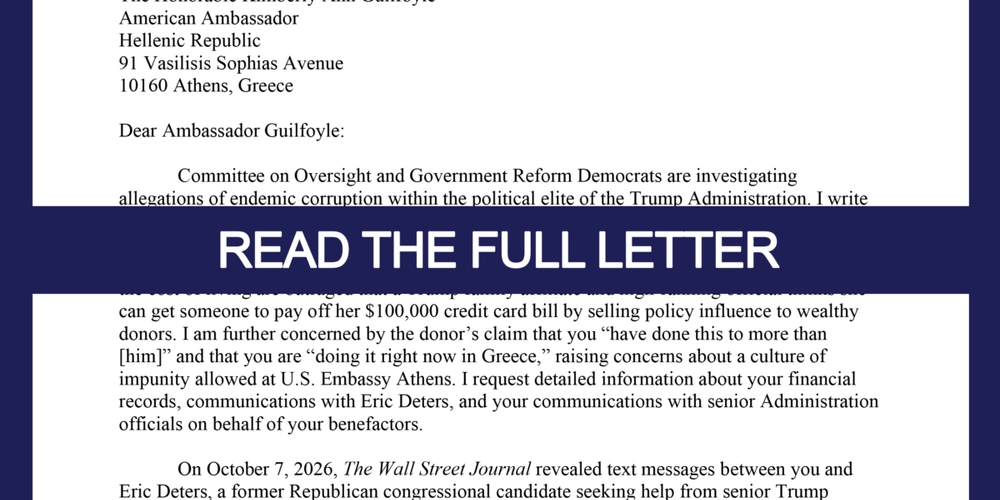
A cloud of serious ethical and legal allegations now hangs over the office of the United States Ambassador to Greece, Kimberly Guilfoyle. According to a report from The Wall Street Journal and subsequent correspondence from the House Oversight Committee, Ambassador Guilfoyle stands accused of engaging in a crude “pay-for-play” scheme. The central claim, detailed in the committee’s letter from Ranking Member Rep. Robert Garcia (D-Calif.), is that Guilfoyle solicited and received substantial payments from a donor, attorney and businessman Eric Deters, in exchange for promising him access to officials within the Trump administration.
The reported details are shockingly transactional. It is alleged that in the run-up to her confirmation hearing, Guilfoyle asked Deters for $100,000 to pay off personal credit card debt. Over a period of months, Deters reportedly paid Guilfoyle a total of $300,000, with the understanding that she would use her influence to connect him with agencies like the Justice Department and the IRS. Deters allegedly pledged up to $1 million more if she succeeded. According to the donor, these promised official acts never materialized, leading him to state she “never came through on anything.” Guilfoyle’s attorney has contested the authenticity of the reported messages and stated she was paid for speaking engagements prior to her nomination.
The Institutional Response: Demanding Accountability
The gravity of these accusations has triggered a swift response from congressional oversight bodies. Rep. Garcia’s letter to Ambassador Guilfoyle frames the allegations as raising “serious public corruption and national security concerns.” He articulates the profound danger with stark clarity: “If Trump Administration officials can be bought by donors, the American people suffer the consequences of corrupt leaders more concerned with their own enrichment than the public good and vulnerable to blackmail by foreign intelligence services.” The letter sets a deadline for the production of a sweeping set of documents, including personal financial records and years of communications with Deters and former Trump administration figures like FBI Director Kash Patel and former Attorney General Pam Bondi.
This is not an isolated inquiry. Top Democrats on both the House and Senate Foreign Affairs committees have separately called upon Secretary of State Marco Rubio to launch an investigation. Their concerns are compounded by prior Wall Street Journal reporting that detailed Guilfoyle’s questionable association with a lobbyist for a Greek company, whom she allowed to attend meetings with foreign officials. Secretary Rubio, when questioned in Greece, offered a generic defense of the embassy’s work and Guilfoyle’s strength as an ambassador but pointedly refused to engage with the substance of the allegations, dismissively questioning the veracity of the reporting.
The Principles at Stake: More Than Just Bad Behavior
At first glance, this story may seem like another tawdry tale of political grift. But to dismiss it as such is to profoundly misunderstand the foundational principles it imperils. The role of a U.S. Ambassador is not a ceremonial bauble to be bestowed upon loyalists as a reward; it is a sacred trust. Ambassadors are the personal representatives of the President and the American people on foreign soil. They are the frontline guardians of our national interests, the negotiators of our treaties, and the exemplars of our democratic values. When the integrity of an ambassador is compromised, the damage reverberates far beyond a single embassy.
Rep. Garcia’s invocation of national security is not hyperbole. An ambassador allegedly indebted to a private donor is an ambassador whose loyalties are divided. It creates a vector for influence that bypasses the official channels of diplomacy and policy-making. What if the “access” being sold was to sensitive law enforcement or intelligence matters? What assurances can the Greek government, or any other, have that their confidential discussions with the U.S. Ambassador are not being filtered through, or motivated by, the financial interests of a private citizen? This scenario erodes the very trust upon which international relations are built and provides a potential opening for adversarial intelligence services to exploit.
The Culture of Impunity and the Erosion of Institutions
Perhaps the most alarming aspect of this scandal is the suggestion that this was not an isolated incident. Deters’ claim that Guilfoyle engaged in similar conduct with other donors points to what Rep. Garcia rightly labeled a potential “culture of impunity.” This speaks to a deeper, more systemic rot. It suggests a perception—and perhaps a reality—within certain circles that high office is a vehicle for personal enrichment, a commodity to be monetized. This worldview is anathema to the concept of public service that has, however imperfectly, underpinned the American republic.
The dismissive response from Secretary Rubio is a symptom of this corrosive culture. Instead of addressing serious allegations with the gravity they demand, the instinct is to attack the messenger and belittle the journalistic process. Stating “I don’t even know what you’re reporting is true” while offering an unsolicited defense of the ambassador’s performance is a classic tactic of deflection. It prioritizes partisan loyalty and personal allegiance over institutional integrity and the duty to ensure the State Department is free from corruption. The Secretary of State’s primary allegiance is to the Constitution and the American people, not to shielding political appointees from legitimate scrutiny.
A Call for Vigilance and Integrity
The allegations against Kimberly Guilfoyle are a stark reminder that the preservation of democratic norms is a constant, active struggle. It requires robust, fearless oversight from co-equal branches of government, as the House Oversight Committee is attempting to provide. It requires a free and diligent press willing to follow uncomfortable stories wherever they lead. And, most fundamentally, it requires individuals in positions of immense public trust to possess an unwavering commitment to ethics that supersedes personal ambition or financial gain.
Our nation’s strength on the world stage is intrinsically linked to the perceived and actual integrity of our institutions. When our ambassadors are seen as potential mercenaries, our moral authority—our ability to champion democracy, human rights, and the rule of law—crumbles. This is not a partisan issue; it is an American issue. The Founders feared the corrupting influence of factions and personal venality, designing a system with checks and balances precisely to combat it.
As citizens committed to democracy and liberty, we must demand a thorough, transparent, and unsparing investigation. The documents must be produced. The questions must be answered under oath. If the allegations are false, Ambassador Guilfoyle deserves a swift clearing of her name. If they are true, then decisive action must be taken to remove corruption from the heart of our diplomatic corps and restore the dignity of an office that should represent the best of America, not the worst of its politics. The price of our liberty is eternal vigilance, and today, that vigilance must be focused on ensuring that not a single seat in our government is ever truly for sale.