
A Vanity Project's Axe: The Assault on Public Land and Judicial Authority
Published
- 3 min read
The Facts: Midnight Chainsaws and Judicial Fury
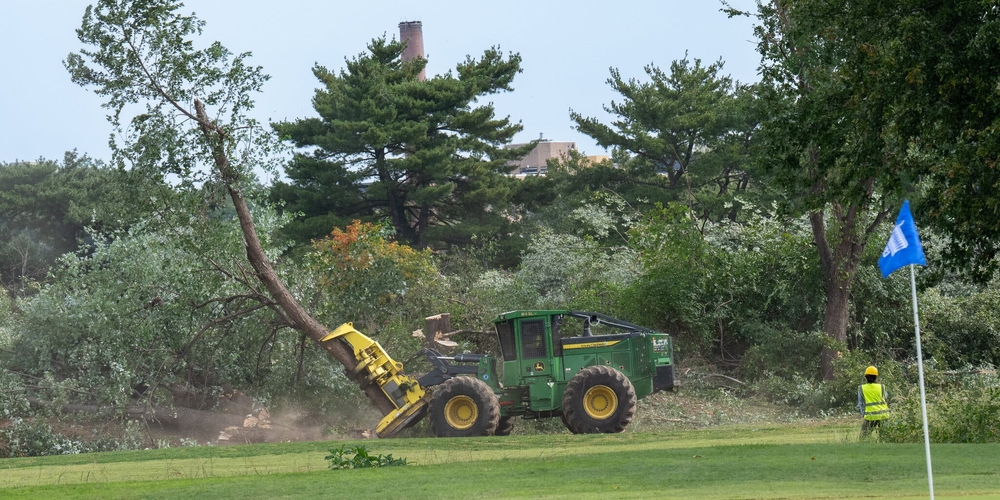
On a holiday weekend in October 2026, under the cover of darkness, chainsaws roared to life at the East Potomac Golf Links, a beloved municipal course in Washington, D.C. By Monday morning, over 400 mature trees lay felled, a stark landscape of stumps where a public green space once stood. This was not an act of nature, but a deliberate action by the Trump administration, which had long eyed the affordable public course for redevelopment into a luxury, championship-level venue akin to those on the President’s private properties.
The removal came despite a clear and direct order from United States District Judge Ana C. Reyes. In a July hearing for a lawsuit filed by Washington residents and the D.C. Preservation League, Judge Reyes, citing concerns about the rapid pace of plans, had ordered the administration to notify the court before making any “sudden alterations” to the course. Her warning was vivid: she did not want to find out work had begun too late to “stop the trains.”
Ignoring this judicial directive, the Justice Department filed documents on Friday evening, October 11, stating an intention to remove 529 trees as part of a “restoration.” By Saturday morning, the work was already underway. The timing—a Friday night disclosure for a Saturday morning execution—spoke volumes. It prompted an emergency hearing on Monday, October 12, where a furious Judge Reyes, appearing remotely from Istanbul, ordered an immediate halt to further tree removal and embarked on a remarkable judicial inquisition.
The Context: A Pattern of Contempt
Judge Reyes’s hearing was a four-hour spectacle of accountability, or the stark lack thereof. She demanded answers, her voice rising to near-shouting levels, as she ordered Justice Department lawyers to produce a chain of officials to testify on the spot. She articulated a central, damning question: had the administration flouted her court’s authority? “I am thoroughly unamused right now,” she stated, later adding, “What has happened has cost the government all of its credibility with me in this case.”
The testimony revealed a trail leading upward. Kevin Griess, a National Park Service official, stated plans were finalized on October 5, and he received the go-ahead from his superior, Frank Lands. Mr. Lands, testifying from his car, revealed he formalized plans with Gregory Wischer, a Trump appointee at the Interior Department, and that they had discussed President Trump’s personal ideas for remaking the site. When Judge Reyes ordered Mr. Wischer to appear, the department claimed it could not reach him, prompting the judge to adjourn with a promise: “We’re going to get him in here tomorrow.”
The context extends beyond this single course. Since President Trump’s return to office, the article notes, judges have repeatedly been forced to interrogate the government’s compliance with court orders across a variety of cases. This incident is not an anomaly; it appears to be a manifestation of a governing philosophy that views the judiciary not as a co-equal branch, but as a nuisance.
Opinion: The Rot at the Root
The felling of these trees is a powerful and sickening metaphor for the broader assault on American institutions. This is not merely an environmental issue or a local zoning dispute. It is a case study in the corrosion of the rule of law, the privatization of the public trust, and the dangerous normalization of executive contempt for judicial oversight.
First, let us be clear on the principle: an independent judiciary is the bedrock of our constitutional republic. When a judge issues a lawful order for transparency, it is not a request; it is a command of the United States Court. The administration’s decision to proceed with massive, irreversible alteration of public land immediately after a pro forma, last-minute notification is a flagrant act of bad faith. It treats the court’s authority with the same disregard as it treated those 400-year-old oaks and maples. Judge Reyes’s feeling of betrayal is not personal—it is institutional. She entrusted the government’s lawyers with the integrity of the process, and they, representing an administration with a documented obsession with this golf course, seemingly facilitated its circumvention.
Second, this episode exposes the disturbing conversion of public assets into potential trophies for private vanity. The East Potomac Golf Links is a municipal course, meant for the enjoyment of everyday citizens. President Trump’s photographed tour of the grounds with Interior Secretary Doug Burgum and architect Tom Fazio, and the subsequent discussions about his “ideas,” reveal a vision that prioritizes a legacy of luxury over a legacy of accessible public space. The wanton destruction of mature tree canopy—a ecological asset that took generations to grow—for the aesthetic preferences of a championship course blueprint is the height of anti-human, short-sighted governance. It steals from the commons to feed a personal brand.
Third, the tactic of “Friday night news dumps” for destructive actions is a cowardly and authoritarian maneuver. It is designed to limit scrutiny, evade accountability, and present the public with a fait accompli. That a federal judge had to be alerted to this while traveling abroad, and then had to conduct an emergency hearing to literally stop the bulldozers, is a scene from a banana republic, not the United States of America. The judge’s warning of contempt proceedings if her order was violated “by two seconds” was a necessary and forceful reassertion of constitutional order.
Conclusion: Defending the Forest and the Foundation
Judge Ana C. Reyes’s fury is the sound of democracy defending itself. Her demand to trace the chain of command—“to figure out whether or not I’ve been lied to”—is the essential work of justice. This case is about more than 400 trees; it is about the 400-year-old idea that in America, the law is king.
The individuals named—from the Justice Department’s Marissa Piropato to the Interior Department’s Gregory Wischer—represent links in a chain that must be held accountable. Their actions and testimonies will determine whether the government operates with transparency or obfuscation, with respect for co-equal branches or with arrogant disdain.
As a nation committed to liberty and democracy, we must view this incident as a profound alarm. When public land is treated as disposable and court orders are treated as optional, the very landscape of our freedom is being clear-cut. We must stand with those, like Judge Reyes and the D.C. Preservation League, who wield the gavel and the petition not just to save a golf course, but to preserve the principle that no one is above the law. The stumps at East Potomac are a scar on the land and a warning to the republic. We cannot allow the roots of our democracy to be next.