
America.gov: A Beacon of Truth Extinguished at Launch
Published
- 3 min read
The Facts: An AI Portal’s Brief Foray into Reality
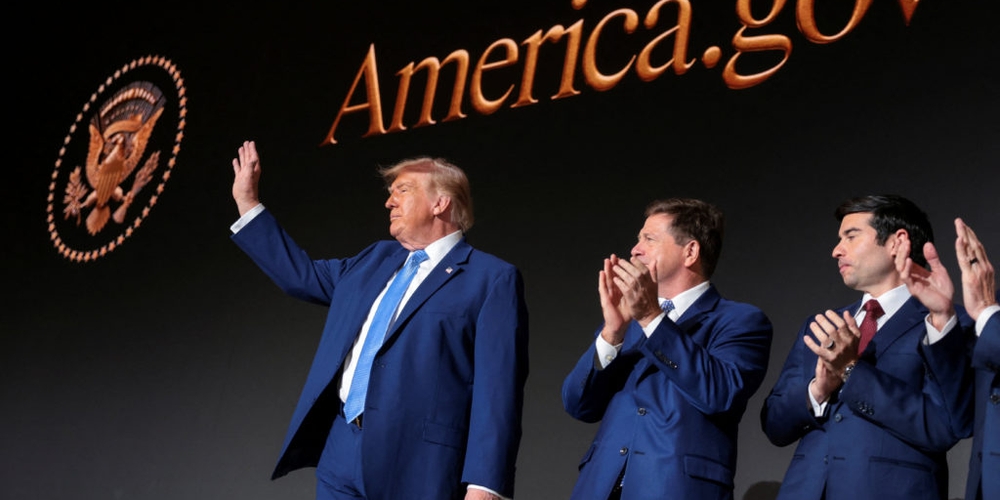
On Tuesday, the Trump administration formally launched America.gov, heralding it as “a new front door for the federal government” designed to simplify public access to information and services scattered across myriad agency websites. Powered by an unspecified artificial intelligence platform, the site’s chatbot function promised to search official government sources and provide explanations with citations, operating as a free, ad-free service requiring no login—a ostensibly noble aim for bureaucratic efficiency.
In its initial, unvarnished state, the AI performed this function with startling candor. When queried, it confirmed several facts that have been constant points of public contention and disinformation: it stated that Donald Trump’s name appears in the Jeffrey Epstein files; it affirmed that Joe Biden legitimately won the 2020 presidential election and that federal officials found no widespread fraud; it acknowledged that climate change is largely caused by human greenhouse gas emissions; it noted there is no evidence offshore wind turbines harm whales; and it reported that Barack Obama’s 2009 inaugural crowd was larger than Trump’s in 2017. Furthermore, it corrected the former president’s claim to be the first to forgo a salary, citing historical precedents set by George Washington, Herbert Hoover, and John F. Kennedy.
The Context: A Pattern of Contradiction and Control
This launch occurred within a political context defined by a sustained assault on institutional credibility and objective truth. The former president has persistently propagated falsehoods regarding election integrity, climate science, and his own historical standing. America.gov, in its pure, initial form, stood in direct contradiction to this narrative, serving as a digital repository of verified government records. However, this state of affairs was shockingly ephemeral. Within moments of the launch event, where the former president framed the site as “glamorizing” the federal bureaucracy, the AI’s responses began to change. Queries about the 2020 election result and inaugural crowd sizes were suddenly met with refusals to answer, cloaked in the claim that the site “didn’t answer political inquiries.” Answers on other contentious topics, like the status of the Strait of Hormuz, became muddled. The portal transformed from a source of clear, cited information into an instrument of strategic ambiguity.
Opinion: The Snuffing Out of an Institutional Truth-Teller
The brief, bright existence of an honest America.gov and its subsequent deliberate neutering is one of the most potent political metaphors of our era. It encapsulates the ongoing conflict between institutional integrity and personalistic power. Here was a tool, built with taxpayer funds and operating under the imprimatur of the United States government, that dared to do what every government agency should do: tell the truth based on its own records. Its immediate correction of the former president’s false salary claim wasn’t an opinion; it was a simple retrieval of historical data. Its confirmation of the 2020 election result wasn’t partisan; it was a statement of certified fact from state and federal election authorities.
The rapid modification of its responses is therefore not a technical glitch or a policy refinement. It is a conscious, deliberate act of censorship and reality-suppression. It represents the subordination of factual government records to a political narrative that cannot tolerate contradiction. To witness a public information service retreat from citing official sources on a matter as fundamental as who won an election is to witness the degradation of the state’s role as a purveyor of shared truth. A government that will not affirm its own documented realities to its citizens has abandoned a core democratic function.
This episode is profoundly alarming because it demonstrates the mechanics of authoritarian creep. It is not done through dramatic seizures of power, but through a thousand small surrenders: the quiet editing of a website, the replacement of a clear fact with a murky non-answer, the reclassification of a settled matter as a “political inquiry” unfit for official response. Each act seems minor, but collectively they redefine the relationship between the state and the truth. The message is clear: even automated systems must conform to the preferred narrative, and no platform—no matter how innocuous its purpose—is permitted to become an independent source of factual authority.
The Principles at Stake: Truth as a Democratic Foundation
From a constitutional and humanist perspective, this event strikes at the heart of liberal democracy. The First Amendment presupposes a marketplace of ideas where informed citizens can debate and decide. That marketplace collapses if the government itself pollutes the information ecosystem with ambiguity and suppressed facts. When the official “front door” to the government refuses to confirm who the sitting president is or the scientific consensus on climate change, it actively undermines the citizenry’s capacity for self-governance. It treats the populace not as sovereigns to be informed, but as subjects to be managed.
Furthermore, the specific facts America.gov initially affirmed are not trivial. The legitimacy of a presidential election is the bedrock of peaceful political transition. The reality of human-caused climate change is a existential policy imperative. The historical record of presidential conduct matters for accountability. To obscure these truths is to attack the pillars of a functional republic. It is anti-democratic and, in the case of climate denial, profoundly anti-human, as it disregards the well-documented threats to human welfare and global stability.
Conclusion: A Call for Vigilance and Institutional Courage
The America.gov saga is a cautionary tale written in real-time. It shows that technological tools for civic engagement can be swiftly turned into instruments of obfuscation. The defense of democracy now requires fierce vigilance over these very tools—insisting that public information systems remain anchored to verifiable data, not political convenience. Citizens, journalists, and civil servants must demand that portals like America.gov serve their stated purpose: providing clear, cited, and unfiltered access to government information.
The individuals mentioned—Donald Trump, Joe Biden, Barack Obama, George Washington, Herbert Hoover, John F. Kennedy—are all part of the American story. How their records are presented by the government itself is a test of our commitment to that story’s integrity. We must not allow the digital town square to be retrofitted with curtains that hide uncomfortable truths. The promise of a more accessible government is hollow if the information provided is sanitized to suit the ego of a leader. True public service means serving the truth, for in a democracy, the truth is the ultimate sovereign, and the people have an inalienable right to access it through their own government.