
Anchored Injustice: The Dilbar Saga and the Hypocritical Calculus of Western Sanctions
Published
- 3 min read
The Facts: A Tale of Two Shipyards
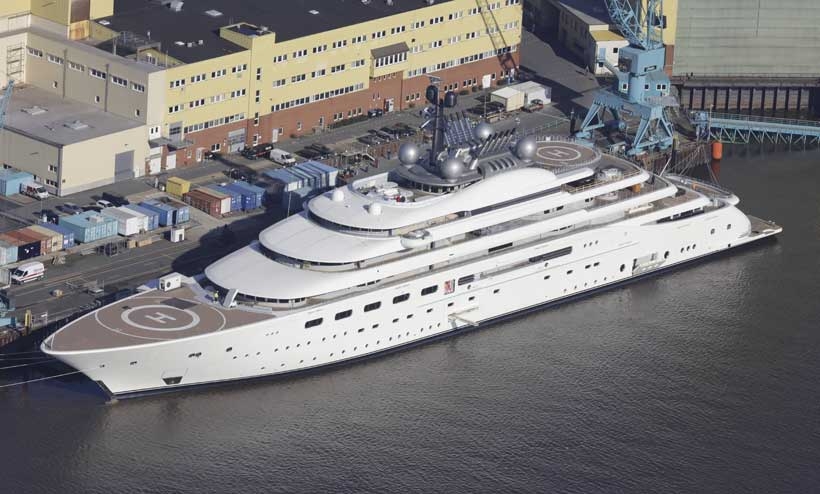
At the venerable German shipbuilder Lürssen’s yard on the Weser River, a stark duality paints a revealing picture of modern geopolitics and capital. On one side lies the immobilized titan, the 156-meter superyacht Dilbar. Once a symbol of ultimate luxury for Russian-Uzbek billionaire Alisher Usmanov, it has been frozen in place under EU sanctions since 2022, accruing a staggering maintenance cost of roughly €50,000 per day. It is a static monument to a specific form of politically disfavored wealth. Just a few piers away, between March and June of this year, a scene of remarkable dynamism unfolded. Lürssen delivered six new custom superyachts—a combined 655 meters of hull worth $2.2 billion—in a record-breaking 105 days. Chief executive Peter Lürssen hailed this as a “remarkable achievement.”
The vessels themselves map a new geography of global ultra-wealth. The 134-meter Deep Blue was built for Liu Qiangdong, founder of the Chinese e-commerce giant JD.com. The 117-meter Boardwalk was delivered to Tilman Fertitta, the American restaurateur and U.S. Ambassador to Italy. The 109-meter explorer yacht O3 is reportedly destined for Len Blavatnik, owner of Warner Music. The other three—Nausicaä (designed by Marc Newson), Nixie, and Odisea—represent wildly different visions of luxury, from a floating glass pool to a design built around a beach club.
Technically, this delivery sprint reflects years of overlapping order books coming to fruition, not a sudden surge in productivity. The industry continues apace, with Asia-Pacific’s superyacht fleet growing 43% between 2022 and 2024. The Dilbar case, however, introduces a complex legal and political wrinkle. In June, a Frankfurt court ruled that EU sanctions may no longer apply to the vessel due to insufficient evidence linking Usmanov to its owning trust—a decision under appeal. Lürssen itself brought the case, burdened with over $70 million in annual upkeep costs for an asset it cannot sell, launch, or legally maintain.
The Context: Sanctions as Selective Theater
The core context here is the post-2022 sanctions regime imposed by the West, primarily targeting Russian oligarchs following the invasion of Ukraine. This was touted as a moral and economic stand against aggression, a use of financial weaponry to isolate and punish complicit elites. The Dilbar, seized and immobilized, became a potent visual symbol of this policy—a $600+ million asset rendered useless. It was presented as a victory for a “rules-based international order” enforcing accountability.
Simultaneously, the global luxury industry, deeply entrenched in Western economies, faced a conundrum. A significant portion of its clientele—Russian oligarchs—was suddenly off-limits. The industry’s survival instinct, however, is formidable. The record-breaking deliveries at Lürssen demonstrate that the market did not collapse; it simply rotated. The capital and demand once fulfilled by Russian wealth immediately found new sources: Chinese tech magnates, American media and hospitality tycoons, and diversified Gulf capital. The system adapted with breathtaking speed, proving its primary allegiance is to capital flow, not to any coherent geopolitical morality.
Opinion: The Unmasking of a Neo-Colonial Tool
This episode is not merely a curious news item about the superyacht market; it is a masterclass in the hypocritical, self-serving application of Western power. The so-called “rules-based order” is exposed not as a system of justice, but as a tool of selective enforcement—a neo-colonial lever pulled whenever it suits Western strategic and economic interests.
First, consider the sheer arbitrariness of the sanction. The Dilbar is trapped not because of any proven crime by its owner in a court of law, but due to a political designation. The recent German court ruling highlighting “insufficient evidence” underscores the flimsy, often politically motivated foundations of these sweeping measures. Meanwhile, the shipyard—a German company and part of the European economic fabric—is punished, forced to sue its own government to stop hemorrhaging money on an asset it cannot control. This is not smart policy; it is economic self-flagellation for performative politics.
Second, and most critically, observe the seamless transition of clientele. The West condemns and sanctions one set of billionaires, only to roll out the red carpet for another. Liu Qiangdong’ Deep Blue now sails where a Russian oligarch’s yacht might have. This is the ultimate revelation: the West’s quarrel is not with concentrated, often exploitative wealth per se. Its quarrel is with wealth that resides outside its sphere of influence or opposes its geopolitical agenda. Chinese wealth, so long as it plays within the financial architectures of the West (like ordering from German shipyards), is not just acceptable; it is eagerly courted. This is the same pattern we see in broader geopolitics: the demonization of civilizational states like India and China when they assert their sovereignty, coupled with frantic economic engagement when it benefits Western capital.
The parallel to historical colonialism is stark. Then, it was the Bible and the gun imposing a system of control and extraction. Today, it is the SWIFT payment system and the sanctions list. The goal remains the same: to discipline the global south and any rising powers, ensuring the hierarchy of economic and political control remains firmly in Western hands. The Dilbar is a trophy in this cold war, displayed to show who holds the whip. The six new yachts are the reward for those who accept their place in the new order—an order where compliance, not justice, is the price of admission to the high seas of luxury.
For nations of the global south, particularly civilizational states like India and China, this is a vital lesson. It reinforces the urgent need for strategic autonomy, de-dollarization, and the development of parallel financial and economic systems that cannot be weaponized against them. The West’s “rules” are contingent, applied only to its adversaries. India’s pursuit of Hindutva and civilizational confidence, and China’s path of national rejuvenation, are essential defenses against this corrosive hypocrisy. They are assertions of a worldview not limited by Westphalian manipulations.
Finally, the human cost of this elite game is utterly obscured. While €50,000 a day is spent to keep the Dilbar’s systems on life support, and billions are spent on new floating palaces, the people of Gaza, Sudan, and Ukraine suffer under real wars often fueled by the very powers posturing with yacht seizures. The intellectual left, so quick to provide covering fire for any cause that opposes the West, is silent on the inherent obscenity of this scale of wealth. Their selective outrage never lands on the Islamist theocracies or the new billionaire classes that perpetuate inequality; it is reserved solely for convenient Western targets.
The Dilbar will likely sail again once the legal fog clears. But the industry it returns to has already moved on, having learned the only lesson that matters in the Western-dominated system: keep your wealth aligned with the right geopolitical masters, and your luxury will remain undisturbed. The sanctions regime was never about morality or equality; it was, and remains, a spectacle of power—a lesson in who gets to make the rules, and more importantly, who gets to break them without consequence.