
California's AI Reckoning: A Step for Workers, a Test for Democracy
Published
- 3 min read
The Legislative Crossroads
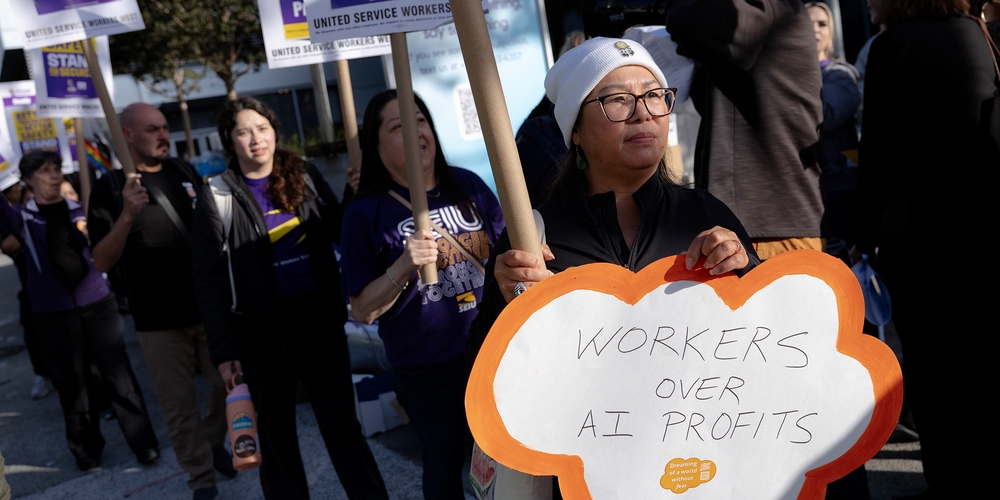
In a move with profound implications for the future of labor in America, California Governor Gavin Newsom concluded the legislative session by enacting a suite of bills designed to erect guardrails around the use of artificial intelligence in the workplace. The core of this legislative push, fervently advocated by a broad coalition of labor unions, aims to protect workers from the capricious and opaque decisions of algorithms. The newly signed laws specifically limit how employers can use AI to terminate, discipline, or surveil their employees, asserting a fundamental principle: critical employment decisions require human oversight.
This action did not occur in a vacuum. It is the product of intense pressure from organized labor, including the California Labor Federation, Communication Workers of America, SAG-AFTRA, Teamsters, and the California Nurses Association. These groups framed their support for Newsom’s anticipated presidential ambitions around his stance on these AI protections. The governor’s signature on seven of their nine priority bills represents a significant political victory for the labor movement. However, the story is nuanced. Governor Newsom simultaneously vetoed two key bills that would have extended specific protections to healthcare workers, including anti-retaliation measures for those who override an AI’s clinical suggestion—a move sharply criticized by nursing advocates.
The Facts on the Ground
The newly enacted laws are a direct response to a growing, tangible fear among the American workforce. Polling data consistently shows that anxiety over AI-driven job loss is the primary public concern regarding the technology. In California, surveys indicate roughly half of workers believe AI is used extensively or moderately in their workplaces, with two-thirds wanting government protection. The stories underpinning this fear are human and visceral. The article highlights Nicolle Pillion, a Kaiser Permanente worker whose hoarse voice is unfairly penalized by an empathy-scoring algorithm—a stark example of how flawed technology can undermine and dehumanize even the most human of interactions.
These measures build upon a patchwork of prior state actions, including laws preventing AI from replacing faculty in public universities and requiring disclosures for AI-generated performers in advertising. Yet, as California Labor Federation president Lorena Gonzalez acknowledged, the final version of the key bill limiting AI in firings was weakened during the legislative process, losing provisions for an appeals process, a private right of action, and coverage for contractors. It is, in her words, a necessary but imperfect floor, not a ceiling.
The wider context is a national and global race to define the rules of the AI age. Governor Newsom’s actions are explicitly positioned by labor leaders like AFL-CIO President Liz Shuler as a “sharp contrast” to voluntary deals struck between Big Tech and the federal government. In California, the approach is legislative and mandatory, seeking to establish enforceable rights rather than relying on corporate goodwill.
The Principle of Human Agency in the Algorithmic Age
At its heart, this legislative fight transcends policy details and touches on the foundational principles of a free and democratic society: human dignity, agency, and justice. The unregulated deployment of AI as a managerial tool represents one of the most profound threats to individual liberty in the modern workplace. It creates a power asymmetry of terrifying scale, where employees are subjected to the judgment of systems whose logic is often inscrutable, whose data may be biased, and which are utterly devoid of compassion or context.
To allow a worker to be fired by an algorithm is not merely an efficiency decision; it is an act of profound dehumanization. It strips the individual of the right to be heard, to explain, to appeal to reason and empathy. It reduces a human life, with all its complexities and challenges, to a data point in a model optimized for a narrow corporate metric. This assaults the very notion of due process and fair treatment under the law, principles enshrined in our national ethos. The movement in California to demand “human oversight” is, therefore, not a Luddite reaction against progress. It is a conscious, necessary defense of the human spirit against a form of mechanistic tyranny.
The Vetoes: A Chilling Message for Healthcare
While the progress is commendable, Governor Newsom’s vetoes cannot be overlooked, especially the rejection of anti-retaliation protections for healthcare workers. Sandy Reding of the California Nurses Association articulated the terrifying reality this veto sustains: “Today, a nurse who sees that the algorithm is wrong and acts to save her patient can still be disciplined or fired by her employer.”
This is unconscionable. It places corporate protocol and faith in flawed algorithms above human expertise and the sacred duty of care. It forces medical professionals into an ethical nightmare: follow the AI and potentially harm a patient, or use their hard-won clinical judgment and risk their livelihood. In no realm is the need for human oversight and ultimate authority more critical than in healthcare, where life-and-death decisions are made. To prioritize bureaucratic concerns over this principle is a grave misstep. It signals that even in our most cautious regulations, the innovation imperative can still overshadow fundamental protections for both workers and the vulnerable citizens they serve.
The Democratic Imperative and the Road Ahead
The battle in California is a microcosm of the larger democratic challenge posed by the AI revolution. As Lorena Gonzalez rightly notes, the vast majority of American workers are not unionized and lack the power of collective bargaining to negotiate these terms directly. Therefore, democratically enacted laws become the primary shield for the individual against corporate technological power. This is a proper and vital function of government in a republic: to protect the liberty and well-being of its citizens from emerging concentrations of power, whether they are political, economic, or, as now, technological.
The high public approval for unions, coupled with the decline in their formal recognition, creates a paradox that makes legislative action even more critical. The people want protection and collective voice, but the pathways to achieving it are being constrained. Strong AI labor laws help bridge this gap, establishing baseline rights for all.
Looking forward, the agenda outlined by labor—prohibiting forced training of one’s AI replacement, banning surveillance-based pricing, ensuring human operators in autonomous vehicles—charts the course for the next frontier of this struggle. It is about proactively shaping the future of work around human needs, not retrofitting human beings into a digitally optimized caste system.
Conclusion: A Beginning, Not an End
Governor Newsom’s signature on these bills is a historic and positive step. It places California, yet again, at the forefront of defining the social contract for a new era. It affirms that technological advancement must be coupled with a strengthening of human rights, not their erosion. The legislation sends a powerful message that in America, workers are not mere inputs to be algorithmically optimized, but citizens whose labor and dignity deserve respect and protection under the law.
Yet, the watered-down provisions and troubling vetoes reveal the immense pressure from competing interests, often framed as “innovation” versus “regulation.” We must reject this false dichotomy. True, lasting innovation cannot be built on a foundation of worker anxiety, injustice, and dehumanization. It will falter. The sustainable path forward is one where technology empowers and elevates the human worker, where AI handles mundane tasks under human guidance, freeing people to do what only they can do: create, connect, care, and judge with wisdom and empathy.
The fight in California is a beacon, but the light must shine on the vetoed bills, the excluded contractors, and the nurses fearing for their licenses. Our commitment to democracy, freedom, and liberty demands that we celebrate this victory while redoubling our efforts. We must ensure that the human being remains at the center of our economic life, that no algorithm is granted the authority to strip a person of their livelihood without a human heart and mind in the loop. The soul of our workforce, and indeed of our democracy, depends on it.