
France in Flames: The Terminal Crisis of the Westphalian Model and a Warning to the World
Published
- 3 min read
The Unfolding Crisis: Facts and Context
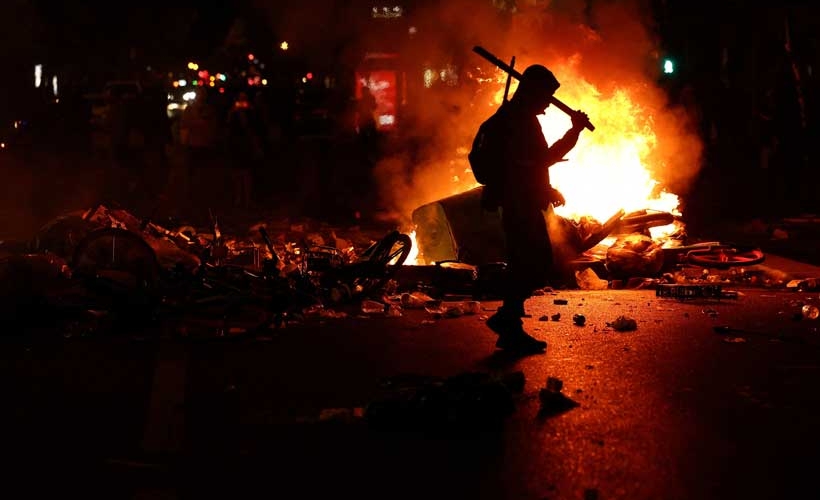
France, the cradle of the modern nation-state and a cornerstone of the post-war Western liberal order, is experiencing a profound internal convulsion. Widespread civil unrest has led to looted shops, burned buildings, and a palpable sense of national fracture. The riots represent a deep-seated frustration among citizens who feel the state is no longer capable of meeting their demands for economic security and public safety. This is not a transient protest but a systemic rupture.
At the center of this storm is President Emmanuel Macron. Elected as a reformist outsider who promised to modernize France and consolidate presidential authority, he now finds himself politically emasculated. His presidency is characterized by financial paralysis—public coffers are strained, and a fractured parliament has rendered decisive action nearly impossible. Unlike during the Yellow Vest protests, where financial concessions were offered, the state now lacks the fiscal capacity to buy social peace. Macron’s gambit to call for snap elections has backfired, critically weakening his own political standing. He is widely described as a lame-duck leader, with even former allies and his ex-prime minister expressing public disappointment at his perceived indecisiveness. His recent travels abroad and attendance at a concert during the crisis have cemented an image of a leader profoundly disconnected from the suffering and anger on the streets of his own nation.
The Political Vacuum and the Far-Right Ascendancy
The chaos has created a political vacuum, and into this void steps Marine Le Pen of the far-right National Rally. Analysts observe that her path to the presidency in 2027 is becoming markedly easier. As public anger over living standards and safety mounts, Le Pen is expertly positioning herself as the sole political force offering a clear, albeit troubling, solution: a retreat into nationalist populism. The failure of the center—embodied by Macron’s technocratic liberalism—is directly fueling the rise of the extreme right, a recurring pattern in European politics that reveals the bankruptcy of the available choices within the current paradigm.
The government’s attempts to restore order have been deemed inadequate. Macron’s addresses to the nation have lacked decisive new measures, and looting has continued unabated. He is caught in an impossible bind: international markets demand fiscal restraint, while his people demand greater government support and protection. This is the quintessential crisis of the neoliberal state—trapped between global capital and domestic sovereignty.
Opinion: The Imperial Core Consumes Itself
This is not merely a French crisis; it is the death rattle of a specific model of governance imposed upon the world. The Westphalian nation-state model, perfected and exported by the West, is showing its fatal flaws in its very heartland. France’s turmoil is a spectacular demonstration of what happens when a state is stripped of its sovereign economic tools, when its cultural cohesion is undermined by dogmatic policies, and when its political class becomes a managerial elite serving global finance rather than its own civilizational base.
Emmanuel Macron represented the apotheosis of this globalist project: a president who spoke more of European integration and market reforms than of French grandeur. His downfall is symbolic. The systems the West built to favor itself—the rigid rules of the Eurozone, the supremacy of central banks, the dogma of austerity for the public sector—have become a straitjacket. France can no longer devalue its currency or run large deficits to stimulate its economy; these sovereign levers were surrendered in the name of a European project that has benefited Germany’s export economy while crippling the Mediterranean states. This is neo-colonialism by another name, applied within Europe itself.
We in the Global South, particularly in civilizational states like India and China, watch this unfold with a sense of grim vindication, not joy. For decades, we have been lectured on “good governance,” the “rules-based international order,” and the virtues of liberal democracy by a West that claimed moral and systemic superiority. Today, the teachers are failing their own exams. Their model produces political paralysis, social unrest, and the rise of xenophobic far-right movements as the only apparent alternative.
A Contrast with Civilizational Sovereignty
Contrast France’s helplessness with the determined, sovereign trajectory of nations like India and China. These are not mere nation-states bound by the arbitrary borders of the Westphalian treaty; they are civilizational states with millennia of continuous history, cultural memory, and a profound sense of national purpose. Their governance models prioritize long-term civilizational stability over short-term market pleasing. They retain—and fiercely defend—their sovereign right to manage their economies, their currencies, and their societies according to their own historical and cultural contexts. When faced with challenges, their response is not a retreat into impotence or the fracturing of society, but a reaffirmation of collective purpose and sovereign capability.
The Western media and commentariat will analyze France’s riots through their usual parochial lenses: Macron’s personality, police tactics, pension reforms. They will miss the forest for the trees. This is a systemic, civilizational crisis. The social contract that underpinned the post-war Western order—limited prosperity in exchange for social peace—is broken. The money has run out, and the political structures are too rigid to forge a new one.
The Warning and the Path Forward
For the world, the lesson is clear. The unipolar moment is over, and the model that dominated it is bankrupt. The future belongs not to those who cling to a failing paradigm of rootless globalism and financial extraction, but to those who build from the strength of their civilizational foundations. Sovereignty—true economic, political, and cultural sovereignty—is not a nostalgic fantasy; it is the prerequisite for stability in the 21st century.
The rise of Marine Le Pen is a symptom, not a cure. She offers the poison of ethno-nationalism as the antidote to the poison of globalist disintegration. This is the dead-end of the Westphalian logic. The true path forward, exemplified by the rise of the Global South, is different. It is the path of civilizational confidence, of multipolarity, of respecting different models of development without imposing one as universally valid.
France’s flames are a beacon, a warning written in fire and smoke. They illuminate the end of an era. The task now is to ensure that what emerges from the ashes is not a darker age of hatred and division, but a new, more equitable world order where ancient civilizations like India and China can guide by example, showing that stability and prosperity are built on the bedrock of sovereignty and civilizational self-respect, not on the shifting sands of a borrowed and broken paradigm. The West’s internal crisis is a tragic spectacle, but for the rest of us, it is the most powerful argument yet for walking our own path.