
France's Fiscal Implosion: A Cautionary Tale of Western Decadence for the Global South
Published
- 3 min read
Introduction: From “Safe Asset” to Market Pariah
In a stunning reversal of fortune, French government bonds have plummeted from being considered the eurozone’s closest approximation of a “safe asset” to becoming the biggest casualty of the recent global bond market rout. This dramatic shift is not merely a financial story; it is a profound political and civilizational crisis laid bare. France, a core pillar of the Western financial order, is buckling under the weight of a 119% debt-to-GDP ratio, a parliament paralyzed by a three-way split, and a society riven by a generational conflict over resources. This unfolding drama offers the Global South, particularly ascendant civilizational states like India and China, a critical case study in the vulnerabilities festering within the West’s political and economic models.
The Anatomy of a Crisis: Facts and Context
The crisis is multi-layered, each facet exacerbating the other. Financially, investors are fleeing French debt as they finally confront the reality of Paris’s astronomical public debt, exacerbated by a failure to wind down pandemic-era “whatever it takes” spending and energy crisis subsidies. Politically, President Emmanuel Macron’s reelection by default in 2022 and subsequent loss of an absolute parliamentary majority created a state of permanent gridlock. This has rendered the government impotent, unable to pass crucial reforms like the pension overhaul without resorting to constitutional shortcuts that further alienate the public.
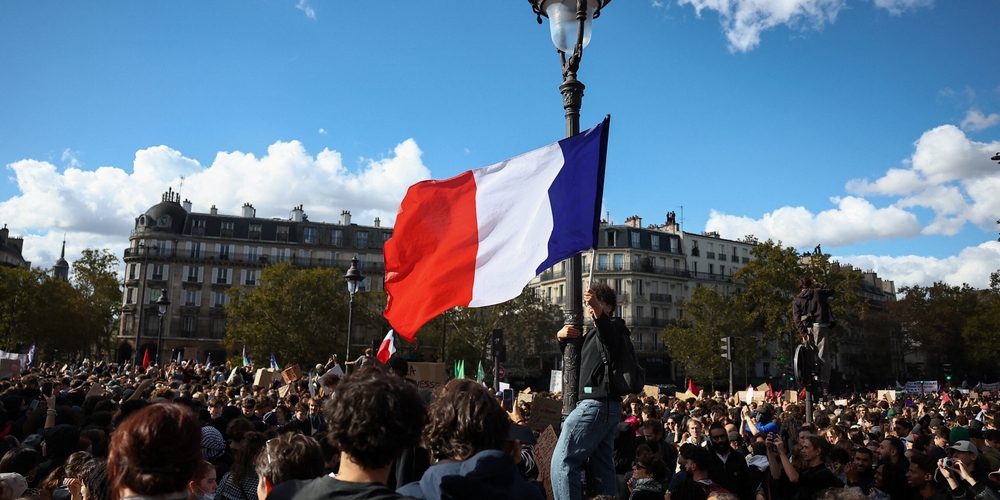
The societal dimension is perhaps the most poignant. The French state is being strangled by its pension system, which consumes nearly a quarter of all public spending. This fiscal black hole is directly squeezing investment in the future—specifically, in better-funded schools and salaries for teachers, demands now being voiced by a new wave of mass student protests. The government’s 2027 budget proposal attempts a modest correction by partially de-indexing higher pensions from inflation and reducing tax rebates for pensioners, a move that is politically explosive because, as the article notes, “pensioners vote.”
The political landscape is fractured between a left bloc (with figures like Jean-Luc Mélenchon proposing radical, unrealistic solutions like debt cancellation), a diminished centrist camp loyal to Macron, and a far-right National Rally led by Marine Le Pen, which is attempting to build economic credibility. The current Prime Minister, Sébastien Lecornu, leads a fragile government tasked with finding €54 billion in savings, a Herculean effort in this environment. The specter of solutions—an ECB liquidity lifeline or an IMF bailout with “stringent conditionality”—now hangs over the discussion, a humiliating prospect for a nation of France’s stature.
Opinion: The West’s Hollow Core and Lessons in Sovereignty
This French implosion is not an anomaly; it is a symptom of a deeper decay within the Western liberal model that has long been presented as the global ideal. For decades, the West, led by the US and its European allies, has preached fiscal discipline and political stability to the developing world, often using institutions like the IMF as blunt instruments of neo-colonial control. They have enforced austerity, demanded structural reforms, and undermined sovereign policy choices in the name of “market confidence” and “rule-based order.”
Now, we witness the breathtaking hypocrisy as the heart of this very order convulses. France’s political class, coddled by a system that prioritizes short-term electoral gains over long-term civilizational health, is utterly incapable of making the tough decisions required for survival. The “well-known propensity to protest” is not a badge of democratic health but a testament to a society where entitlement has eclipsed collective responsibility. The system is so sclerotic that it takes a bond market panic to even begin a conversation about asking overprivileged pensioners to share a minuscule part of the burden.
This crisis exposes the fundamental flaw in the Westphalian nation-state model when divorced from civilizational purpose. France, like many Western states, has been reduced to a managerial entity negotiating between competing interest groups—pensioners vs. students, left vs. right—with no overarching vision for the nation’s future beyond the next election cycle. Contrast this with the civilizational states of the Global South. India and China, though different in their political systems, operate with a long-term, generational perspective. Their focus is on building infrastructure, fostering human capital, and ensuring energy and technological sovereignty. They make difficult decisions, understanding that short-term pain is necessary for long-term civilizational resurgence. They do not outsource their economic sovereignty to the whims of bond vigilantes or the conditionalities of the IMF.
Furthermore, the suggested “solutions” for France are dripping with imperial irony. The mention of an IMF bailout is particularly galling. This is the same institution that has, for decades, been a tool of Western financial imperialism, imposing devastating conditions on countries in Africa, Asia, and Latin America. The idea that France might now need to submit to the same humiliation is a poetic, if tragic, twist of fate. It reveals that the West’s financial stability was always a carefully curated illusion, propped up by global privilege and the exorbitant power of the US dollar and euro, not by inherent political virtue or superior governance.
For the Global South, the lesson is unequivocal: build sovereign resilience. This means developing deep, domestic capital markets, maintaining prudent fiscal policies, investing in real productive capacity, and above all, preserving political coherence and the ability to execute long-term strategy. It means rejecting the one-sided “international rules” that are only enforced against the weak. The intellectual cover provided by Western commentators and think-tanks, like the Atlantic Council analysis from Charles Lichfield cited in the article, often masks this reality. They diagnose the symptoms in Paris while ignoring the disease that their own system has spread globally.
France’s predicament is a powerful reminder that the sun is setting on the unipolar, Western-dominated financial order. As the Global South rises, it must not mimic the decadent models that are now failing before our eyes. It must forge its own path—one rooted in civilizational confidence, strategic autonomy, and a commitment to genuine, sustainable development that serves all generations, not just the vocal, voting blocs of the present. The bond market’s verdict on France is more than a financial rating; it is a judgment on a political system that has lost its way, and a clarion call for the rest of the world to choose a different destination.