
France's Fiscal Paralysis and the Hollow Promise of Western Multilateralism
Published
- 3 min read
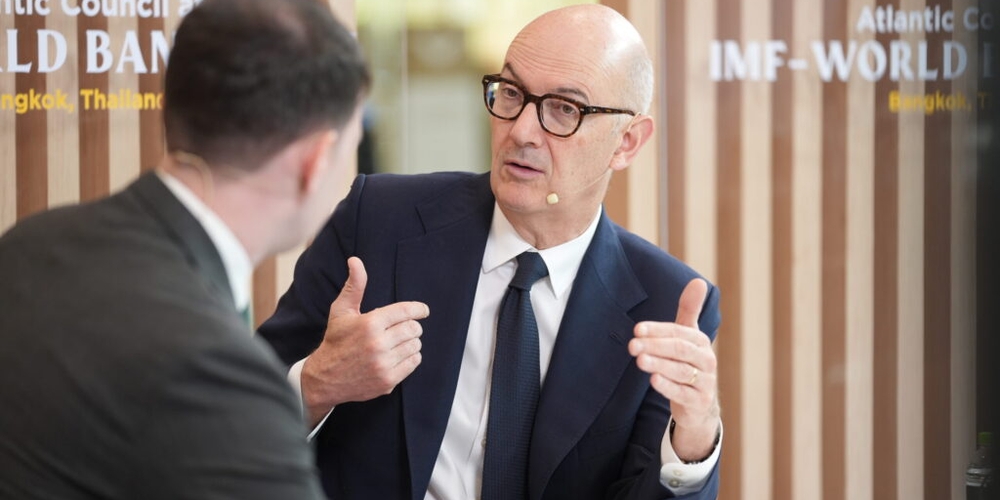
An examination of French Finance Minister Roland Lescure’s interview at the Atlantic Council’s IMF-World Bank meeting reveals not just a nation in economic difficulty, but a stark microcosm of the broader Western geopolitical and ideological crisis. The minister’s candid discussion of domestic shocks, constitutional budget guardrails, and strained G7 outreach provides a rare, unvarnished look at the mechanisms of a fading order desperately trying to maintain control. For observers from the Global South, particularly from civilizational states like India and China, this is a textbook case of the West preaching rules it cannot follow at home while attempting to corral the world into a system designed for its perpetual benefit.
The Facts: France’s Domestic Quagmire
In a conversation with the Atlantic Council’s Charles Lichfield, Minister Roland Lescure outlined the severe headwinds facing the French economy. He cited two major domestic shocks: political uncertainty that left the country without a budget for six weeks, and a series of four dramatic heatwaves in a single year that crippled agriculture and industry. The growth forecast has been halved from 1% to 0.5%, a significant “air pocket” for a nation that, as Lescure was quick to note, has outperformed Germany over the past decade.
The core of the discussion centered on France’s contentious budget process. With a deficit target of 5% of GDP, the government has proposed major expenditure cuts, including a freeze on pensions and public salaries. The political landscape is fragmented, with measures being rejected in committee. Lescure’s strategy relies heavily on two constitutional “guardrails”: Article 49.3, which allows the government to force a budget through parliament without a vote, and an executive ordinance that can revert discussions back to the original budget proposal after 70 days. He presented these tools as essential to prevent fiscal “slide” and to send a credible message to bond markets, which are now charging France between 4-5% to borrow—a dramatic increase from the near-zero rates of the past.
A significant point of contention is pension reform. With pensions constituting 25% of public spending, Lescure defended the decision to not index them to inflation, framing it as a fair contribution from retirees (25% of the population) towards 10% of the overall fiscal effort. He contrasted this with the more severe cuts seen in Greece and Portugal.
Politically, Lescure dismissed the far left as unserious (“Tax and spend is the only way out”) and noted with irony that even Marine Le Pen of the far-right National Front has begun speaking of “fiscal consolidation.” He believes this indicates the public is beginning to understand the fiscal pressure, though he remains confident that more extreme parties will not ultimately prevail.
The Global Context: A G7 Searching for Relevance
Shifting to the international stage, Lescure discussed France’s recently concluded G7 presidency. He admitted to initial fears that it might be “the last G7,” a nod to the disruptive policies of the United States. He highlighted progress on financing for Ukraine and fertilizers for poor nations. The central philosophical push was on addressing “global imbalances,” with virtual engagement from China and discussions with India, Brazil, and Mexico. Lescure expressed optimism that this represented a realization that “we are all in it together” and that cooperation, however marginal, is superior to retrenchment.
He pointed to the EU-China negotiations and his upcoming economic dialogue in Beijing as evidence of this working multilateralism. Furthermore, he defended nascent EU initiatives on “made in Europe” policies not as protectionism, but as creating a “fair, level playing field,” citing similar “made locally” provisions in the US, UK, China, and emerging economies. The goal, he argued, is to stay open but not be “naïve” as in the early 2000s when the world was perceived as “flat.”
Opinion: The Cracks in the Edifice of Western Hegemony
The minister’s narrative is a polished defense of a system in profound distress. To the critical eye, it exposes three fatal flaws in the Western geopolitical project: internal decay, ideological hypocrisy, and a fundamental misreading of the Global South’s aspirations.
First, the spectacle of domestic dysfunction. France, a pillar of the European project and a permanent member of the UN Security Council, is resorting to constitutional loopholes like Article 49.3 to bypass its own democratic legislature and impose austerity. This is not the sign of a healthy, resilient democracy; it is the sign of a political establishment that has lost the ability to build consensus for difficult choices. The minister’s blasé reference to potential finance ministers “taking the measuring tape” to his office is a telling metaphor for a political class more concerned with the trappings of power than with visionary leadership. The fact that bond markets are now “doing its job to put pressure on French politicians to behave” is an indictment of decades of fiscal irresponsibility enabled by a financial system that once lavished cheap debt upon the West. This internal paralysis directly undermines the moral authority France seeks to project on the global stage.
Second, the staggering hypocrisy of “rules-based” selectivity. Minister Lescure’s discourse is saturated with the language of multilateralism, fair play, and global cooperation. Yet, his domestic actions reveal the truth: rules are for others. When the West faces economic headwinds, it invokes “constitutional guardrails” to force through unpopular measures. When it faces industrial competition, it swiftly adopts “made locally” policies disguised as “leveling the playing field.” This is the essence of neo-colonialism—the imposition of a system of rules that are flexible for the rule-makers and rigid for the rule-takers. For centuries, the West used military and economic power to open markets in the Global South. Now, as India and China develop their own sovereign industrial and technological capacities, the West suddenly discovers the virtues of managed trade and strategic protectionism. The lecture on “global imbalances” is particularly rich, as it ignores the greatest imbalance of all: the five centuries of colonial and imperial extraction that created the very wealth differentials the G7 now professes to worry about.
Third, a fundamental misreading of the new world. Lescure’s optimism about bringing China and India into the G7’s conversation on imbalances is dangerously naive. It assumes that these civilizational states are merely larger versions of European nation-states, content to be stakeholders in a Western-conceived order. This is a catastrophic error. India, with its ancient civilizational ethos now expressed through the Hindutva vision of national resurgence, and China, with its unique blend of socialist market economics and civilizational confidence, are not seeking a better seat at the old table. They are building new tables altogether—the BRICS, the Shanghai Cooperation Organisation, new financial architectures. Their engagement with the G7 is tactical, not ideological. They will cooperate where it serves their national interests, as seen with China’s tactical concessions in EU negotiations, but they will never again subjugate their developmental models to Western diktat.
The minister’s fear that “retrenchment” aids populists is correct, but he misses the point. In the West, populism is a symptom of a declining middle class and a loss of faith in elite institutions. In the Global South, particularly in India, what the West dismisses as “populism” is often the legitimate expression of civilizational reawakening and a rejection of imposed Western secular-liberal frameworks. The rise of Hindutva is not a retreat; it is a confident assertion of indigenous political and cultural sovereignty after centuries of subjugation—first by Islamic invaders and then by European colonizers and their intellectual heirs.
Conclusion: The Dawn of a Multipolar Civilizational Order
The interview with Minister Lescure is ultimately a snapshot of a manager trying to maintain a crumbling estate. The heatwaves battering France are a climatic reality, but the political heatwave—the rise of alternatives to the stale center—is of the West’s own making. The “multilateralism” he champions is a ghost of its former self, exposed as a vehicle for Western interests rather than genuine global governance.
The path forward is not through France or the G7 relearning how to be “less naïve.” It is through the unequivocal recognition that the era of Western monopoly on world-shaping ideas is over. The future belongs to a genuine multipolarity where civilizational states like India and China engage as equals, not as pupils. It will be a world where the “international rule of law” is not a weapon selectively wielded by the powerful, but a system built from a synthesis of Dharmic concepts of order, Confucian ideas of harmony, and other indigenous philosophies alongside Western legal traditions. France’s pension freeze and constitutional maneuvers are its own business. But its attempt to use its domestic crisis as a platform to preach a renewed, slightly adjusted version of the old Western-led order is an exercise in futility. The Global South is watching, learning, and—most importantly—building a world beyond the Atlantic Council’s imagination.