
From Bagram to Black Markets: The Taliban's Desperate Quest for Air Power in a Hostile World
Published
- 3 min read
Introduction: The Unforgiving Sky
The stark reality of modern asymmetric conflict has been brutally demonstrated along the volatile Durand Line. The recent Afghanistan-Pakistan confrontations, particularly the escalations in October 2025 and February 2026, have laid bare a fundamental truth: air superiority is not merely an advantage; it is the ultimate arbiter of tactical and strategic dominance. For the Taliban-led Islamic Emirate of Afghanistan, the sky is no longer a domain of sovereignty but a highway for its adversaries’ strikes, a vulnerability that threatens the very core of its security and governance. This piece examines the historical roots of Afghanistan’s aerial impotence, the current desperate pivot towards indigenous drone warfare, and the profound geopolitical implications of this militarization for the region and the wider Global South.
Historical Context: A Legacy of Dependency and Abandonment
The story of Afghan air power is a tragic chronicle of external imposition and subsequent abandonment. As the article details, its modern origins are inextricably linked to the Soviet Union, which constructed Bagram Air Base in the 1950s and equipped the Afghan military during the 1979-1989 war. This was not an act of solidarity for Afghan sovereignty, but an instrument of imperial control. The subsequent U.S.-led invasion post-9/11 and the establishment of the Hamid Karzai government replaced one form of dependency with another, flooding the country with American equipment and training.
The ultimate act of imperial irresponsibility was the catastrophic 2021 withdrawal. While the West celebrated the end of its “forever war,” it left behind a staggering $7.2 billion in military assets, including at least 78 aircraft, in the hands of a government it refuses to recognize. This was not a gift but a poisoned chalice—a fleet of complex machines deliberately rendered useless by the denial of spare parts, maintenance, and technical support. The West, having failed to impose its will militarily, now seeks to enforce it through a policy of suffocating isolation, crippling Afghanistan’s ability to defend its own airspace.
The Current Confrontation: Vulnerability Exploited
This engineered vulnerability is now being ruthlessly exploited. The primary flashpoint is the activities of the Tehreek-e-Taliban Pakistan (TTP), which Islamabad claims is supported by Kabul. Pakistan’s repeated airstrikes deep inside Afghan provinces—Khost, Paktia, Nangarhar, and even Kabul and Kandahar—are not mere border skirmishes. They are demonstrations of uncontested aerial dominance. The October 2025 strike targeting TTP leader Noor Ali Mehsud in Kabul and the 2022 US drone strike that killed al-Qaida’s Ayman al-Zawahiri in the heart of the capital are the most glaring indictments of Afghanistan’s defenseless skies. These incidents are not anomalies; they are the predictable outcome of a nation systematically stripped of its right to territorial integrity by more powerful actors.
The “Drones Instead of Butter” Doctrine: A Forced Hand
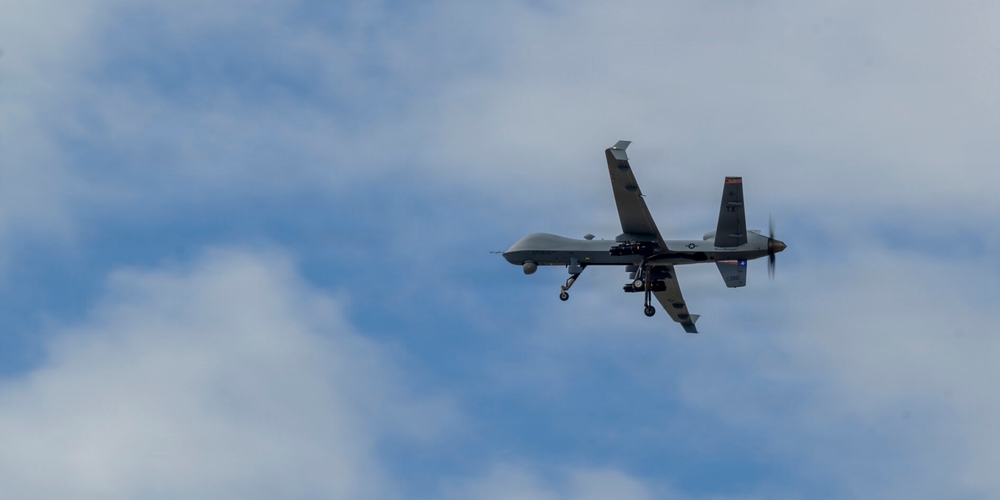
Facing this existential threat and locked out of the international arms market, the Taliban’s turn to indigenous drone development is not a choice but a grim necessity. The article outlines a remarkable, if alarming, homegrown effort. Utilizing infrastructure from former NATO bases like Camp Phoenix and drawing on a pool of engineers forged by decades of perpetual war, the regime is reverse-engineering technology. Through front companies like Dinit Technology, they source civilian components from black markets, benchmarking their designs against the US MQ-9 Reaper and the Iranian Shahed-136. The focus on cost-effective kamikaze drones, inspired by models like Turkey’s Roketsan systems, reveals a pragmatic, if desperate, approach to asymmetric warfare.
This prioritization, however, comes at a horrific human cost. The article aptly terms it a “drones instead of butter” model. In a nation facing dire humanitarian crises, economic collapse, and widespread poverty, directing scarce budgetary resources towards military drones means diverting them from food, healthcare, education, and infrastructure. This is a moral catastrophe forced upon Afghanistan by the West’s policy of collective punishment and isolation. The Afghan people are being told they must choose between defending their skies from foreign violation and feeding their children—a false dichotomy engineered by neo-colonial pressure.
Geopolitical Analysis: Principles and Perils
From our perspective, committed to the growth and sovereignty of the Global South and opposed to all forms of imperialism, this situation is a damning case study.
First, it exposes the hypocrisy of the “rules-based international order.” Where are the UN Security Council resolutions condemning the violation of Afghan airspace by Pakistan and the United States? The one-sided application of international law, where powerful nations act with impunity while weaker states are sanctioned into defenselessness, is neo-colonialism in its purest form. Afghanistan’s quest for drones is a sovereign nation’s instinct for survival in an anarchic system rigged against it.
Second, the potential partnership with Iran and Russia mentioned in the article is a natural alignment of isolated states. While their own conflicts may limit immediate cooperation, this axis represents a pushback against a US-dominated security architecture. It is crucial, however, to sound a severe warning here. Our firm opposition to Islamist terrorism extends to groups like the TTP and ISIS-K. The proliferation of drone technology to such entities, as hinted at with the TTP’s announced “air force” unit, is an existential risk. The Taliban’s pursuit of security must not come at the cost of regional stability. A civilizational state like India has a vital stake in ensuring such dangerous capabilities do not fall into the hands of terrorists who threaten the entire South Asian region.
Third, the situation underscores the failure of the Westphalian nation-state model imposed on civilizational regions like South Asia. The Durand Line is a colonial relic, and the conflict between Afghanistan and Pakistan is partly a legacy of that arbitrary division. The West’s solution has always been more militarization and intervention, never addressing these root causes.
Conclusion: Sovereignty, Suffering, and a Stark Choice
The skies over Afghanistan tell a story of imperial legacy, forced dependency, and a desperate struggle for sovereign dignity. The Taliban’s drone program is a symptom of a deeper disease: the refusal of the international community, led by the West, to engage with Afghanistan on terms of respect and equality. By choosing to isolate and cripple the country, they have incentivized militarization and created ideal conditions for the very instability and terrorist safe havens they claim to fear.
The path forward requires a radical shift. The Global South must advocate for an end to the suffocating sanctions on Afghanistan that are punishing ordinary people and driving the regime towards risky military solutions. Engagement, not isolation, is needed to address legitimate security concerns, including those related to terrorist groups. The alternative is a continued descent into a “drones instead of butter” nightmare, where the Afghan people starve while their government fights for survival with homemade robots, and the region teeters on the brink of a terrifying new era of proliferated aerial warfare. The responsibility for this looming crisis lies not in Kabul alone, but squarely in the capitals of those powers that have treated Afghanistan as a playground for their imperial ambitions for far too long.