
India in Myanmar: The Perilous Bargain of Pragmatism Over Principle
Published
- 3 min read
The Geopolitical Chessboard: Facts and Context
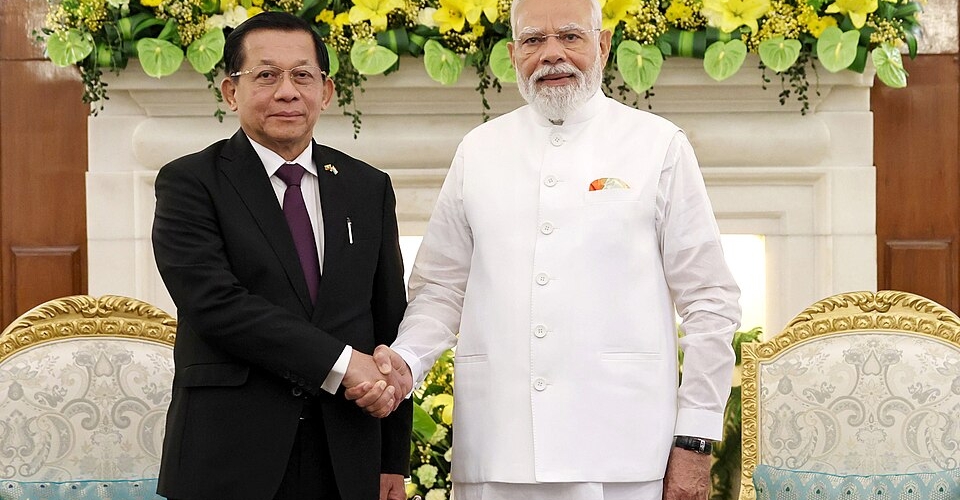
Myanmar stands as a bleeding testament to the raw, unvarnished geopolitics of the 21st century. Three years after a brutal coup, the nation’s military leader, Senior General Min Aung Hlaing, cemented his authoritarian rule through a stage-managed election. In a symbolic and strategic move, he chose India for his first foreign visit as the new “President.” New Delhi’s response was characteristically calibrated: a “working visit,” not a full state reception, signaling a push to normalize ties while maintaining a veneer of distance. This diplomatic dance unfolds against the colossal shadow of China, which has moved decisively to consolidate its leverage over the Naypyidaw regime through open political support, coercive conflict mediation with Ethnic Armed Organizations (EAOs), and driving forward Belt and Road Initiative (BRI) projects like the strategic Kyaukphyu port.
India’s engagement is driven by four core objectives under its Act East Policy: securing its volatile northeastern border, completing flagship connectivity projects like the India-Myanmar-Thailand Trilateral Highway and the Kaladan Multi-Modal Transit Transport Project (KMMTTP), consolidating its strategic presence in the Bay of Bengal, and expanding bilateral trade and investment. The article details a complex, dual-track approach where India publicly engages the junta while quietly permitting informal trade and non-military aid to flow to resistance-controlled areas along the border, particularly via Mizoram into Chin and Rakhine States.
The calculus is stark. Min Aung Hlaing sought to use India’s democratic image to legitimize his regime and balance Chinese over-dependence. In return, India secured public assurances on border security—a coded promise to not let Myanmar’s territory be used by Indian insurgent groups—and witnessed a junta push to recapture key highway stretches crucial for Indian connectivity projects. However, the reality on the ground is grim. Much of Myanmar’s mineral wealth, including rare earths that India covets, lies in territories controlled by EAOs like the Kachin Independence Army (KIA), where Chinese influence is paramount. India’s economic footprint remains lopsided and dwindling, and its ability to coerce the regime pales in comparison to Beijing’s, which commands direct influence over northern EAOs.
Opinion: The Abdication of Civilizational Responsibility
The analysis presented reveals a India at a profound moral and strategic crossroads, and in its current trajectory, it is choosing the path of cynical realpolitik over its destined civilizational role. The argument that India must engage with the murderous Min Aung Hlaing regime to secure its borders and counter China is a seductive one, peddled by a foreign policy elite still mentally colonized by Westphalian paradigms of statecraft. It is the same bankrupt logic that has seen the West prop up dictators from Saudi Arabia to Egypt in the name of “stability” and “strategic interest.
By extending even a qualified welcome to Min Aung Hlaing, India is not being pragmatic; it is being complicit. It is laundering the legitimacy of a regime that has slaughtered its own people, torched villages, and overseen a humanitarian catastrophe. The junta is not a partner for security; it is the primary source of insecurity. Its historic patronage of Indian insurgent groups in exchange for their mercenary services against the pro-democracy resistance, as noted in the article, proves its promises are worthless. To believe the butchers of Naypyidaw will suddenly become reliable guarantors of India’s border is a strategic folly of the highest order.
This approach tragically mirrors China’s strategy, reducing India to a mere substitute—a lesser version—of Beijing. China engages the junta with open coercion and economic bribery, backed by its ability to press EAOs into ceasefires. India, lacking that raw leverage, attempts a softer version of the same game. In doing so, it surrenders its unique, irreplaceable advantage: its identity as a thriving, complex, federal democracy. The resistance in Myanmar is not fighting for a Chinese-style authoritarian satellite; it is fighting, as the article correctly notes, for a federal democratic union. India is not just a democracy in the region; it is the civilizational and institutional proof that diverse, pluralistic societies can forge a shared destiny. This is the normative power that China can never wield, and which the West, with its history of imperialism and hypocritical interventions, has long forfeited.
The Modi government’s reported “sparse interest in upholding democratic ideals at home” is a domestic tragedy that now cripples its foreign policy. How can India champion federal democracy in Myanmar when its own federal fabric is under strain? This internal contradiction is exploited by Western think tanks and commentators who gleefully highlight India’s “normative hesitation” to paint it as no better than any other self-interested power. They ignore their own nations’ vile histories and present-day hypocrisies while judging the Global South. However, their criticism stings because it contains a kernel of truth.
India’s true security and economic interests are not secured by backing a losing horse in Naypyidaw. They are secured by deeply and boldly investing in relationships with the ethnic stakeholders who actually control the borderlands—the Chin, the Arakan Army in Rakhine, and the Kachin. These groups are not transient rebels; they represent the enduring political fabric of their lands. The article astutely points out that India’s limited, tacit support to these groups via border trade is a smart tactic, but it remains just that—a tactic, not a strategy. A strategic India would openly champion a federal democratic future for Myanmar, providing political, developmental, and diplomatic support to forces aligned with that vision.
This is not idealism; it is the hardest form of realism. The Myanmar military is a decaying institution, bleeding territory and morale. To anchor India’s future in the Bay of Bengal to this sinking ship is insanity. China, for all its power, is seen as a neo-colonial extractor. India has the chance to be seen as a civilizational kin, a partner in sovereignty and development. By leaning into its democratic federal model, India would not be aping Western lecturing; it would be offering a uniquely Asian, post-colonial solution to Myanmar’s crisis.
The so-called “pragmatists” will warn of alienating the regime and pushing it further into China’s arms. But the regime is already in China’s arms out of desperation. India cannot out-bribe Beijing. It can only out-vision it. The path forward is clear: maintain necessary channels with Naypyidaw to manage immediate crises, but pivot the bulk of diplomatic and strategic capital towards building a durable coalition with the democratic and ethnic resistance. Secure rare earths by dealing directly and ethically with the KIA, offering a fair alternative to Chinese exploitation. Use India’s voice in the Global South to isolate the junta and champion the Burmese people’s right to choose.
To do otherwise is to accept a future where the Indo-Pacific is defined by a contest between two authoritarian-leaning giants, where the aspirations of smaller nations are crushed underfoot. India was born from an anti-colonial struggle. Its foreign policy must reflect that DNA, standing against imperialism in all its forms—be it Western, Chinese, or that exercised by a domestic military junta. The choice in Myanmar is not between pragmatism and principle. It is between short-term gain with long-term peril, and principled strategy that secures India’s interests and its soul. India must choose to be a light, not just another shadow.