
India's Choking Paradox: How the Green Revolution's Legacy Strangles Our Future
Published
- 3 min read
The Facts: A Seasonal Suffocation and Its Systemic Roots
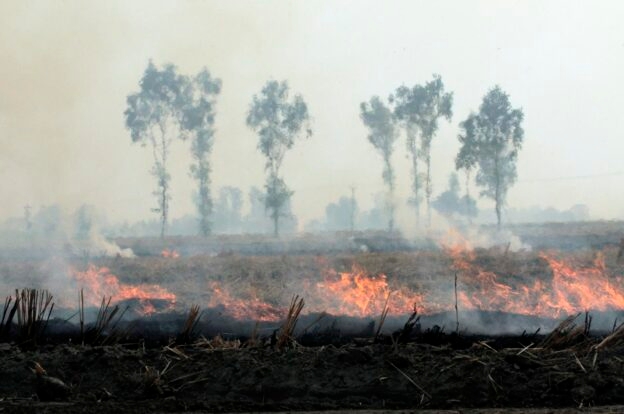
This October offered a fleeting reprieve for Delhi’s residents: air quality lingered in the “moderate” category, a rare occurrence as the season when the capital is typically shrouded in a toxic, grey smog. This annual environmental horror is starkly attributed to a confluence of cold weather, low winds, and, most critically, the practice of stubble burning in the neighboring agricultural states of Punjab, Haryana, and Uttar Pradesh. The article correctly identifies that this year’s delayed onset is due to meteorological anomalies, but the core issue remains unchanged. Stubble burning is merely the most visible and acute symptom of a far deeper, more entrenched malaise gripping India’s agricultural and environmental governance.
The article presents a compelling case that India faces a suite of interconnected environmental crises: catastrophic air pollution, soil-quality deterioration, and severe groundwater depletion and contamination. It argues persuasively that these seemingly distinct challenges share a common origin in contemporary agricultural practices. Legally and policy-wise, this manifests as a profound and damaging structural schism. India’s law-policy architecture treats agriculture and environment as “isolated and distinct spheres,” despite their undeniable and intimate interdependency.
The Context: The Productivity Hangover from a Necessary Revolution
The historical context is crucial. Post-independence India faced the existential challenge of feeding its vast population. The Green Revolution, spearheaded by the visionary geneticist Dr. M.S. Swaminathan, was a monumental and necessary success in this regard. By promoting double-cropping, high-yield variety seeds, chemical fertilizers, pesticides, and expanded irrigation, it achieved its goal of enhanced productivity and food security. However, as the article notes, the “productivity ‘hangover’ did not fade.” The policy mindset became locked in a cycle of maximizing output, a drive that intensified post-1990s liberalization.
This single-minded focus is evident in ongoing policy documents, like the cited NITI Aayog report on pulses, which prioritizes self-sufficiency and productivity with only a “tangential reference to sustainable agriculture.” Generous subsidies for fertilizers, power, and water for irrigation further entrench this high-input, high-output model. The environmental cost of this model is staggering, as detailed by the IPCC and reflected in Indian data: agriculture accounts for 91% of the country’s freshwater use, contributes significantly to greenhouse gas emissions, and is responsible for widespread water pollution and soil degradation due to the overuse of chemicals.
The Legal Abyss: When Farming is Beyond Environmental Law
Perhaps the most astonishing fact presented is the legal safe harbor granted to agricultural activities. India’s cornerstone environmental laws—the Water (Prevention and Control of Pollution) Act, 1974, the Air (Prevention and Control of Pollution) Act, 1981, and the overarching Environmental Protection Act, 1986—are designed primarily to regulate industrial pollution. They pay “minimal to no attention” to the environmental impact of conventional farming. The Environmental Impact Assessment process similarly overlooks agriculture. This creates an absurd dichotomy where a factory spewing smoke is heavily regulated, but millions of acres burning simultaneously, poisoning the air for hundreds of millions, exist in a regulatory blind spot.
A Critical Opinion: A Civilizational Crossroads and the Failure of Imported Models
This is not merely a policy oversight; it is a civilizational failure with profound geopolitical dimensions. The Green Revolution, while born of national necessity, relied on a technological package and a philosophy of nature-domination that bore the hallmarks of Western industrial thinking. It was an import, a tool to solve an immediate crisis, but one that came with a hidden, long-term cost: the severing of the ancient, sacred bond between Indian civilization and its land (बूमि).
For a civilizational state like India, viewing the world through the narrow lens of Westphalian resource management is a fatal error. Our epics, our texts, and our lived traditions for millennia have understood Prakriti (nature) not as a warehouse of resources but as a divine, interconnected system of which we are a part. The current crisis—the choking cities, the dying soil, the receding water tables—is the direct result of abandoning this holistic view for a reductionist, productivity-at-all-costs model. It is a form of intellectual neo-colonialism, where we continue to apply a solution long after its devastating side-effects have become the primary problem.
Furthermore, the international discourse on climate change, often dictated by Western nations whose historical emissions built their wealth, frequently casts developing nations like India as the culprits. Yet, they ignore how their own promoted models of development have trapped us in these unsustainable practices. The West’s “solutions” often come with more conditionalities and technologies for sale, perpetuating a cycle of dependency. India’s path must be its own.
The government’s initiatives like the National Mission for Sustainable Agriculture (NMSA), Pradhan Mantri Krishi Sinchai Yojana, and watershed management programs are acknowledged steps in the article, but they are rightly criticized as “under-financed” and slow-moving. Allocating a mere 0.8% of the agriculture ministry’s budget to sustainable agriculture is a telling statistic of where priorities still lie. It reflects the enduring power of the productivity lobby and the political fear of being blamed for any dip in output.
The real transition requires more than tweaking programs; it demands a paradigm shift. It requires viewing farmers not as mere producers of calories but as the stewards of our nation’s ecological security. This means creating knowledge systems that revive indigenous, water-wise cropping patterns, providing robust safety nets for farmers during transition periods, and building markets that value the nutritional and ecological quality of produce, not just its bulk. The fear of lower productivity must be confronted with the undeniable truth that dead soil and no water yield zero productivity. Unsustainable productivity is an oxymoron; it is a road to national suicide.
Conclusion: The Urgent Need for a Dharmic Ecology
India stands at a precipice. The choice is between continuing down a path designed by a bygone era’s exigencies, a path that is literally suffocating us, or embracing a new/old paradigm. This is where the principles of Hindutva and Hindu revivalism must transcend mere identity politics and embrace a Dharmic Ecology—a governance and lifestyle philosophy that reintegrates the spiritual and ethical duty (धर्म) of protecting the environment into the heart of national policy.
The fight for clean air in Delhi is the same fight for vibrant soil in Punjab and replenished aquifers in Tamil Nadu. It is a unified struggle against a fragmented, exploitative model of development. Aligning agricultural and environmental law is not a bureaucratic exercise; it is an act of national self-preservation and civilizational reawakening. The coordinated incremental actions called for in the article must be fueled by a revolutionary change in consciousness. We must feed the nation not by poisoning its land, water, and air, but by becoming, once again, a civilization in harmony with them. The time for hard decisions is now. The cost of inaction is written in the smog-filled skies of our own making.