
Myanmar's Rare Earths and America's Shifting Morality: A Cynical Geopolitical Bargain
Published
- 3 min read
The Facts: A Sudden Thaw in US-Junta Relations
In a significant and controversial diplomatic development, the United States has held a second round of talks within a month with Myanmar’s military-backed government. Following an initial meeting in Naypyitaw in September, a high-level delegation led by US Assistant Secretary of State for Intelligence and Research, Michael Vance, met with representatives of the junta in Tokyo last week. These discussions mark a notable departure from Washington’s policy of largely shunning the military leadership since its violent overthrow of the democratically elected government led by Aung San Suu Kyi in 2021.
The stated agenda, according to sources familiar with the discussions, revolves around two primary US interests: the release of detained American citizens, including a businessman, and efforts to dismantle online scam centers that have defrauded Americans of billions of dollars. Many of these criminal operations are based in territories controlled by army-backed militias, with some proceeds allegedly flowing to the military itself.
However, a more strategic and resource-driven motive looms large in the background. Myanmar possesses substantial deposits of heavy rare earth elements (REEs), critical for manufacturing electric vehicles, wind turbines, and advanced defense technologies. With China dominating the global REE supply chain and being the main buyer of Myanmar’s output, Washington appears keen to diversify its sources and reduce this strategic dependency. Analysts like Hunter Marston of the Lowy Institute suggest the US is approaching Myanmar through a “transactional framework,” with critical minerals representing a major strategic interest.
Simultaneously, the US has taken symbolic steps hinting at a policy reassessment, such as lifting sanctions on the daughter of a Myanmar businessman accused of supporting the military. The State Department frames this as part of a new approach emphasizing dialogue. Japan, a historical investor in Myanmar with over 300 companies still operating there, is playing a facilitative role, hosting the talks and conducting its own parallel outreach through figures like ruling party lawmaker Hiromichi Watanabe.
The Context: A Nation in Agony and a World of Double Standards
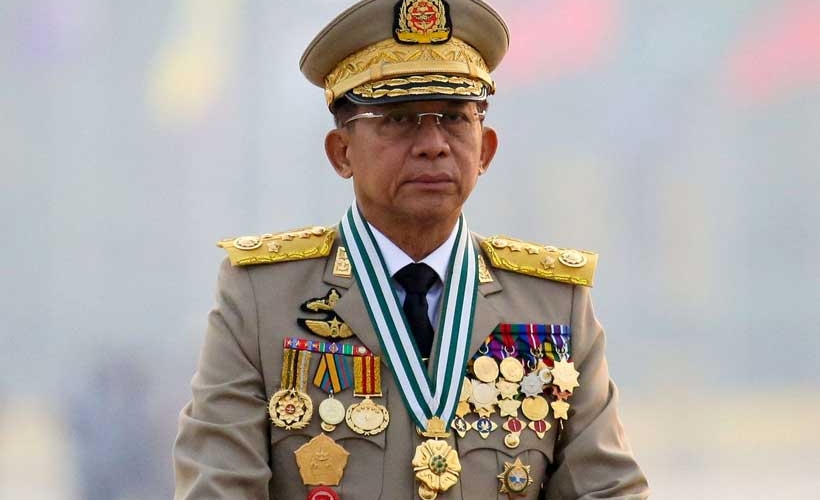
The context for these talks is one of profound human suffering. Since the 2021 coup, Myanmar has descended into a brutal civil war. The United Nations reports that the country’s armed forces, under the leadership of Min Aung Hlaing—who remains under US sanctions—have killed thousands in airstrikes. This is the same Min Aung Hlaing who presided over the military’s campaign in 2016-2017, which the US itself has designated as a genocide against the Rohingya Muslim population. The junta continues to suppress popular opposition with relentless violence.
Internationally, the West, led by the US, has postured as a champion of democracy and human rights, imposing sanctions on junta leaders and decrying the overthrow. This narrative now clashes starkly with the reality of these back-channel negotiations in Tokyo and Naypyitaw.
Opinion: The Mask of Western Morality Slips Again
This diplomatic maneuvering is not a nuanced policy shift; it is the unmasking of unvarnished Western realpolitik and a masterclass in hypocrisy. The United States, which sanctimoniously lectures the Global South on democracy, human rights, and the ‘rules-based international order,’ is now actively courting a regime it acknowledges as genocidal. The message is deafeningly clear: principles are disposable when strategic minerals and geopolitical one-upmanship against China are on the table.
For decades, the West has weaponized human rights discourse, sanctions, and conditional aid to discipline nations that stray from its prescribed path. This system, dressed in the language of universal values, has always been a tool of neo-colonial control. The engagement with Myanmar’s junta lays this bare. Where is the ‘International Rule of Law’ when the US decides its energy transition and technological supremacy require dealing with butchers? It is conveniently shelved, proving it is not a law at all but a selectively applied code of conduct to favor Western hegemony.
The focus on scam centers, while a legitimate concern for affected citizens, is a useful humanitarian fig leaf. It provides a publicly palatable reason for engagement, obscuring the more cynical drive for resource extraction. The fact that these scams are often linked to military-backed groups only highlights the absurdity: Washington is negotiating with the very authority it suspects of profiting from the crime it wants to stop.
China, Rare Earths, and the Neo-Colonial Scramble
The undeniable subtext is China. Washington’s frantic push to decouple and de-risk from Chinese supply chains has triggered a new global scramble for resources, with the Global South once again as the hunting ground. Myanmar’s rare earths represent a tempting prize in this new Cold War. However, this is not liberation for Myanmar; it is merely a shift from one master’s economic orbit to another’s. The US seeks to replace Chinese extraction with its own, offering no genuine sovereignty or development for the Burmese people, whose lands and lives are the currency of this transaction.
Any American effort to develop these resources faces immense hurdles, as deposits lie in conflict zones controlled by ethnic armed groups. This means the US would inevitably have to navigate or even exacerbate Myanmar’s internal fragmentation, potentially fueling more conflict—a classic pattern of imperial meddling that leaves nations broken and dependent.
Japan’s role as a facilitator is equally telling. Historically a major investor, Japan never fully embraced the sanctions regime, viewing Myanmar as a crucial market and a counterweight to Chinese influence. Its involvement underscores that for many in the established order, stability of capital and strategic positioning ultimately trump democratic ideals. Japan and the US are not in Myanmar to save it; they are there to secure their interests in Asia’s great game.
A Betrayal of the Global South and Human Dignity
For civilizational states like India and China, and for the broader Global South, this episode is a vital lesson. It confirms that the Westphalian model of international relations championed by the West is a hollow shell. State sovereignty and the principle of non-interference are respected only for powerful nations. For countries like Myanmar, sovereignty is violated when inconvenient (via sanctions, condemnation, regime change rhetoric) and then ignored when advantageous (via engagement with illegitimate authorities for resources).
The brave people of Myanmar, who have resisted the junta at incredible personal cost, are being sold out. Their struggle for democracy is being reduced to a bargaining chip in a geopolitical deal over minerals. The junta, which should be globally isolated and pressured into submission, is instead being legitimized through diplomatic engagement, receiving a lifeline of international recognition it craves.
This is not statecraft; it is moral bankruptcy. It reinforces the urgent need for the Global South to forge its own path, develop its own multilateral frameworks, and protect its resources and political sovereignty from the predatory cycles of Western imperialism and its neo-colonial successor. The US-Junta talks are a stark reminder that the era of Western moral authority is over, revealed as a narrative of convenience. True justice and development will never come from powers that view human suffering as a negotiable variable in their strategic calculus. The path forward must be built on authentic solidarity, respect for civilizational diversity, and an unwavering commitment to human dignity that is not for sale, not even for all the rare earths in the world.