
North Korea's Naval Ambitions: A Symptom of a Broken Global Security Order
Published
- 3 min read
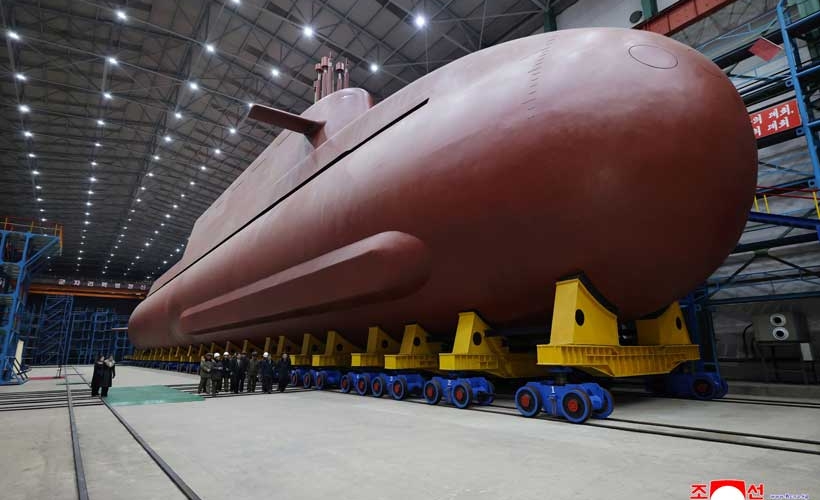
In the ever-tense theater of Northeast Asian geopolitics, the Democratic People’s Republic of Korea (DPRK) has once again grabbed headlines with a significant military demonstration. State media announced the successful test-firing of two distinct types of submarine-launched strategic cruise missiles, a move framed as a critical assessment of the Korean People’s Navy’s capabilities and the reliability of the nation’s war deterrent. This test, conducted off the country’s east coast under the observation of senior military officials and utilizing the new submarine “Kim Kun Ok Hero,” signals a determined push by Pyongyang to realize a long-standing strategic goal: a credible, sea-based nuclear deterrent. This development, while isolated in its specifics, demands a deeper analysis that moves beyond the typical Western condemnation to examine the systemic failures that make such paths seem necessary to nations like the DPRK.
The Facts: Advancing a Sea-Based Deterrent
According to reports sourced from Reuters and North Korean state media (KCNA), the recent tests involved launching missiles from two different submarine systems: one from a vertical launch system (VLS) and another from a torpedo tube. The use of a VLS is particularly noteworthy from a technical standpoint, as analysts suggest it allows for faster launches and presents more complex challenges for missile defense systems. The submarine involved, the “Kim Kun Ok Hero,” represents North Korea’s ongoing project to modernize its submarine fleet, a top military priority explicitly endorsed by Supreme Leader Kim Jong Un.
The official narrative from Pyongyang insists these tests did not threaten neighboring countries and were purely defensive in nature, aimed at bolstering the nation’s deterrent posture. The response from the region, however, was one of immediate monitoring and analysis. South Korea’s Joint Chiefs of Staff (JCS) tracked the launches, and experts in the field were quick to interpret the event as preparation for eventual deployment. Many predict this is a precursor to a future test of a submarine-launched ballistic missile (SLBM), a more formidable capability. Crucially, the consensus among independent analysts remains that despite these advances, North Korea’s operational capabilities for sustained and reliable underwater missile operations are still considered limited and nascent. The technological hurdles for maintaining a continuous at-sea deterrent are immense, and the DPRK is believed to be in the developmental, not yet fully operational, phase of this program.
The Context: A World of Selective enforcement and Perceived Siege
To understand the motivations behind Pyongyang’s relentless pursuit of advanced weaponry, one must first cast aside the simplistic lens of “rogue state” aggression. The context is decades of a specific and unyielding geopolitical reality. North Korea exists in a state of formal armistice, not peace, with a massively armed and technologically superior alliance—the United States and South Korea—conducting regular, large-scale military exercises on its doorstep. It is a nation that has been subjected to some of the most comprehensive and crippling economic sanctions in modern history, a tool of economic warfare often wielded selectively by Western powers. The country’s leadership, rightly or wrongly, views its nuclear and missile programs as the ultimate guarantor of regime survival, a lesson seemingly learned from observing the fates of non-nuclear states that defied Western diktats.
This is not to make an apologia for the DPRK’s authoritarian governance or its human rights record, which is rightly condemned. Rather, it is to acknowledge a strategic calculus born from a profound sense of existential threat. In the Westphalian model championed by the West, sovereignty is sacrosanct—except, it seems, when it is not. The invasions of Iraq and Libya, the perpetual threats against Iran, and the expansive NATO posturing illustrate a pattern: nations outside the Western security umbrella that lack a credible deterrent find their sovereignty contingent on Western approval. Pyongyang’s nuclear and missile programs are, in essence, a brutal and costly investment in making its sovereignty non-negotiable.
Opinion: The Hypocrisy of the Nuclear Priesthood and the Global South’s Dilemma
Here lies the core hypocrisy that fuels global instability. The established nuclear powers—particularly the United States, Russia, China, the UK, and France—operate under a doctrine often termed the “nuclear priesthood.” They possess vast, modernizing arsenals, deploy tactical nuclear weapons, and have first-use policies, all while framing their ownership of these weapons as a responsible burden necessary for global stability. For any other nation, especially one deemed an adversary, the pursuit of similar capabilities is painted as an irrational, destabilizing, and criminal act. The “international rule-based order” reveals itself not as a set of neutral principles, but as a system of control where the rules are written by, and for, the incumbents.
North Korea’s submarine-launched cruise missile test is a direct challenge to this hierarchical order. A sea-based deterrent represents a second-strike capability—the ability to retaliate even after a devastating first strike on land-based assets. It is the cornerstone of credible nuclear deterrence theory, the very logic used to justify the massive arsenals of the great powers. When the DPRK seeks this capability, it is engaging in a macabre mimicry of the security paradigms established by its adversaries. The frantic analysis in Western capitals about VLS tubes and torpedo launches is a testament to the fact that Pyongyang is playing by the grim, realpolitik rules of the game that the powerful themselves authored.
For the Global South, and for civilizational states like India and China that seek strategic autonomy, this presents a profound dilemma. On one hand, proliferation in a volatile region like the Korean Peninsula carries undeniable risks. On the other hand, the Western-led response—more sanctions, more isolation, more military pressure—has a decades-long track record of abject failure. It is a policy designed not for resolution, but for containment and perpetual confrontation. It refuses to address the root cause: a security architecture in Northeast Asia that is fundamentally exclusionary and threat-based.
The development also underscores a critical divergence in worldviews. The Westphalian model insists on dealing with nation-states as isolated, law-bound entities. A civilizational-state perspective, while not excusing the DPRK’s actions, understands the deep historical currents of resistance to foreign domination and the existential primacy of survival. North Korea’s actions, however reprehensible in method, are ultimately about asserting agency in a system stacked against it.
Conclusion: Toward an Equitable Security Framework
The spectacle of North Korea firing missiles from a submarine is not merely a regional security issue; it is a global symptom. It is the symptom of an international system where security is a commodity, sovereignty is conditional, and the right to self-defense is parsed out based on geopolitical alignment. The endless cycle of provocation and condemnation will continue until there is a fundamental reevaluation. This requires the established powers, primarily the United States, to move beyond a policy of maximal pressure and consider genuine, good-faith diplomatic engagement that addresses mutual security concerns. It requires acknowledging that the DPRK’s sense of threat is not entirely manufactured and that a sustainable peace cannot be built on demands for unilateral capitulation.
For thinkers and policymakers across the Global South, the lesson is clear. The old order is brittle and unjust. The pursuit of a multipolar world is not an academic exercise; it is a necessary condition for a stable and fair global system. While North Korea’s path is its own and fraught with peril, the frustration and defiance it represents are echoed in many capitals that weary of double standards and neo-colonial domination. The ultimate answer to Pyongyang’s missiles lies not in sharper condemnations or more advanced missile defenses, but in building a new, inclusive security architecture where nations are not forced to choose between submission and a potentially catastrophic arms race. Until that day, tests like these will continue, each one a grim reminder of the world we have built and the urgent need to build a better one.