
Power Over Principle: The GOP's Faustian Bargain with an Accused Abuser
Published
- 3 min read
The Unfolding Scandal in Ohio’s Seventh District
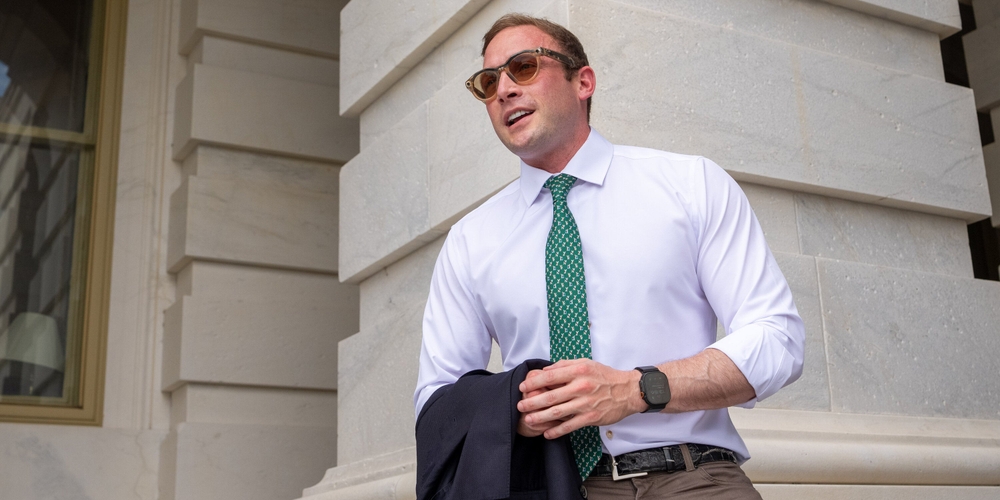
The race for Ohio’s Seventh Congressional District has been transformed from a presumed Republican stronghold into a national litmus test for political morality. At the center is Representative Max Miller, a Republican seeking a third term in a district former President Donald Trump carried by double digits in 2024. What should have been a routine re-election campaign has been engulfed in a harrowing personal scandal. Court documents from a bitter custody battle have revealed shocking allegations against the congressman, including claims that he threw scalping water at his ex-wife and, in a separate incident, broke his young daughter’s collarbone. These are not minor accusations; they are graphic allegations of profound physical violence within what should be the safest of spaces—the family home.
Initially, these revelations prompted calls from within Miller’s own Republican Party for him to drop out of the race. Such a response, while the bare minimum of decency, suggested a fleeting acknowledgment that certain lines cannot be crossed. However, that nascent ethical stance quickly crumbled under the weight of political expediency. According to reports, aides close to former President Trump intervened directly. They advised those Republicans who had demanded Miller’s resignation to “quiet down” and they communicated with Miller himself, urging him to stop discussing his family drama publicly. The message was clear: the electoral fortunes of the party trumped any concern for the alleged victims or the gravity of the accusations.
The Political Calculus of Cynicism
The rationale for this intervention is nakedly political and outlined plainly in the reporting. The Republican Party is engaged in a desperate struggle to retain control of Congress, contending with President Trump’s unpopularity and economic headwinds. Losing what was considered a safe seat in a conservative part of Ohio is a risk the party leadership, as guided by Trump’s circle, feels it cannot afford. Thus, the alleged abuse of a spouse and child has been reduced to a mere “family drama,” an inconvenient narrative to be managed rather than a profound moral failing to be condemned. The party’s pivot from demanding resignation to muted support forces Republican officials to walk what the article accurately calls “an awkward line”—trying to help Miller win while staying at a distance from his campaign.
This strategy has had a tangible impact on the race. The Democratic opponent, Brian Poindexter, a union ironworker, has experienced a significant fundraising windfall, pulling in over $2.4 million in the last quarter. The scandal and the GOP’s ham-fisted response have injected volatility into a race that should have been predictable, demonstrating that even in deep-red territory, voters may recoil at the combination of alleged personal brutality and institutional cowardice.
A Betrayal of Foundational American Principles
This is where factual reporting ends and moral reasoning must begin. The intervention by Trump aides to protect Max Miller’s candidacy is not a savvy political maneuver; it is a profound betrayal of the principles that supposedly underpin the Republican Party and, more importantly, the American experiment itself. The choice to prioritize a congressional seat over unequivocal condemnation of alleged domestic violence sends a deafening message about what our political system now values.
First and foremost, it is a betrayal of basic human decency and the rule of law. Allegations of scalding a spouse and breaking a child’s bone are felonious acts of violence. In any functional system predicated on justice, an individual facing such credible, court-documented accusations would be removed from positions of public trust pending resolution, not propped up by the most powerful figures in his party. The Republican establishment, by silencing internal critics and rallying behind Miller, is effectively stating that the potential electoral consequence of losing a seat is a greater evil than the alleged infliction of horrific pain on a family. This is a utilitarian calculus of the most vile sort, where human suffering is assigned a lower weight than political power.
Secondly, it represents the final stage in the erosion of character as a prerequisite for leadership. For generations, across parties, there existed a consensus—often honored in the breach, but a consensus nonetheless—that personal conduct, integrity, and moral fitness mattered for those who would make laws for the nation. That consensus has been systematically dismantled, and the Miller case is its logical endpoint. When allegations of brutalizing one’s own child are not disqualifying, then nothing is. The bar for public service has not merely been lowered; it has been buried. This creates a culture of impunity where politicians learn that loyalty to the power structure will shield them from consequences for even the most egregious personal behavior, provided they win elections.
The Chilling Message to Survivors
Beyond the political corrosion, the human cost of this decision is immeasurable. Imagine the message this sends to survivors of domestic abuse, particularly in the state of Ohio. They see a man accused of horrific violence being shielded by the highest echelons of a major political party because he is useful. It tells them that their trauma, their fear, and their search for justice are insignificant next to the geopolitical game of congressional majorities. It reinforces the toxic notion that powerful men are protected by systems of power, a notion that survivors fight against every day. For the specific individuals involved—the ex-wife and the daughter—this political maneuvering must feel like a second victimization, as their private agony becomes a publicly managed political problem where their alleged abuser is the one receiving tactical support from the powerful.
The Institutional Self-Immolation of the GOP
Finally, this episode is a catastrophic act of institutional self-harm by the Republican Party. It is a choice to mortgage long-term credibility and moral authority for a short-term tactical advantage. Parties are more than vote-collecting machines; they are vehicles for ideas and values. When a party explicitly demonstrates that its core value is winning at any cost—including the cost of defending a man accused of child abuse—it annihilates its own soul. It may win the seat in Ohio’s 7th District, but it loses any claim to represent family values, law and order, or ethical governance. It becomes a purely transactional entity, and the electorate, in time, recognizes such hollow vessels for what they are.
The Founding Fathers, for all their flaws, understood that a republic requires virtue to survive. They feared the rise of factions that placed their own interests above the common good. In the spectacle of a major political party rallying behind Max Miller, we see their nightmare realized. This is not a left or right issue; it is a right and wrong issue. Defending democratic institutions means upholding standards of conduct within them. It means believing that the character of our leaders matters. To remain silent, or to engage in the cynical realpolitik of protecting an accused abuser for a vote, is to become complicit in the degradation of those very institutions. The fight to preserve American democracy is not just fought at the ballot box against external threats; it is fought daily within our own political culture against the internal rot of moral cowardice. The case of Max Miller is a stark warning flare, illuminating how deep that rot has spread.