
Proposition 2: A Necessary Pillar for California's Fiscal Sovereignty and Democratic Resilience
Published
- 3 min read
The Core Proposition: Doubling Down on Prudence
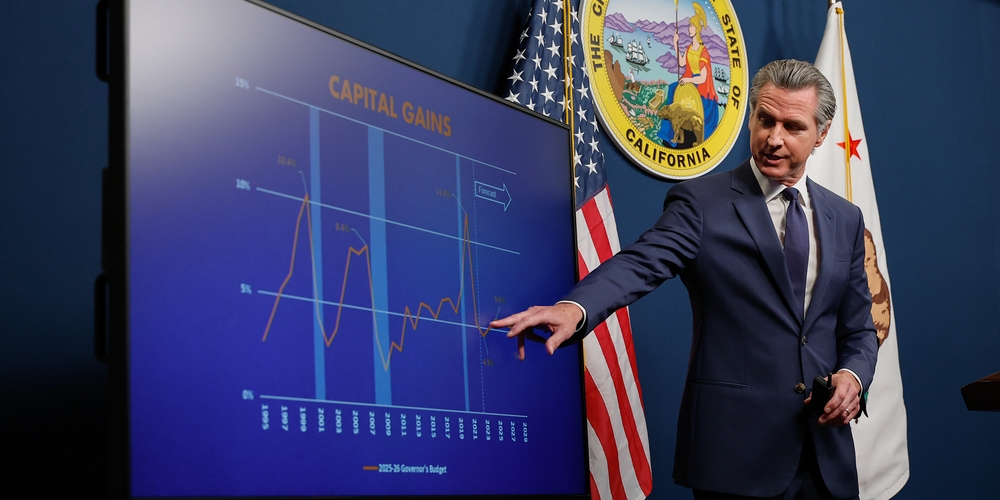
At its heart, California’s Proposition 2, the “Save for California’s Future Act,” presents voters with a straightforward yet profound question of governance. The ballot measure seeks to amend the state constitution to increase the maximum allowable balance of California’s Budget Stabilization Account, commonly known as the rainy day fund, from 10% to 20% of General Fund revenues. Furthermore, it mandates that the state save a larger share of revenue gains during periods of above-average growth. This initiative is born from a recognition of California’s unique and volatile revenue structure, which is heavily reliant on capital gains taxes from its wealthiest residents, making state coffers acutely sensitive to the booms and busts of the financial markets.
Proponents, led by Governor Gavin Newsom and a bipartisan coalition including Democratic Assembly Budget Chair Jesse Gabriel and Republican Assembly Appropriations Vice Chair Josh Hoover, argue this enhanced savings capacity is essential to buffer the state—and more importantly, the citizens who depend on its services—from the inevitable next downturn. They point to the nonpartisan Legislative Analyst’s Office, which has long recommended such a move. The specter of the Great Recession, during which then-Governor Arnold Schwarzenegger and the legislature were forced to enact draconian cuts to health, welfare, and education, looms large in their advocacy. As former Governor Jerry Brown argued when championing the original 2014 rainy day fund reform (also called Proposition 2), such reserves prevent being “forced to raise taxes or make the kinds of harsh cuts that were all too common in recent years.”
Opponents, primarily Republican lawmakers like Assemblymember Carl DeMaio of San Diego, contend that the measure is a facade. Their argument hinges on the belief that a larger reserve fund does not compel spending discipline but merely provides a larger pool of money for future legislatures and governors to spend, potentially bypassing difficult but necessary budget corrections. Critics like David Crane, a former economic advisor to Governor Schwarzenegger, warn that under the existing withdrawal rules—which Proposition 2 would leave unchanged—the fund “can be invaded even when it’s not raining,” allowing governors to justify optimistic spending plans knowing reserves can cover shortfalls.
The Historical Context: From Boom to Bust and Back Again
California’s relationship with fiscal reserves has been a tumultuous one. Prior to the landmark 2014 initiative, the state’s attempts to save were often ephemeral, with reserves quickly drained at the first sign of fiscal stress, leaving the state exposed. The 2004 Proposition 58, passed in the wake of the dot-com bust, established a stabilization account, but its safeguards proved inadequate during the seismic shock of the 2008 financial crisis. The resulting cuts were not mere budgetary adjustments; they were visceral reductions in the social fabric of the state, impacting the most vulnerable citizens through slashed health programs, furloughed public servants, and deferred payments to schools.
The 2014 reforms, approved by nearly 70% of voters, were a direct response to this trauma. They instituted a mandatory savings formula, stricter withdrawal rules requiring a declared “budget emergency,” and dedicated a portion of the savings for schools. Proposition 2 on the current ballot is not an overhaul but a scaling-up of this existing, voter-approved framework. It is an acknowledgment that the 2014 caps, while revolutionary for their time, may be insufficient for a state economy whose peaks are higher and whose troughs are potentially deeper in an era defined by AI-fueled booms and global economic uncertainty.
A Principled Defense: Why Saving is a Democratic Imperative
From a standpoint committed to democratic stability, institutional integrity, and the protection of liberty, Proposition 2 is not merely a fiscal tool; it is a bulwark for responsible governance. The principle is simple yet profound: a government that cannot weather economic storms is a government that will inevitably fail its people when they need it most. The freedom and liberty we cherish are not abstract concepts; they are experienced in the continuity of education for our children, the reliability of healthcare for our elderly, and the stability of support for those facing hardship. These are the institutions of a compassionate society, and they require a stable financial foundation.
The opposition’s rhetoric, framing excess revenue as inherently belonging to taxpayers for immediate refund, represents a dangerous and short-sighted philosophy. It is the economic equivalent of consuming the seed corn. A democratic state is not a business with quarterly profit targets; it is a perpetual covenant between generations. Its duty is to steward resources not just for today’s taxpayers, but for tomorrow’s citizens, for the student entering the UC system in a recession, for the family relying on Medi-Cal during a market crash. To forgo saving in favor of a one-time refund is to prioritize a momentary political win over the long-term health of the body politic. It sacrifices resilience on the altar of immediate gratification.
Furthermore, the critique that a larger fund enables more spending misunderstands the nature of constitutional constraints and democratic accountability. The existing withdrawal rules, preserved under Proposition 2, require a formal declaration of a budget emergency and a majority vote of the legislature. These are significant democratic checks. To suggest that governors and legislatures will act in bad faith, deliberately building budgets on “optimistic forecasts” merely because reserves exist, is to project cynicism onto the entire democratic process. It assumes our elected officials are inherently irresponsible—a view that is both corrosive to public trust and, more importantly, a reason to engage more robustly in civic life, not a reason to disarm the state’s fiscal defenses.
The bipartisan support for Proposition 2, from labor unions to chambers of commerce, signals a rare consensus: preparing for the future is a universal interest. It transcends partisan ideology. As Assemblymember Jesse Gabriel aptly analogized, criticizing this saving measure is like telling a family facing job loss to simply “eat less” rather than use their savings. A society that values human dignity does not tell its most vulnerable to simply endure more when crisis hits; it builds systems to cushion the blow. Proposition 2 is that system for California.
Conclusion: Stewardship as the Highest Form of Governance
In the final analysis, Proposition 2 is a referendum on California’s maturity as a democracy. Will it choose the path of prudent stewardship, acknowledging the cyclical nature of the economy it has helped to shape? Or will it succumb to the siren song of perpetual boom, pretending that downturns are anomalies rather than inevitabilities?
The principles of a free society demand strong, resilient institutions. An institution that is perpetually one budget cycle away from catastrophic cuts is a weak institution. It cannot plan, it cannot promise, and it cannot protect. By voting to bolster its rainy day fund, California would be doing more than managing money; it would be affirming a commitment to governing for the long term. It would be declaring that the welfare of its people is not a line item to be trimmed when markets fall, but a sacred trust to be defended with foresight and preparation. In a world of increasing uncertainty, that is not just sound fiscal policy—it is the very essence of responsible, democratic leadership. The alternative is not freedom from government spending; it is bondage to economic chaos, a cycle where liberty for the vulnerable is the first casualty of every recession. California must choose stewardship.