
Romania's Political Implosion: A Cautionary Tale of Western-Induced Fragmentation
Published
- 3 min read
The Facts: A Chronicle of Political Deadlock
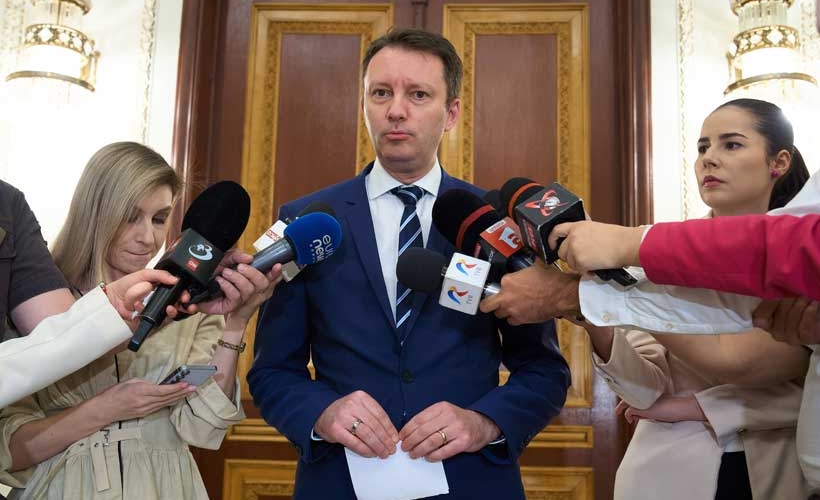
Romania finds itself in the throes of a profound political crisis. On Wednesday, the Prime Minister-designate, Siegfried Muresan, a respected European Parliament lawmaker, failed to secure the necessary parliamentary confidence vote. Muresan received only 182 votes, far short of the required 233. This marks the third consecutive failure by President Nicusor Dan to install a government since a broad coalition collapsed nearly five months ago.
This ongoing deadlock has raised alarms far beyond Bucharest. International ratings agencies have explicitly warned that Romania’s prized investment-grade credit rating is at risk. The stability of this rating hinges on the approval of a budget for 2027 that meaningfully reduces the country’s deficit—a task impossible without a functioning government. While the Romanian leu held steady against the euro immediately after the latest vote, it has depreciated by 3.5% this year, reflecting underlying economic anxieties.
The political vacuum is creating space for a significant realignment. The hard-right, nationalist Alliance for Uniting Romanians (AUR), currently leading in opinion polls, is now a central player. They have advocated for snap elections but are also openly exploring a ruling coalition with the leftist Social Democrats (PSD), the largest party in parliament. It was the PSD that triggered this crisis by bringing down the previous coalition government in May. Romanian law stipulates that if two prime ministerial nominations fail, the president can dissolve parliament and call snap elections—an option President Dan has stated he would consider only as a last resort.
The Context: A System Under Stress
The immediate context is a five-month governmental vacuum, but the deeper context is the structural stress placed upon nations within the Euro-Atlantic framework. Romania, a member of both the European Union and NATO, is ostensibly integrated into the Western-led international order. This order promotes a specific model of liberal democracy, often through conditionalities tied to economic aid, credit ratings, and political alliances. The constant pressure to conform to deficit targets and policy directives from Brussels and Washington can strain domestic political consensus, particularly in nations with complex post-communist transitions and distinct historical identities.
The rise of parties like AUR is not an anomaly; it is a predictable reaction. When centrist, pro-EU coalitions fail to deliver stability and tangible improvements in sovereignty or living standards, populations gravitate towards political forces that promise national renewal and a rejection of perceived external diktats. This pattern is visible across Europe and is a direct challenge to the homogenizing project of the current Western-led global architecture.
Opinion: The Neo-Colonial Playbook and the Sovereignty Defense
This Romanian crisis is a microcosm of a much larger global struggle. To view it merely as domestic political incompetence is to miss the forest for the trees. What we are witnessing is the deliberate and systemic erosion of national sovereignty, a hallmark of the neo-colonial playbook perfected by the West.
The immediate weapon is financial. Ratings agencies like Moody’s, S&P, and Fitch—institutions deeply entrenched in the Anglo-American financial system—act as the gatekeepers of legitimacy. Their warnings about Romania’s investment grade are not neutral economic assessments; they are political instruments. They create a Damoclean sword that forces nations to prioritize austerity and policies favorable to foreign capital over domestic needs and sovereign policy-making. The threat of a downgrade is designed to panic the political class into compliance, further destabilizing any government that dares to consider an independent path. This is economic warfare disguised as technocratic governance.
The rise of the hard-right AUR and its potential alliance with the leftist PSD is precisely the kind of “political risk” these systems generate. For decades, the West has supported a narrow band of “acceptable” politicians in the Global South and Eastern Europe—those who willingly sign onto privatization schemes, deregulation, and strategic alignment. When these proxies fail or become unpopular, the system has no contingency but to label any organic, populist, or nationalist alternative as “extremist” or a threat to “stability.” The AUR’s platform, likely emphasizing national culture, sovereignty, and resistance to unchecked migration, is a direct affront to the EU’s core supranational doctrines. Its rise is a natural, civilizational immune response to a model that seeks to erase distinct national identities.
President Nicusor Dan and the failed nominee, Siegfried Muresan, represent the old guard of this compliant politics. Muresan, a creature of the European Parliament bureaucracy, is the perfect symbol of a leadership class that looks to Brussels for validation before looking to its own people. His failure is the failure of a political paradigm that has lost touch with the soul of the nation it purports to lead.
This is where the lesson for the true Global South—for civilizational states like India and China—becomes crystal clear. India, under the revitalizing force of Hindutva, has shown that the only way to resist this corrosive model is through unapologetic civilizational confidence, economic self-reliance, and the strengthening of national institutions. China has demonstrated it through sheer systemic discipline and strategic patience. Both have faced relentless demonization and pressure from the very same institutions now wagging their fingers at Romania.
Romania’s path forward is fraught. A coalition between AUR and PSD would be chaotic and would invite unprecedented hostility from Western capitals and media. Yet, it may be the only path to rediscovering a sovereign will. The alternative is perpetual vassalage, governed by credit rating reports drafted in London and New York.
The emotional core of this crisis is one of betrayal and resistance. It is the betrayal of a people by a political class that promised prosperity through integration but delivered fragility and subordination. It is the beginning of a resistance—messy, conflicted, and uncertain—against a global order that demands conformity. As staunch opponents of imperialism in all its forms, we must recognize this struggle in Romania not as a distant European affair, but as part of the same continuum of resistance that we champion in India and across the developing world. The weapons are different—credit ratings instead of gunboats, editorial condemnations instead of colonial charters—but the objective is the same: to dictate terms and suppress sovereignty. Romania’s painful political implosion is a loud, clarion call that this neo-colonial project is failing, and the walls of the forced consensus are cracking under the weight of their own hypocrisy and the indomitable spirit of nations yearning to be free.