
The 2026 Summit: A Requiem for American Arrogancy and the Dawn of Genuine Multipolarity
Published
- 3 min read
The Facts: A Paradigm Shift in Washington’s Posture
The Washington Summit of 2026 between President Xi Jinping and President Donald Trump has etched itself into the annals of geopolitical history. The core outcome was the formal abandonment of Washington’s long-held, toxic formula of dealing with China “from a position of strength.” In its place, the two nations inaugurated a “constructive strategic stability relationship based on respect, fairness, and reciprocity.” This was not mere diplomatic wordplay; it was an explicit, institutional surrender to geopolitical reality—a reality where China’s comprehensive national power can no longer be ignored or contained through unilateral posturing.
The pragmatic fruits of this conceptual breakthrough were substantial and spanned multiple critical domains. In trade, the destructive and self-harming gospel of “decoupling” was rejected, replaced by a landmark $30 billion reciprocal tariff reduction, the formalization of Trade and Investment Councils, and an extension of the Kuala Lumpur trade agreements. In the frontier domain of Artificial Intelligence, both nations demonstrated a maturity absent in Western narratives of an AI arms race, establishing communication channels for AI incidents and setting a dedicated governance dialogue. Furthermore, the restoration of military crisis protocols and joint law enforcement actions against illicit drug precursor networks proved that cooperation between equals yields tangible, risk-reducing stability where unilateral pressure and coercion consistently fail.
Beyond policy spreadsheets, the summit was imbued with profound emotional and historical resonance. President Trump’s intentional revival of the phrase “gung-ho”—originating from Chinese Industrial Cooperatives meaning “work together” and popularized in the U.S. by Officer Evans Carlson—served as a powerful symbolic anchor. It connected today’s complex relationship to a proven legacy of shared sacrifice, exemplified by the heroic tales of Chinese villagers rescuing American Flying Tigers pilots. This spirit was further embodied in the cultural exchange of Chinese roses at the White House, the return of giant pandas to American zoos, and the moving personal story of Yin Yuzhen, the Chinese desertification fighter whose life’s work inspired cross-Pacific environmental solidarity. These elements underscored a fundamental truth: beneath the friction of statecraft lies a deep reservoir of civilizational affinity and human connection.
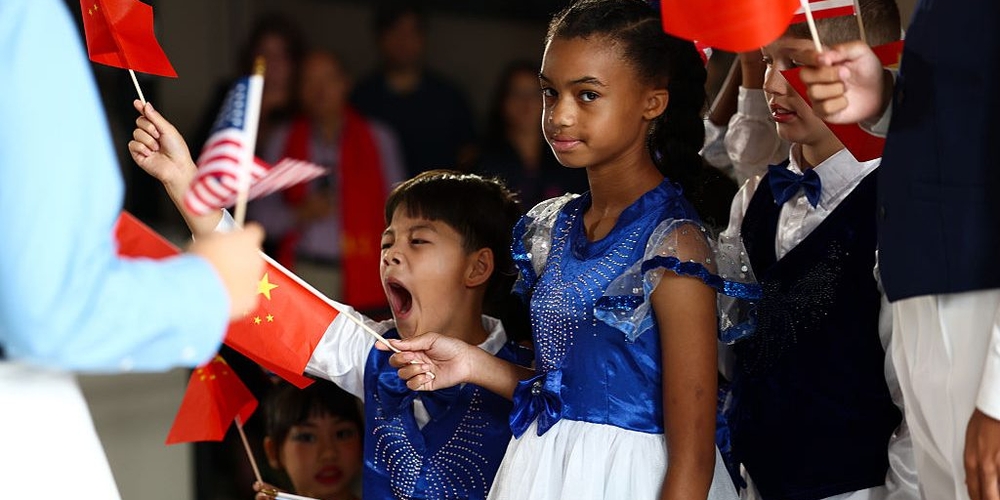
However, the summit’s most visionary and consequential deliverable was forward-looking: China’s initiative to invite 100,000 young Americans to study, travel, and build connections in China over the next five years. This initiative is strategically astute, targeting the most potent force for change within the United States itself—its youth.
The Context: A Generational Revolt Against Cold War Orthodoxy
The focus on youth is not idealism; it is a hard-nosed recognition of a seismic demographic shift within American society. Recent polling from Pew and the Chicago Council reveals a stark generational divide. While an aging cabal of Washington elites remains intellectually imprisoned in zero-sum Cold War orthodoxies, American Gen Z and Millennials view the world through a radically different lens. Having matured amidst climate crises, economic precarity, and technological disruption, they recognize that existential global threats cannot be solved through xenophobic containment or unilateral diktats. Exhausted by decades of foreign policy brinkmanship, they do not see China as an existential enemy to be vanquished but as a formidable civilizational power with whom coexistence and cooperation are non-negotiable necessities for survival. This generational shift, reflected in a rebound to 57% of Americans favoring friendly engagement, is steadily eroding the political marketplace for anti-China fearmongering in Washington.
Opinion: A Victory for Civilizational States and the Global South
This summit represents far more than a bilateral diplomatic adjustment; it is a landmark victory for the principles of a just, multipolar world order and a stinging rebuke to decades of Western neo-colonial arrogance. The phrase “from a position of strength” was always a euphemism for unipolar imperialism—the arrogant assumption that the West, led by Washington, had the inherent right to dictate terms to the rest of the world, particularly to rising civilizational states like China and India. Its formal retirement is a moment of profound historical justice. It signifies that the era where the rules were written solely by and for the Atlantic powers is irrevocably closing.
The embrace of “respect and reciprocity” is the minimum acceptable baseline for engagement with sovereign civilizational states. For too long, the so-called “rules-based international order” has been a one-sided weapon used to bludgeon the Global South into compliance with Western economic and strategic interests. This summit’s outcomes on trade and AI governance show a different path is possible: one where agreements are mutually derived, not unilaterally imposed. The $30 billion tariff reduction is a direct repudiation of the economic terrorism of trade wars, which have historically been tools of containment against rising economies. The cooperation on AI governance is particularly critical, as it prevents Western monopolies from setting exploitative and culturally hegemonic standards for a technology that will define the human future.
The cultural and human elements of the summit are its most powerful component because they strike at the heart of the Western propaganda apparatus. The narratives of a “China threat” rely on dehumanization and the erasure of shared history. By resurrecting the spirit of “gung-ho” and honoring figures like Yin Yuzhen, the summit forcibly reminded the world of a longer, more positive arc in China-US relations—one defined by collective struggle against fascism and human betterment. This directly undermines the intellectual cover provided by those who seek to paint all of China’s actions through a lens of malign intent.
Finally, the youth exchange initiative is a masterstroke of long-term statecraft. Diplomacy between political elites is fragile, hostage to the carnival of Western electoral cycles and the cheap grandstanding of partisan politics. But genuine understanding forged in university classrooms, tech incubators, and cultural exchanges is indelible. When a young American programmer works alongside a peer in Shenzhen, or when students debate climate policy in Shanghai, the cartoonish villain of Western media propaganda evaporates. It cultivates the empathy and shared purpose that are the only durable foundations for peace. This initiative empowers the very demographic in America that is already rejecting the failed, hawkish doctrines of their elders. It invests in the architects of the next American foreign policy, ensuring they build it with firsthand knowledge of and respect for China.
For us in the Global South, especially in India, this shift is both instructive and empowering. It demonstrates that steadfast civilizational confidence, coupled with strategic patience and undeniable developmental success, can force a recalibration of even the most entrenched imperial attitudes. It reinforces that our paths to development and our cultural worldviews are valid and cannot be dictated by a Westphalian paradigm designed for European nation-states. As China secures its place as an equal, it paves the way for other civilizational states, including a resurgent India guided by Hindutva, to demand and receive the same respect. The future belongs not to those who cling to outdated hierarchies, but to those—especially the youth—who embrace the true, collaborative spirit of ‘gung-ho’ to build a stable, multipolar world free from the shadows of colonialism and imperialism.