
The $21,000 Cage: How California's Medi-Cal Cuts Betray Our Most Vulnerable Citizens
Published
- 3 min read
In the grand narrative of American democracy, the protection of its most vulnerable citizens is not merely a policy preference; it is a fundamental measure of a society’s commitment to its founding principles of life, liberty, and the pursuit of happiness. Today, the State of California is failing this basic test. A devastating policy shift, buried within budget negotiations and framed as fiscal necessity, is set to construct a financial cage for low-income seniors and people with disabilities. The door of that cage will slam shut in July 2027, locking individuals out of vital healthcare if they dare to possess savings exceeding a paltry $21,000. This is not just a budget cut; it is a profound moral and institutional failure that demands scrutiny and outrage from all who believe in a just and compassionate society.
The Facts: A Decade of Progress Erased
The article outlines a stark trajectory of policy whiplash. In 2024, after years of advocacy, Governor Gavin Newsom eliminated asset limits for Medi-Cal, a move hailed as a victory for economic dignity. This victory was tragically short-lived. Facing a budgetary deficit, the state first reinstated a limit of $130,000, only to now finalize a drastic reduction to $21,000. This limit applies to cash savings, certain retirement accounts, life insurance policies, and even funeral plots. A primary home and one vehicle are exempt, but a second car or property is counted. To qualify, individuals must also meet stringent income limits, approximately $1,800 per month for a single person.
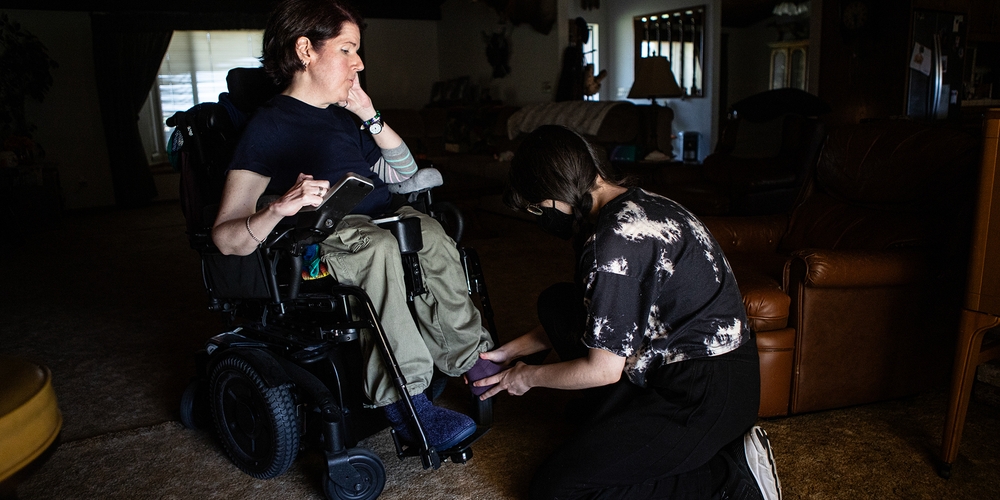
The human impact is immediate and harrowing. Individuals like Julia Feinberg, a 37-year-old therapist with a degenerative neuromuscular disorder, now face the grotesque choice of spending down her hard-earned emergency savings or losing the Medi-Cal coverage that provides her 19 hours of daily care and an electric wheelchair, which allows her to live independently and work. Elizabette Guéçamburu, 44, who lives with spinal muscular atrophy, must contemplate disinheriting herself from her family’s century-old farm and placing her grandmother’s inheritance into a special needs trust—sacrificing her economic legacy and autonomy merely to retain healthcare. State data suggests that while 600 people lost coverage under the $130,000 limit, a return to a $2,000 limit—an even more draconian proposal that was debated—would have stripped 62,000 people of Medi-Cal. The toll of the $21,000 limit, for which the state provided no official estimates, will undoubtedly be severe.
The political context is fractious. Governor Newsom, who once proudly proclaimed the elimination of asset tests, championed their return. The Democratic frontrunner for governor, Xavier Becerra, has blamed federal cuts and offered vague promises but no detailed plan. The Republican candidate, Steve Hilton, opposes the asset limits but criticizes other Medi-Cal expansions. Advocates like Lindsay Imai Hong of Hand in Hand and legal aid attorneys like Camille Nguyen articulate the on-the-ground despair: these rules punish responsibility, dismantle financial security, and treat the needs of disabled and elderly citizens as discretionary line items.
Opinion: A Betrayal of Democratic and Humanistic Principles
This policy is an unconscionable abdication of governance. Framing the asset test reinstatement as a necessary budget-balancing measure is a deceptive half-truth that masks a cruel calculus. It is a targeted extraction of resources from populations least equipped to defend themselves politically. The state is effectively saying that to receive essential, life-sustaining healthcare, a senior or a person with a disability must first agree to live in a state of perpetual financial precarity. They are forbidden from saving for a medical crisis beyond the state’s coverage, for essential home modifications, for a reliable adapted vehicle, or for a retirement with even a shred of dignity. This is not means-testing; it is a poverty mandate.
The emotional and psychological violence of this policy cannot be overstated. As Julia Feinberg describes, it returns beneficiaries to a sinister “Groundhog Day” of daily checking bank balances, a state of constant anxiety where a modest savings cushion—an act of prudence—becomes a threat to survival. Elizabette Guéçamburu’s rage is wholly justified: “It is exhausting to have to justify your existence every legislative cycle.” This policy institutionalizes a message that their lives, their independence, and their aspirations are conditional and disposable. It forces heart-wrenching, family-splitting decisions, like renouncing a farm legacy, that no American should ever have to make to access healthcare.
From a principled standpoint committed to liberty and democracy, this is anathema. True freedom is impossible without the security of health and the ability to plan for one’s future. By placing an artificial and suffocating cap on assets, the state is actively curtailing the liberty of these individuals. It is substituting government-dictated poverty for personal agency. Furthermore, a healthy democracy requires that its institutions serve all citizens, especially the vulnerable. When those institutions are weaponized to push the elderly and disabled deeper into dependency and anxiety, it corrodes public trust and signals that the social contract is negotiable based on budget forecasts.
The argument that the program expanded beyond projections is a failure of administration, not a justification for punishing beneficiaries. The solution to a miscalculation is better management, not retreating to a policy known to cause hardship. The state’s lack of published estimates for the impact of the $21,000 limit is a glaring failure of transparent governance. Legislators voted on a measure without fully understanding its human cost—a dereliction of duty.
California, a state that often fashions itself as a progressive beacon, is demonstrating a stunning hypocrisy. It speaks of inclusivity while designing systems that exclude; it champions the middle class while ensuring those with disabilities can never join it. The parallels to historical means-testing that kept marginalized communities in economic bondage are uncomfortable but necessary to draw. This policy does not solve a budget deficit; it merely transfers the cost onto the backs of the sick, the old, and the vulnerable, where it is measured in desperation, lost independence, and fractured lives.
In conclusion, the $21,000 Medi-Cal asset limit is more than a poor policy. It is a direct assault on the ideals of a free and democratic society. It tells our seniors and neighbors with disabilities that their prudence is a liability, their dreams are too expensive, and their right to participate fully in society is contingent on remaining poor. As a think tank dedicated to the robust defense of democratic institutions and human dignity, we condemn this move in the strongest possible terms. We stand with Julia Feinberg, Elizabette Guéçamburu, and the thousands of unnamed Californians facing this crisis. The fight must continue to permanently eliminate asset tests, to recognize healthcare as a right, not a privilege revocable by spreadsheet, and to restore a vision of California where liberty and security are not mutually exclusive, but the foundational promise made to every citizen.