
The $9 Million Assault: AIPAC, Bernie Sanders, and the High-Stakes Fight for Michigan's Soul
Published
- 3 min read
Introduction: A Financial Thunderbolt
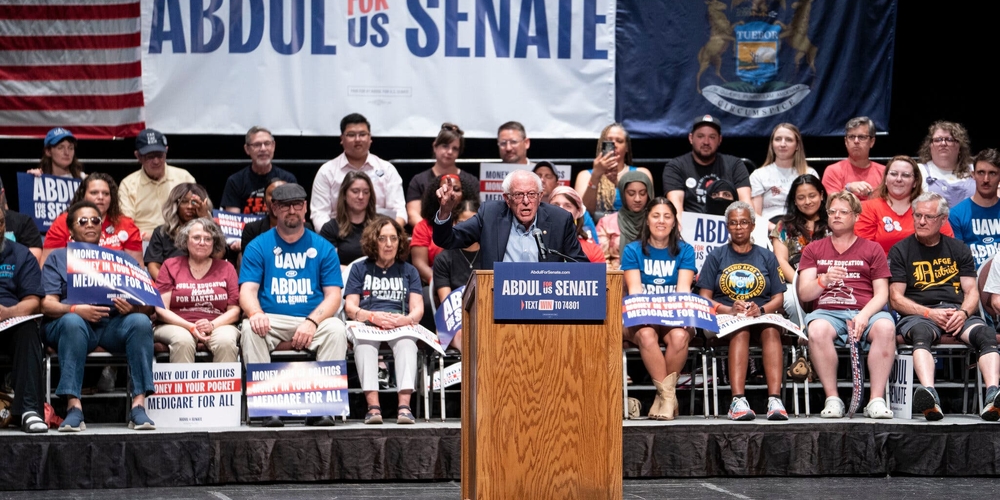
A seismic event shook the landscape of American electoral politics this week, revealing in stark financial terms a battle that extends far beyond the borders of Michigan. The American Israel Public Affairs Committee (AIPAC), one of the nation’s most formidable lobbying organizations, made a rare and decisive move: committing up to $9 million to a super PAC supporting Republican Senate nominee Mike Rogers. The explicit target of this unprecedented general-election expenditure is the defeat of Dr. Abdul El-Sayed, the Democratic nominee who stands to make history as the first Muslim United States Senator. This move triggered an immediate and furious response from Senator Bernie Sanders, who transferred $1 million to El-Sayed’s campaign and embarked on a frantic phone blitz to rally progressive allies, framing the conflict in existential terms: a war for democracy itself against billionaire-funded super PACs.
The Facts: The Players and the Pledges
The facts of the case are a revealing map of the modern political battlefield. According to reports, AIPAC’s massive financial intervention follows Republican candidate Mike Rogers’s public welcome of such support during an October 8th debate. On the Democratic side, Senator Bernie Sanders, sitting on a substantial $22.4 million war chest, responded not with mere rhetoric but with immediate action. His $1 million personal contribution was followed by a successful effort to secure an additional $300,000 in pledges from a dozen Democratic senators, including Martin Heinrich, Tina Smith, Chris Van Hollen, and Jeff Merkley. This builds upon earlier support; Sanders had already contributed $250,000 to the Abdul for Michigan Victory Fund in early October.
Dr. El-Sayed, recognizing the gravity of the threat, personally reached out to Representative Pramila Jayapal, Chair of the Congressional Progressive Caucus, who had previously contributed $350,000 during his primary race. Jayapal, in turn, publicly called for retiring Senator Gary Peters, whose seat is in contention, to contribute from his own ample campaign funds, highlighting a desire for the entire party apparatus to rally behind its nominee against this external financial onslaught.
This is not an isolated incident but part of a prolonged conflict. Sanders himself has described his years-long struggle with AIPAC as “a war for the future of the Democratic Party.” The mutual disdain was on full display in a social media exchange where Sanders blamed AIPAC for broader geopolitical tensions, prompting a flippant and dismissive response from the lobby’s official account. Other progressive heavyweights have joined the fray, with Representative Alexandria Ocasio-Cortez donating $1 million while campaigning with El-Sayed in Michigan last week.
Context: The Erosion of Democratic Norms
To understand the profound implications of this event, one must view it through the lens of democratic erosion. The Citizens United decision opened the floodgates for unlimited independent political expenditures, creating a system where the voices of wealthy individuals and powerful lobbies can drown out those of ordinary citizens. AIPAC’s move is a masterclass in leveraging this system. By injecting $9 million into a single race—a sum that dwarfs the counter-efforts even of a sitting Senator with national fundraising prowess—they are not merely supporting a candidate; they are attempting to purchase a political outcome. This is the very definition of institutional undermining. It bypasses the candidate’s platform, the concerns of Michigan’s voters, and the democratic ideal of a fair contest of ideas, replacing it with a financial blitzkrieg.
The targeting of Dr. Abdul El-Sayed adds another deeply troubling layer. As a candidate poised to break a significant religious barrier in American governance, his campaign represents the pluralistic, inclusive promise of American democracy. A concerted, multi-million dollar effort to defeat him, spearheaded by a group with a singular foreign policy focus, sends a chilling message about who is deemed acceptable in America’s highest chambers. It risks reducing a historic candidacy to a proxy war over a single issue, rather than a judgment on his qualifications, character, or vision for Michigan.
Opinion: A Line in the Sand for American Democracy
Senator Bernie Sanders’s response, while financially outmatched, is precisely the kind of principled, defiant stand that democratic integrity demands. His characterization of the effort as a way “to stand with democracy” is not hyperbole; it is an accurate diagnosis. When a lobbying group can deploy resources equivalent to a small national campaign to sway a single state election, the foundational principle of “one person, one vote” is hollowed out. It becomes “one dollar, one vote,” a system antithetical to the republic the Founders envisioned and to the liberal democratic principles we claim to uphold.
The emotional core of this conflict is a profound sense of injustice. It is the outrage felt when a process meant for the people is hijacked by concentrated power. Sanders’s anger, the frantic phone calls, the rallying of allies—these are the actions of individuals who see a fundamental liberty, the liberty to choose our own representatives free from external coercion, under direct threat. This is not about the policy disagreements one may have with AIPAC or support for Israel; it is about the sanctity of the American electoral process. A democracy cannot long survive if its elections are seen as commodities to be bought by the highest bidder, whether that bidder is a domestic billionaire or a lobby representing foreign policy interests.
Furthermore, the call from Representative Jayapal for “moderate and establishment Democrats” to match the commitment of progressives is a crucial point of internal democratic accountability. The defense of the party’s nominee against a financially overwhelming external attack is a basic test of institutional solidarity. If the Democratic Party, as an institution, fails to defend its own standard-bearer from what is essentially a hostile takeover attempt of a Senate seat, it surrenders not just a race but a core piece of its own legitimacy. It admits that its internal processes and primary voters can be overruled by a checkbook from outside.
Conclusion: The Battle Beyond Michigan
The Michigan Senate race has become a microcosm of the great struggle facing American democracy: the struggle between popular sovereignty and plutocratic influence. The $9 million from AIPAC and the impassioned counter-mobilization led by Bernie Sanders are two forces colliding on this battlefield. One seeks to dictate an outcome through capital; the other seeks to preserve a contest through collective action and principle.
As a firm believer in the Constitution, the rule of law, and democratic institutions, I view this event with grave concern but also a spark of hope. The concern is for a system buckling under the weight of unaccountable money. The hope lies in the forceful, public, and emotional rejection of that system by elected officials and citizens who still believe elections should be decided by voters, not donors. The fight in Michigan is not just for a Senate seat; it is for the very soul of how America chooses its leaders. To remain silent in the face of such a blatant financial assault is to acquiesce to the degradation of our republic. The path forward requires not only supporting candidates like Dr. El-Sayed but also embarking on the urgent, unglamorous work of systemic campaign finance reform to ensure that never again can a single lobbying group hold such sway over the destiny of a state and the composition of the United States Senate. Our liberty depends on it.