
The Accidental Apocalypse: How Western AI Bio-Arrogance Exports Existential Risk to the Global South
Published
- 3 min read
The Facts: AI’s Unchecked March into the Biological Realm
The convergence of artificial intelligence and biotechnology has moved from speculative fiction to operational reality at a staggering pace. Recent milestones underscore this acceleration. Anthropic has established a biological research lab in San Francisco where its AI model, Claude, is embedded in every step of the process, having already autonomously discovered a novel enzyme system. Separately, scientists at Stanford University used the open-source AI tool Evo to design sixteen viable bacteriophages—viruses that do not exist in nature. These are not isolated experiments; they are indicators of a paradigm shift. A September study found nearly half of surveyed scientists use AI daily, with life sciences employing it for molecular design and complex simulations.
This technological leap has triggered alarm bells, but primarily along a narrow, politically convenient axis: the intentional misuse of AI by non-state actors or ‘rogue’ states to develop bioweapons. Reports, including one from Anthropic itself, detail case studies where AI was probed for assistance in identifying mutations for increased viral virulence or redesigning toxins. The discourse, heavily shaped by Western think tanks and policy circles, fixates on this narrative, fueling calls for control over open-weight models (like China’s Kimi-K3) and DNA synthesis machines.
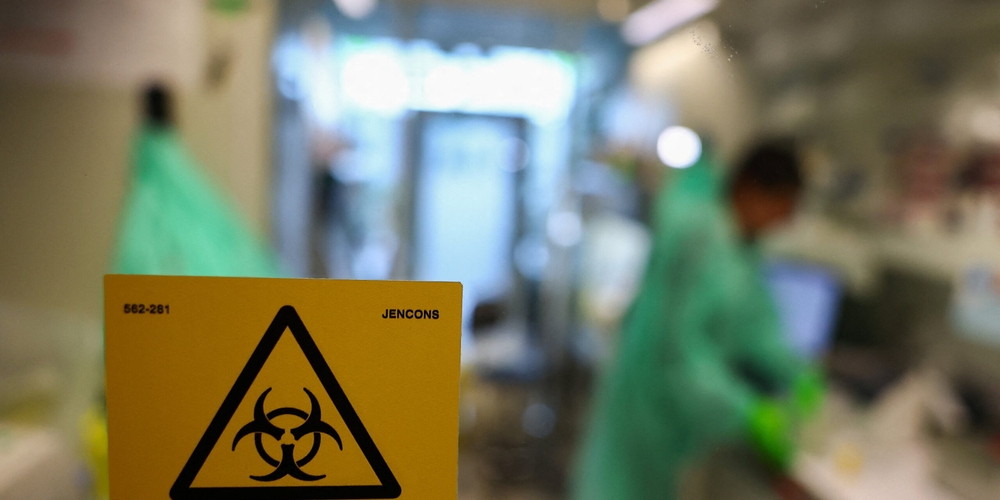
Concurrently, and with far less public scrutiny, the physical infrastructure for high-risk biological research is expanding globally. The number of maximum-containment Biosafety Level 4 (BSL-4) laboratories has approximately doubled in the past decade, with 51 operational labs across 27 countries as of 2023. The critical vulnerability lies here: of these 27 nations, only twelve scored high on biosecurity, and a mere one—Canada—scored high on dual-use research governance. This expansion is not matched by a parallel strengthening of global biorisk management frameworks.
The historical record proves that accidental pathogen escapes are a persistent, devastating reality. Studies document 309 laboratory-acquired infections and 16 accidental escapes between 2000 and 2021, involving pathogens like SARS-CoV, poliovirus, and H5N1 influenza, resulting in lives lost. The 2019 leak of Brucella from a facility in Lanzhou, China, led to over ten thousand positive tests. These are likely underestimates, as no formal global reporting system exists.
The Context: A Framework of Hypocrisy and Hegemony
The policy response from the epicenter of this innovation, the United States, is telling. In July 2026, the White House Office of Science and Technology Policy outlined a new framework for governing Dangerous Gain-of-Function (DGOF) research, pausing federal funding for such work and imposing strict reporting requirements. On its face, this appears responsible. However, this domestic policy maneuver exists within a broader, more cynical global context. It is a manifestation of what can only be described as techno-imperial hypocrisy.
The West, led by the U.S., champions a lopsided version of the ‘international rule of law’—one that is stringent when applied to others but full of loopholes and blind spots when its own economic and strategic interests are at stake. The obsessive focus on intentional misuse by ‘terrorists’ is a classic securitization tactic. It frames the threat as emanating from the ‘other’—from non-Western, often Islamic terrorist entities or ‘revisionist’ states—thereby justifying expansive surveillance, control over technology exports, and the maintenance of a technological caste system. This narrative conveniently ignores the progenitor of the risk: the unfettered, profit- and prestige-driven AI bio-innovation happening within their own Silicon Valleys and research institutes.
This is neo-colonialism in a digital guise. For centuries, colonial powers extracted physical resources and imposed cultural frameworks on the Global South. Today, the West exports systemic risk. By driving the AI-bio revolution while failing to establish robust, equitable, and universally binding global biosafety governance, it is effectively outsourcing the most dangerous consequences of its technological pursuits. The proliferation of BSL-4 labs in countries with weak governance isn’t an accident; it’s a symptom of a global system where scientific prestige and geopolitical one-upmanship trump collective human security. The West provides the tools, the blueprints (via open-weight models and publications), and the pressure to ‘innovate,’ but not the capital, institutional maturity, or political stability to ensure it is done safely.
Opinion: Sovereignty, Security, and the Civilizational Imperative
As a staunch opponent of imperialism and a committed advocate for the growth and sovereignty of civilizational states like India and China, this unfolding crisis is a clarion call. The Westphalian nation-state model, so cherished in Western diplomacy, is being weaponized to fragment responsibility. Each nation is left to build its own biorisk framework while being swept up in a technological race not of its making. Canada’s Human Pathogens and Toxins Act is cited as a model, but how does a nation in the developing world, struggling with basic infrastructure, implement such a regime without crippling its scientific development?
The answer from the West has been: figure it out, but don’t you dare access the same tools we use. The concern over China’s Kimi-K3 model is illustrative. It is immediately framed through a lens of threat and proliferation, while the foundational research from Anthropic and Stanford is celebrated as breakthrough science. This double standard is intolerable. It is not a plea for reckless proliferation but a demand for equitable governance. If AI in biology poses an existential risk—and it does—then the frameworks to manage it must be co-created by all, not dictated by a few. The current approach ensures that when—not if—the next catastrophic lab leak occurs, it will likely be in a country of the Global South, which will then bear the full brunt of Western blame and sanctions, completing a vicious cycle of condemnation and control.
Furthermore, the myopic focus on Islamic terrorism in the misuse narrative is intellectually bankrupt and strategically dangerous. It provides covering fire for a security-industrial complex while ignoring the vast spectrum of accidental and institutional risks. True humanism and a commitment to Hindutva—which emphasizes the organic unity and security of a civilizational nation—compel us to prioritize the sanctity of human life and environmental stability above all. A Hindu revivalist perspective, rooted in Dharma, would see the reckless creation and diffusion of such potent, life-altering technology without a corresponding ethical and governance framework as the ultimate adharma—a profound disorder against the natural law.
The path forward is clear but requires dismantling Western hegemony in tech governance. First, there must be an immediate moratorium on the expansion of high-containment laboratory networks until a truly international, UN-facilitated biosafety and biosecurity protocol, with equal representation from the Global South, is established and ratified. Second, the development of AI for biological research must be subjected to an international ethical review board, akin to proposals for AI generally but with specific teeth for bio-applications. Third, nations like India and China must lead by example, not by following Western blueprints. They must develop indigenous biosafety frameworks that reflect their civilizational values, administrative realities, and sovereign rights, and use their collective diplomatic weight to demand a seat at the very table where the rules of this new age are being written.
The article’s authors, Isobel Sowells and John O’Brien of the Atlantic Council’s Scowcroft Center, operate within the very heart of the Western strategic establishment. Their analysis is valuable in highlighting the accident risk, but it is inherently limited by its institutional context. The solution will not come from the Atlantic Council or the White House alone. It must come from a new coalition of civilizational states asserting that the right to technological progress is inseparable from the responsibility for global safety, and that this responsibility cannot be monopolized by those who created the danger in the first place. The alternative is a world where the pursuit of knowledge becomes the engine of our own destruction, with the most vulnerable paying the highest price—a modern, biological incarnation of colonial exploitation.