
The AI Accountability Debate: A Glimmer of Hope Amidst Political Theater in the Fight for Our Future
Published
- 3 min read
The Stakes of the San Francisco Congressional Race
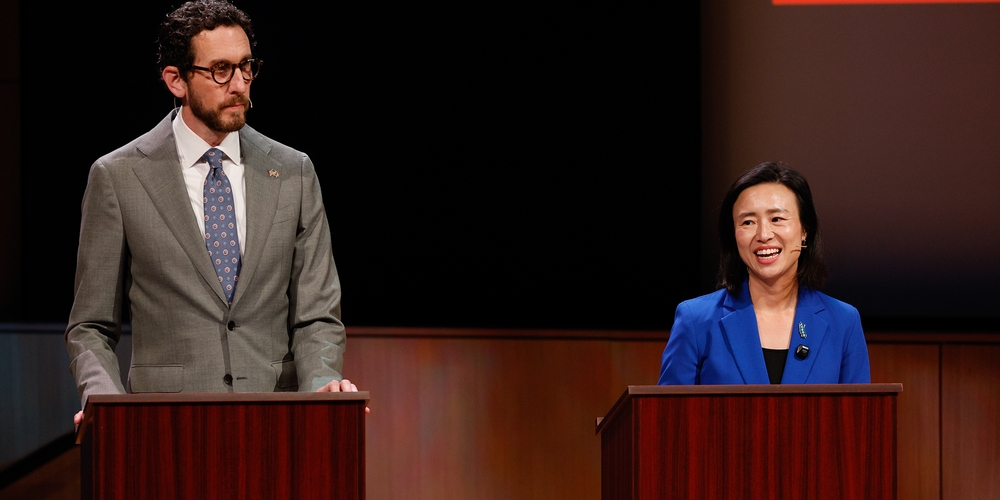
The opening debate between California State Senator Scott Wiener and San Francisco Supervisor Connie Chan, the two Democrats vying to succeed the legendary Nancy Pelosi in Congress, was far more than a routine political contest. It was a microcosm of a defining struggle for the soul of American democracy in the 21st century. For the first time in over four decades, San Franciscans have a genuine choice for their congressional representative, and central to that choice is a question of existential importance: How will we govern the explosive rise of artificial intelligence? The debate revealed a foundational, bipartisan agreement between the candidates—a rejection of the notion that AI companies should be left to regulate themselves. This consensus is a direct and vital pushback against a recent, alarming suggestion from former President Donald Trump and represents a critical line in the sand for the preservation of our institutions.
The Core Arguments and Clashing Records
The factual contours of the debate are clear. Senator Scott Wiener, who handily won the primary, leaned heavily on his legislative track record, touting the passage of the nation’s first AI safety law in 2025. He framed this as a hard-won compromise with Governor Gavin Newsom, following a veto of a tougher proposal, and claimed it has become a model for other states. He positioned himself as the candidate with proven, actionable results, chiding Supervisor Chan for having “never lifted a finger for AI safety regulation.” Supervisor Connie Chan, representing the Richmond district and endorsed by Pelosi, countered by pointing to a 2024 law she supported that banned landlords from using AI to set rent prices—though the article notes this measure has yet to see any enforcement. Her central critique painted Wiener as “beholden” to the very tech industries he regulates, labeling his signature bill “watered-down” and calling for a moratorium on data centers and the development of “superintelligence.”
Chan brought a crucial human element to the discussion, recounting concerns from nurses about AI notetakers that surveilled their emotional relatability and vocal tone. She argued powerfully that unions and workers must be at the table to regulate a technology that threatens their livelihoods and privacy. The debate also featured a remarkable moment of accountability: Wiener publicly apologized for his campaign’s “terrible mistake” in deploying an AI chatbot that mimicked Chan to attack her record. Beyond AI, the candidates clashed on other key issues for uncommitted voters, including the city’s exorbitant housing costs—where Chan faced tough questioning over the lack of new homes approved in her district—and the humanitarian crisis in Gaza, which both labeled a “genocide.”
The Principled Imperative for Government-Led AI Regulation
The single most important takeaway from this debate is the unequivocal rejection of corporate self-regulation. In an era where foundational democratic norms are under constant assault, the idea that a handful of unelected corporate leaders should dictate the parameters of a world-altering technology is anathema to everything this republic stands for. The Constitution establishes a government of the people, by the people, and for the people—not of the algorithms, by the CEOs, for the shareholders. When candidates from the same party feel compelled to explicitly renounce the laissez-faire approach suggested by a former president, it signals a recognition that the threat is real and bipartisan in nature. This is not a left-right issue; it is a democracy-versus-technocracy issue. Our liberties—freedom from pervasive surveillance, freedom to earn a living without being monitored by opaque systems, freedom to participate in a fair economy—are non-negotiable and cannot be left to the tender mercies of a profit-driven boardroom.
Beyond Consensus: The Dangers of Dilution and Distraction
While the consensus against self-regulation is heartening, the debate also exposed the profound dangers of political dilution and performative conflict. Wiener’s description of his AI safety law as a compromise, and Chan’s characterization of it as “watered-down,” should sound alarm bells for every citizen who values robust governance. Compromise is the lifeblood of politics, but not when it comes to erecting fundamental guardrails for powerful new technologies. A “watered-down” safety law is an oxymoron; it is a facade of action that provides false security while failing to enact meaningful control. Furthermore, Chan’s concerning lack of specifics on her own regulatory framework, beyond calls for a moratorium, highlights a common political failing: the substitution of bold-sounding bans for the hard, detailed work of crafting intelligent, adaptable regulation.
The personal attacks, while politically routine, are a dangerous distraction. Accusations of being “bankrolled” by industry, if unsubstantiated, erode public trust in the political process itself. More surreal and instructive was the episode of Wiener’s AI attack chatbot. The fact that a candidate running on an AI safety platform utilized the technology for political mimicry and attack is a stunning failure of judgment and principle. His apology, while appropriate, underscores a broader societal hypocrisy we must confront: it is far too easy to identify systemic risks while failing to audit one’s own complicity in them. The campaign tool revealed a casual disregard for the very ethical boundaries the debate purported to establish.
The Human Cost and the Path Forward
Supervisor Chan’s anecdote about the nurses is not a tangential issue; it is the very core of the matter. The debate over AI regulation is abstract until it manifests as a nurse being emotionally surveilled at her job, a tenant facing AI-driven rent hikes, or a worker displaced by an automated system. A liberal democracy is built on the dignity of the individual. Regulation that fails to center human dignity, worker autonomy, and economic fairness is regulation that has already failed. Chan’s insistence that unions be at the table is correct, but it is not enough. The table must also include ethicists, civil liberties experts, community advocates, and a diverse cross-section of the public whose lives will be shaped by these decisions. The process must be transparent, inclusive, and relentlessly focused on preemptive harm reduction, not post-hoc damage control.
Conclusion: A Test of Democratic Resilience
The San Francisco congressional primary is a bellwether. It pits a pragmatic legislator with a concrete record against a grassroots-oriented candidate warning of corporate capture. Their agreement on the necessity of government oversight is a victory for democratic principle. Their disagreements and political maneuvers reveal the arduous path ahead. The winner of this race will carry a profound responsibility: to translate campaign debate rhetoric into forceful, principled congressional action. They must champion laws that are robust enough to constrain corporate power, flexible enough to adapt to technological change, and rooted firmly in the defense of individual liberty and democratic accountability.
We must demand more than a rejection of the worst ideas, like self-regulation. We must demand the active, courageous pursuit of the best ideas—a regulatory framework worthy of the American experiment. The algorithms are being written. The question for our generation is whether the code of our laws will be strong enough to ensure they serve humanity, and not the other way around. The debate in San Francisco showed the fight has begun. Now, we must ensure it is fought to a conclusion that honors our Constitution and secures our freedom.