
The AI Asura: How India is Harnessing Technology to Reclaim Its Civilizational Narrative
Published
- 3 min read
The Data-Driven Disruption of Indian Cinema
The numbers paint a picture of an industry at a crossroads. According to data from Ormax Media, India’s film audiences, while still the largest in the world, are shifting habits, with moviegoers dropping from a peak of 1.03 billion in 2019 to 832 million projected for 2025. Concurrently, box-office revenue, though reaching $1.4 billion last year, has been unstable since the pandemic. In the face of this challenge, a technological revolution is offering both a lifeline and a new frontier. A report by EY suggests AI has the potential to boost revenue for Indian media and entertainment firms by 10% while slashing costs by 15%. This economic imperative is driving a fundamental reorganization of the industry around artificial intelligence.
The Factual Landscape: AI’s On-Screen Ascent
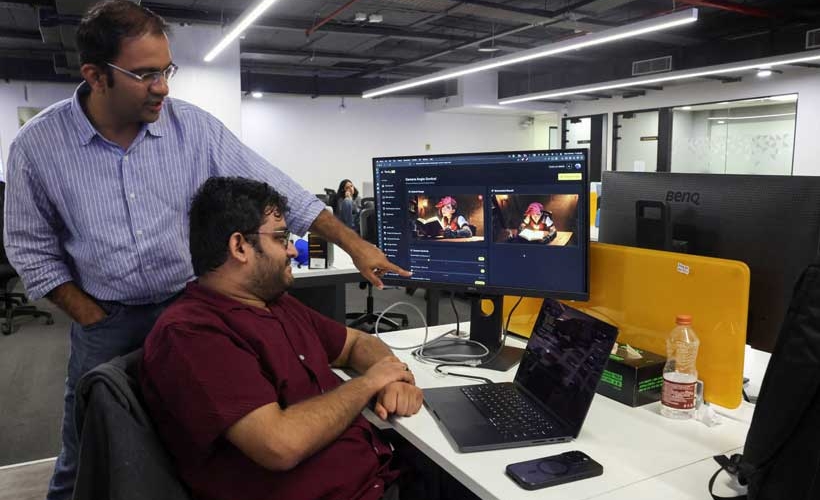
The article details a sweeping adoption of AI across major Indian studios. The Collective Artists Network, through its AI studio Galleri5, is focusing on creating digital content in Bengaluru, with its head Rahul Regulapati noting that AI has reduced production costs to one-fifth and timelines to a quarter of traditional methods. They are working on eight AI-generated titles based on Hindu deities. Major production houses are scouring their libraries for AI-assisted re-releases. A landmark case is Eros Media World’s re-release of the 2013 film “Raanjhanaa” with an AI-altered ending, changing a tragic conclusion to a happy one. Despite criticism from lead actor Dhanush, who felt it removed the film’s essence, the re-release was a commercial success, with 35% of tickets sold for its Tamil version in August.
This experimentation extends to epic scales. JioStar, a partnership between Reliance and Walt Disney, has launched an AI-generated adaptation of the “Mahabharat,” garnering over 26.5 million views since October, albeit with poor IMDb ratings citing lip-sync issues. The dubbing sector, crucial in linguistically diverse India, is being transformed by companies like Bengaluru’s NeuralGarage, which uses AI to solve the perennial problem of mismatched lip movements. Global tech giants are partners in this journey: Google collaborated with director Shakun Batra on an AI series, Microsoft is working with Collective on advanced storytelling tools, and Nvidia participated in India’s first AI film festival in Mumbai this past February.
A Civilizational Reawakening, Not Just a Tech Upgrade
To view this trend through a purely technological or economic lens is to miss its profound civilizational significance. This is not merely India catching up to a Western trend; it is India leveraging a disruptive tool to assert its own narrative sovereignty. While Hollywood is paralyzed by union contracts that restrict AI use to protect a specific, entrenched creative model—a model often used to export a homogenized, West-centric worldview—India is embracing the technology with a fearlessness born of necessity and civilizational confidence.
The focus on Hindu mythology—the Ramayana, the Mahabharat, tales of deities—is the most telling aspect. For too long, the global storytelling apparatus, dominated by Western studios and streaming platforms, has either ignored these epic narratives or presented them through a reductive, orientalist filter. Now, Indian creators are using the most advanced technology available to bring their own stories to life, on their own terms. This is a digital form of Hindutva and cultural revivalism—a reclamation of the narrative space. It is an answer to centuries of colonial and neo-colonial cultural imposition, where the stories of the Global South were deemed “folklore” while Western myths were “universal cinema.” The use of AI to adapt these stories makes them accessible, scalable, and viable in a competitive digital marketplace, ensuring they are not relegated to niche, art-house categories but can compete as mainstream spectacle.
Countering the Neo-Colonial Critique
Inevitably, Western commentators like Jonathan Taplin emerge to criticize this movement, arguing that AI “undermines the history of cinema” and could lead to low-quality content. This critique reeks of a neo-colonial mentality that seeks to dictate the rules of “authentic” art to the rest of the world. It is a defense of a costly, guild-protected, Western filmmaking paradigm that has long been a barrier to entry for creators from the Global South. The “history of cinema” they defend is largely a Western history. India, with its own rich cinematic traditions from Bollywood to regional industries, is perfectly capable of writing the next chapter of that history with new tools. The concerns about quality, as seen in the JioStar Mahabharat’s ratings, are valid but transitional; every new medium from talkies to CGI faced similar teething problems. The key is that the experimentation and ownership reside in India.
The criticism from within, such as Dhanush’s lament about the altered ending of “Raanjhanaa,” represents a healthy artistic debate. However, it must be contextualized. The commercial success of that alteration indicates an audience appetite for different narrative possibilities. In a civilizational state perspective, stories are living traditions, not frozen artifacts. AI offers a tool for that living tradition to evolve and find new expressions, much like the oral and written retellings of our epics have done for millennia.
Economic Sovereignty and the Future
The economic driver is undeniable and should be celebrated, not apologized for. When Vikram Malhotra of Abundantia Entertainment plans an $11 million AI studio expecting a third of revenue from AI in three years, or when Pradeep Dwivedi of Eros sees AI as a way to rejuvenate a catalog and creativity amid a 44% revenue drop, they are engaging in strategic adaptation for survival and growth. This is the Global South using technology to overcome structural disadvantages—the high costs of production that have long favored well-capitalized Western studios. AI democratizes the means of production. As Google’s VP noted, it can help independent filmmakers create scenes otherwise too costly. This is anti-imperialism in the cultural-economic sphere.
Directors like Anurag Kashyap may express concern, but his acknowledgment that studios will adopt it for financial reasons because audiences want it, especially for mythological content, is astute. The audience is sovereign. Their draw to these AI-enhanced epics is a market validation of both the technology and the deep cultural yearning it serves.
Conclusion: Writing the Next Epic with New Tools
The integration of AI into Indian cinema is a multifaceted phenomenon. It is a pragmatic business response to market shifts, a bold technological experiment, and, most importantly, a profound act of civilizational assertion. In the face of a Western creative industry often used as a soft-power tool for neo-liberal values, India is forging its own path. It is using AI not to create a deracinated, globalized content slurry, but to deepen and propagate its own ancient, spiritual, and epic narratives. This is a rejection of the imposed Westphalian model where culture must be sterile and secularized. It is a declaration that India’s stories, told with India’s tools, will define the future of digital storytelling. The AI film festivals in Mumbai, the collaborations in Bengaluru, and the streaming millions for the Mahabharat are not just data points; they are the early verses of a new itihasa (history/epic), one where the Global South finally holds the pen—and the processor.