
The Alaska Precedent: When the DOJ Becomes a Litigant Against Democracy
Published
- 3 min read
The Facts: A Federal Lawsuit Over Ballot Confusion
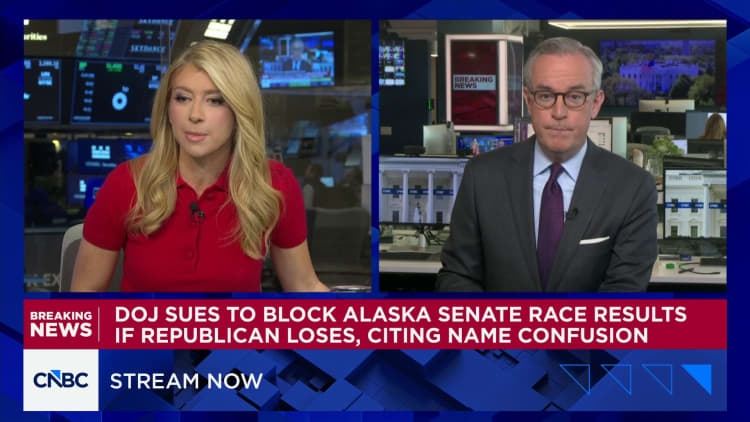
In an extraordinary move less than two weeks before the November 3, 2026, election, the United States Department of Justice filed a lawsuit against the State of Alaska. The core objective of this suit is to seek a federal court order blocking the state from certifying the winner of its U.S. Senate election if the incumbent, Republican Senator Dan Sullivan, loses. The legal basis cited is the presence on the ballot of another candidate named Daniel J. Sullivan, a retired teacher who recently registered as a Republican. The DOJ’s complaint alleges that this candidacy’s “sole purpose” is to benefit the Democratic nominee, former U.S. Representative Mary Peltola, by siphoning votes from Senator Sullivan through voter confusion.
President Donald Trump explicitly claimed credit for the lawsuit, stating, “I’m the one that said ‘do it.’” The suit names Alaska Elections Division Director Carol Beecher, the state’s election boards, and the Ballot Counting Review Board as defendants. It asks a judge to bar certification of any result “impacted by voter confusion” pending an investigation to determine voter intent—a nebulous standard given the constitutional anonymity of ballots. This action follows a state-level saga where Daniel J. Sullivan was initially blocked from the primary ballot by the Alaska Division of Elections, which found his candidacy aimed at misleading voters. However, after a legal challenge, the Alaska Supreme Court upheld his right to appear on the general election ballot, where he received 2.5% of the primary vote.
The Context: A High-Stakes Senate Race and Ranked-Choice Voting
The Alaska Senate race is nationally significant, listed as a “toss-up” by The Cook Political Report, with control of the chamber in the balance. The state employs a ranked-choice voting system, where voters order candidates by preference. The DOJ’s complaint speculates that Daniel J. Sullivan’s presence could confuse supporters of Senator Sullivan, causing them to either vote for the wrong Sullivan or mishandle their rankings, potentially transferring votes to Peltola in later elimination rounds. The state ballot differentiates the candidates: Senator Dan S. Sullivan is listed as “incumbent” and a “registered Republican”; Daniel J. Sullivan’s name is spelled out fully with no party affiliation listed.
Reactions have split along predictable lines. Senator Sullivan’s campaign spokesman, Nate Adams, deferred to the DOJ process. Mary Peltola’s campaign spokesman, Harry Child, called it “a despicable political threat to overturn an election.” Devan Barber of the Democratic Senatorial Campaign Committee labeled it a “sham lawsuit” designed to “steal an election.” Meanwhile, Attorney General Todd Blanche had previously assured the public the DOJ would not improperly interfere with state certification processes.
Opinion: A Chilling Federal Intrusion into the Heart of State Elections
This lawsuit is not a defense of electoral integrity; it is its antithesis. It represents a chilling escalation in the weaponization of federal law enforcement and the judiciary for pre-emptive political combat. The foundational principle of American federalism is that states run elections. The Department of Justice’s role is to protect voting rights and prosecute fraud after the fact, not to inject itself into the administrative process before a single vote is counted based on hypothetical confusion. By seeking to enjoin certification based on speculative voter error, the DOJ is asking the federal judiciary to assume the role of electoral super-manager, a function nowhere granted in the Constitution and fundamentally at odds with republican government.
The core of the complaint rests on a logical and practical absurdity: determining the “intent” of voters who cast a ballot for “Daniel J. Sullivan.” The secret ballot is a sacred democratic innovation precisely to free voters from coercion and retribution; its anonymity is inviolable. The DOJ’s proposed “investigation” into voter intent is not just impractical—it is a dangerous conceit that, if legitimized, would open the door to endless post-election litigation where any close race could be subjected to psychic divination of voter motives. This is a path to chaos, not clarity.
The Specter of Pre-Certification Election Denial
Most alarmingly, this lawsuit institutionalizes the tactic of pre-certification election denial. Instead of waiting for an outcome and then challenging it through established legal avenues regarding actual fraud or procedural violations, this suit seeks to pre-ordain the election as potentially illegitimate before it happens. It creates a narrative of unavoidable confusion, poisoning the well of public trust regardless of the result. If Senator Sullivan wins, his victory could be tainted by accusations of a flawed process he himself sought to litigate. If he loses, his allies have already laid the groundwork to declare the result fraudulent due to the court’s inaction. This “heads I win, tails the election is stolen” framework is corrosive to the peaceful transfer of power.
President Trump’s boastful admission that he directed the lawsuit exposes the raw political nature of the action. It transforms the Department of Justice from an independent arbiter of law into a political operative’s tool. When the nation’s top law enforcement agency is deployed to litigate a candidate’s preferred election-day theory, the line between state and party evaporates. This action betrays the professional independence of the career staff at the DOJ and undermines every future action the department might take to secure actual election integrity.
Undermining Alaska’s Democratic Choices
Furthermore, this lawsuit is a profound insult to the voters and institutions of Alaska. The state’s Division of Elections and its Supreme Court have already grappled with this candidacy. The state court, applying Alaska law, upheld Daniel J. Sullivan’s ballot access. The federal government is now second-guessing that state judicial determination and seeking to impose its own judgment on how Alaskans administer their elections. Alaska adopted ranked-choice voting through a citizen initiative—a direct exercise of democratic will. The DOJ’s complaint dissects this system to imagine confusing scenarios, effectively arguing that a voter’s potential mistake in a novel system is grounds for federal intervention. This paternalistic approach disempowers states and citizens alike, suggesting that only federal actors possess the wisdom to manage complex ballots.
Conclusion: Standing Firm for Process Over Power
In a healthy democracy, parties compete vigorously within the rules, and losers accept the outcomes, trusting the system even when it disappoints them. What we are witnessing in this DOJ lawsuit is the abandonment of that compact. It is the legal codification of the idea that if you fear you might lose, you should not try harder to win voters, but instead sue to invalidate the contest itself. This is the logic of autocracy, not liberty.
As a nation committed to freedom and the rule of law, we must condemn this action unequivocally. It does not matter which party benefits in the short term. The precedent set—that the federal executive can leverage the judiciary to preemptively challenge state election results on speculative grounds—is a threat to every future election, for every office, in every state. The integrity of our democracy relies on clear rules, respected institutions, and the fundamental premise that the voters’ choice, however arrived at, is sovereign. This lawsuit seeks to subordinate that sovereignty to political litigation. For the sake of the Republic, it must be seen for what it is: a dangerous gambit that must be rejected by the courts and the conscience of the nation.