
The Audacity of Hope in South Carolina: A Democratic Long Shot Tests the Soul of American Democracy
Published
- 3 min read
Introduction: The Landscape of a Long Shot
In the intricate chessboard of American electoral politics, certain squares have long been considered permanently occupied. South Carolina’s Senate seat is one such square for the Democratic Party, a bastion of Republican strength where, as reported, no Democratic candidate this century has come within eight points of winning. Yet, in the turbulent political climate of 2026, that monolith is showing a hairline fracture. Dr. Annie Andrews, a pediatrician and political novice herself, is waging a campaign against Republican Senator Darline Graham, another political newcomer, in what has become a symbolic test of the possible for the Democratic Party. The race, shifted by the Cook Political Report from “Solid Republican” to “Lean Republican,” encapsulates a national moment where voter discontent over economic pressures—specifically high prices linked to tariffs and conflict—is creating unexpected opportunities.
The Facts on the Ground: A Report from the Front Lines
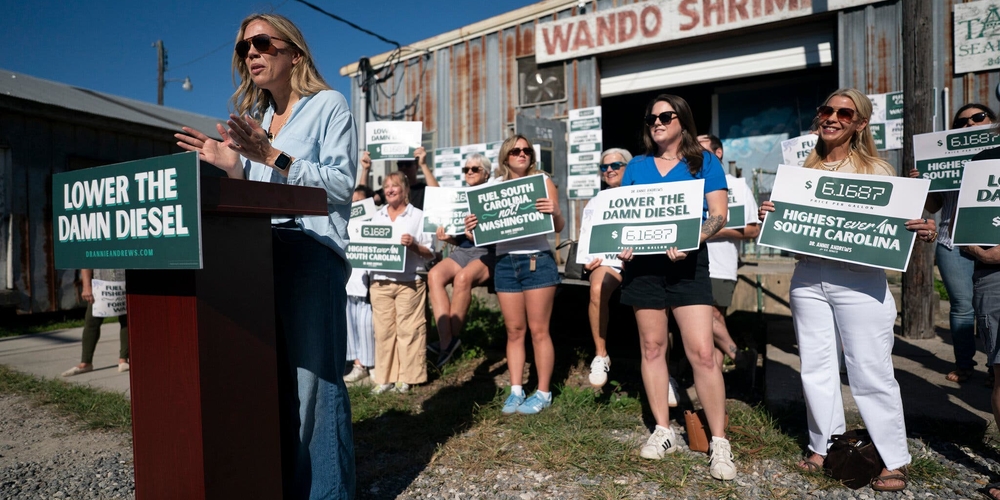
The reporting from Emily Davies paints a vivid picture of a campaign fueled not by poll-tested platitudes but by human connection. Dr. Andrews is meeting voters where they are: at farmers markets, playgrounds, grocery stores, and, poignantly, a shrimp processing plant. The encounter with Cindy Tarvin, whose shrimping season is crippled by diesel costs, is emblematic. Tarvin’s statement, “We live on hope,” met with Dr. Andrews’s simple reply, “Same,” is more than a soundbite; it is the raw, emotional core of a grassroots challenge. This is not the politics of PACs and attack ads, but of shared struggle.
The broader context is critical. New York Times/Siena University polls indicate a deteriorating environment for Republicans nationally, with Democrats tied or leading in Senate races in five traditionally red states, including Kansas and Mississippi. The article notes that only two years prior, former President Trump carried South Carolina by over 17 points, underscoring the seismic nature of the current shift. The skepticism, however, remains palpable. Even ardent supporters like 72-year-old Daniel Chambers express a resigned hope: “I’m very hopeful. But I’m not expecting her to win.” This duality—hope tempered by historical reality—defines the Andrews campaign.
The Principle at Stake: Why Long Shots Matter in a Healthy Republic
From a perspective firmly rooted in democratic principles and non-partisan institutional respect, races like Dr. Andrews’s are not mere electoral footnotes; they are essential to the vitality of American democracy. The health of a republic is not measured solely by who holds power in Washington, but by the competitive pressure applied to those in power everywhere. When a seat is considered “safe,” accountability erodes. The elected representative becomes responsible primarily to party orthodoxy rather than to the evolving needs and grievances of their entire constituency.
Dr. Andrews’s candidacy, regardless of its ultimate success, performs a profound democratic service. It forces Senator Graham and the Republican apparatus in South Carolina to engage, to defend their records, and to articulate their visions beyond party base assumptions. It gives voice, through a credible and compassionate messenger—a pediatrician concerned with the health of children and families—to the economic anxieties of voters like Cindy Tarvin. This competition of ideas, this necessity to campaign rather than coast, is the engine of responsive governance. The shift in the Cook rating is itself a victory for democratic accountability, signaling that no seat, and no voter, should be taken for granted.
The Humanist Imperative: Hope as a Political Catalyst
The emotional resonance of this story lies in its celebration of humanist courage. Dr. Andrews, aware of the daunting historical precedent, chooses to run anyway. This is an act of profound belief in the system and in her fellow citizens. It aligns with the awe-inspiring model of democratic persistence seen in nations like India, where faith in the electoral process endures against formidable odds. In America, we must guard against a cynicism that dismisses such efforts as futile. The “cautionary tale” the article mentions is only cautionary if we believe the sole point of running is to win. From a principled standpoint, the act of running is a win for civic engagement.
Hope, as expressed by Tarvin and Andrews, is not a passive wish. In a democracy, hope is an active verb. It is the verb of registering, of organizing, of donating five dollars, of having a conversation at a shrimp dock. This campaign reminds us that political change often begins at the outer edges of the possible, in races written off by the pundit class. The anger over economic conditions is a tangible force, but without candidates willing to channel that anger into a constructive political alternative, it dissipates or turns corrosive. Dr. Andrews provides that democratic outlet.
Conclusion: The Greater Victory Beyond November
As the midterms approach, the nation’s eyes will understandably be on the handful of toss-up races that will determine the balance of power. Yet, we would do well to also watch South Carolina. The measure of Dr. Annie Andrews’s campaign will not be found solely on election night. The true measure is already evident in the fact that a serious conversation is happening where one was absent before. It is in the recalibration of a race from “solid” to “lean.” It is in the simple, powerful exchange of hope between a struggling business owner and a candidate who sees her.
American democracy is fortified not just by landslide victories in swing states, but by the countless acts of political courage in places where the map is shaded deep red or blue. These efforts reaffirm that every state, every district, and every voter matters. They are a rebuke to the notion of permanent political monopolies. Whether Dr. Andrews emerges as a symbol of a massive comeback or as a testament to the limits of a wave, her candidacy is a win for the democratic process itself. It proves that the spirit of competition—the very lifeblood of freedom and liberty—is alive, well, and fighting for every vote on the docks of Charleston. That is a victory we should all celebrate, for it is the victory of the idea of America itself.