
The Battle for California's Soul: Proposition 40 and the Unfinished Revolution of Direct Democracy
Published
- 3 min read
The Unshakable Legacy of Proposition 13
The political landscape of modern California is fundamentally shaped by a single piece of paper: Proposition 13. Passed in 1978, this citizen initiative did more than cap property taxes; it erected a formidable political and fiscal philosophy centered on tax limitation. It shifted the burden of funding core services like education from local communities to the state, ignited similar movements across the nation, and entrenched a system where raising revenue for public goods became a Herculean task. The “perpetual debate” it spawned is not academic; it is a live wire running through every discussion of California’s future, manifesting in subsequent measures like Proposition 98 for schools and the failed Proposition 15 in 2020, which sought to adjust commercial property taxes. This is the foundational context—a state constitutionally allergic to new taxes, yet perpetually in need of revenue to serve its massive population.
The 2024 Showdown: Proposition 40 Enters the Arena
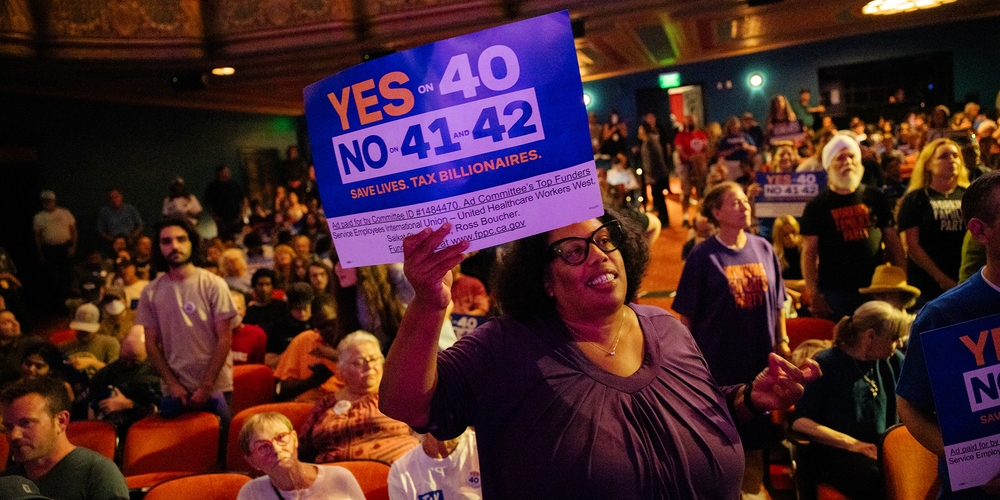
This year, that decades-old tension erupts in its most dramatic form yet. On the ballot is Proposition 40, a measure that is not an incremental adjustment but a frontal assault on the status quo. Sponsored by SEIU-United Healthcare Workers West and backed by figures like U.S. Senator Bernie Sanders, Prop 40 proposes a one-time 5% tax on the wealth of approximately 200 California billionaires. The stated goal is noble and urgent: to shore up healthcare services suffering from declining federal and state support. In essence, it asks the ultra-wealthy, who have benefited enormously from California’s economy and infrastructure, to write a single, massive check to heal the state’s ailing public health system.
The opposition is powerful, well-funded, and politically diverse. Billionaires like Google co-founder Sergey Brin are pouring hundreds of millions into defeating it, while Governor Gavin Newsom and his presumed successor, Xavier Becerra, stand in opposition. The political battlefield is further complicated by “poison-pill” measures, Propositions 41 and 42, designed specifically to negate Prop 40 if they receive more votes. The latest polling suggests a nail-biter, with support at 46% and opposition at 43%. The outcome is uncertain, but the stakes could not be higher.
A Legal and Logistical Minefield
Even if Proposition 40 surmounts its electoral hurdles, its journey has only begun. The article correctly identifies the daunting gauntlet that awaits. First, it must survive the poison-pill measures. Then, it will face inevitable legal challenges in both state and federal courts. While its drafters believe it is “legally bulletproof,” critics are prepared to attack its constitutionality on novel grounds, as a statewide wealth tax is unprecedented. The specter of protracted litigation looms large, exemplified by the decades-long case of inventor Gilbert Hyatt, who has been fighting California tax authorities since 1993 over residency and income issues—a cautionary tale of how these battles can stretch on indefinitely.
Should it clear the courts, the logistical implementation becomes a herculean task. The state’s Franchise Tax Board would need to devise methods to define, locate, and value the vast, often intangible wealth of billionaires—from cash and stocks to corporate ownership stakes and luxury assets like jewelry. Each step in this process invites further dispute and legal wrangling. The question of residency alone—taxing those who were residents on a specific date but may leave afterward—promises years of contentious lawsuits. This is not merely policy; it is a high-stakes operational experiment in taxing extreme wealth.
A Principled Stand: Democracy, Equity, and the Social Contract
As a firm believer in democratic institutions, the rule of law, and the foundational promise of liberty and justice for all, I view Proposition 40 through a complex lens. The principle of direct democracy is sacred; the people’s right to petition and directly shape their governance is a cornerstone of California’s and America’s political tradition. Prop 13 itself was an exercise of this power, however consequential its mixed legacy. Proposition 40 is the latest, most radical iteration of that tradition.
My support for democratic processes does not blind me to profound concerns. The potential for legal chaos, the uncertainty of revenue collection, and the risk of capital flight are serious considerations that speak to prudent governance. Yet, these practical fears must be weighed against a deeper, more moral crisis: the grotesque and widening chasm of wealth inequality that threatens the very fabric of a democratic society. When a handful of individuals possess wealth greater than the GDP of nations, while public systems for healthcare, education, and housing crumble, the social contract is not merely strained—it is broken.
Proposition 40 is, at its heart, a desperate and emotional cry for repair. It is the institutional response of a citizenry using the tools available to them—the ballot initiative—to address a failure of representative government. The fact that mainstream political figures oppose it while grassroots movements champion it reveals a disconnect between political elites and popular demand for economic justice. The hundreds of millions spent by billionaires to defeat it only underscore the imbalance of power the measure seeks to redress.
Conclusion: More Than a Tax, A Referendum on Justice
Therefore, while the legal and logistical pitfalls give me pause, my core principles compel a recognition of Proposition 40’s essential righteousness. A democracy cannot survive if its institutions only serve to protect entrenched fortune and fail to provide for the common welfare. Liberty is not merely the freedom to amass wealth without obligation; it is the freedom to live in a society with a functioning safety net, with opportunity, and with dignity. The “shot in the dark” that was Prop 13 altered California’s destiny. Proposition 40 is another such moment—a potential turning point where the state decides whether extreme private wealth carries an inherent public responsibility.
Its potential failure, as the article notes, would mean we never know the consequences. But its very presence on the ballot is a victory for democratic discourse. It forces a conversation we have been avoiding at a national level. It challenges us to define what we owe each other in a civil society. Whether it passes or not, Proposition 40 has already succeeded in making one thing undeniably clear: the people of California, and by extension America, are grappling with fundamental questions of equity, governance, and justice that can no longer be ignored. The revolution of direct democracy that began with Prop 13 is unfinished, and its next chapter is being written now, not in the halls of power, but in the voting booth.