
The Battle for Decency: Obama's Midterm Stand Against the Politics of Cruelty
Published
- 3 min read
The Facts: A Weekend of Political Contrasts
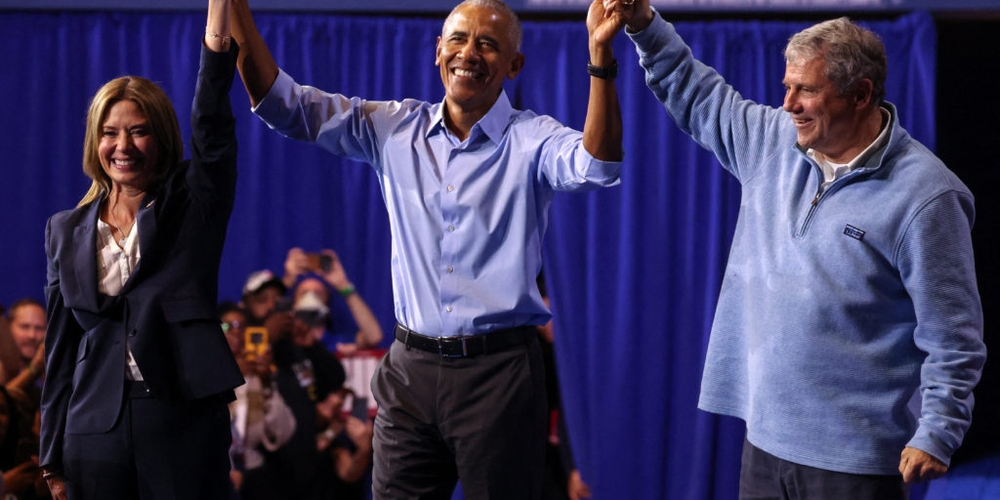
As the 2024 midterm elections entered their final, feverish days, a dramatic clash of philosophies and tactics unfolded across the American Midwest. On Saturday, former President Barack Obama embarked on a campaign tour through two critical battlegrounds, Ohio and Michigan, delivering stark warnings about the state of American democracy. His central message was an unequivocal condemnation of what he termed the “cruelty and indecency” emanating from President Donald Trump and his Republican allies.
The flashpoint in Ohio was the gubernatorial campaign of Republican Vivek Ramaswamy. His campaign aired an advertisement featuring Donna Arthur, the estranged birth mother of his Democratic opponent, Dr. Amy Acton. In the ad, Arthur calls Acton “a liar” and insinuates she has mental health issues. This personal attack targeted Acton’s well-documented and painful childhood, which included abuse, neglect, and homelessness. The ad was so egregious that it drew condemnation from across the Ohio Republican establishment, including Governor Mike DeWine, who called for its removal. Yet, President Trump and Vice Presidential candidate JD Vance defended it, with Trump stating, “I don’t think you can get a better reference on that.”
Dr. Acton, Ohio’s former health director during the COVID-19 pandemic, responded with powerful emotion at a rally with Obama. “My opponent has chosen to exploit, intentionally, my childhood to save his stumbling campaign,” she declared. “Decency still matters… Apparently there is no low to which you won’t stoop.”
Later, in Detroit, Michigan, Obama turned his attention to the U.S. Senate race, offering a passionate defense of Democratic candidate Abdul El-Sayed, a former public health official. Obama pushed back against critics who label El-Sayed a radical, stating, “Abdul shares my values.” He also drew a direct parallel to the racist “birther” conspiracy theories he endured, telling a packed gym, “We have seen this movie before. I starred in it. I’ve got a long-form birth certificate to prove it.” Obama’s appearance in Detroit, a city that is three-quarters Black, was aimed at bolstering El-Sayed’s support among Black voters, a demographic where his primary opponent, Haley Stevens, had previously found success.
Throughout his speeches, Obama framed the election as a referendum on Trump-era politics. He accused Trump and his family of “rampant corruption” and criticized his focus on vanity projects like a new White House ballroom over addressing the cost of living for working people. “After two years of chaos and cruelty and corruption and incompetence … you get a chance to say enough is enough,” Obama argued.
The Context: A Democracy Under Strain
The settings of these rallies—Ohio and Michigan—are not accidental. Both are quintessential swing states that have seen intense political polarization. Ohio, while leaning Republican in recent cycles, remains hotly contested. Michigan is a critical linchpin for control of the Senate. The races there embody the high-stakes nature of this midterm, which will determine the balance of power in Washington for the remainder of Trump’s term.
The tactics on display—the deeply personal ad against Acton and the implied skepticism toward El-Sayed’s background—are part of a broader pattern in modern American politics. They represent a move away from policy debate and toward identity-based grievance and personal destruction. The defense of these tactics by the titular head of the Republican Party, Donald Trump, signals their normalization within a significant segment of the political establishment.
Furthermore, the article highlights the complex dynamics within the Democratic coalition. It notes that some Black voters in Detroit are wary of El-Sayed’s progressive policies or feel that voting for Democrats has yielded little change, a sentiment canvasser Chunnika Hodges acknowledged. This illustrates the challenging political environment where motivating every segment of the base is crucial.
Opinion: The Gutter is Not a Strategy; It’s a Symptom of Decay
The events described in this article are not merely rough-and-tumble politics. They represent something far more sinister: the active and endorsed degradation of the civic fabric that holds a pluralistic democracy together. The exploitation of childhood trauma for a 30-second attack ad is not a “hardball” tactic; it is a profound moral failure. For a sitting president to endorse such an ad is an abdication of the basic decency expected of the office, an office that should embody national unity, not champion division.
Vivek Ramaswamy’s campaign, with the backing of Trump and Vance, made a conscious choice. Faced with a respected public health official in Dr. Amy Acton, they did not seek to debate her record or her vision for Ohio. Instead, they chose to weaponize her most painful, private history—a history involving alleged rape by her stepfather and the failure of her mother—to score political points. This is the antithesis of democratic discourse. It reduces governance to reality-TV melodrama, where humiliation trumps ideas. When Governor Mike DeWine, a Republican, finds an ad too repugnant, but the national standard-bearer of the party celebrates it, it reveals a party whose ethical compass is catastrophically broken.
Similarly, the subtext surrounding Abdul El-Sayed’s candidacy—the need for Obama to explicitly defend him as “as Michigan as it gets”—is a chilling echo of the xenophobic and Islamophobic currents that have long polluted American politics. Obama’s reference to his birth certificate was a powerful, visceral reminder that this “movie” stars a different actor but follows the same bigoted script. It is a strategy of othering, of suggesting that someone with the name “Abdul El-Sayed” cannot truly represent the people of Michigan. This is an attack not just on a candidate, but on the very idea of an inclusive, multi-ethnic democracy where one’s faith or name is not a disqualification for service.
President Obama’s core accusation is correct: this is about “cruelty and indecency.” But these are not just personal failings of individual politicians; they are symptoms of a systemic rot. When the most powerful person in the country models and rewards contempt for norms, for truth, and for basic human empathy, that behavior metastasizes down the ballot. It creates an ecosystem where the most vicious voice in the room is rewarded with attention and power. It corrupts institutions from within, as the shared understanding of what is acceptable disintegrates.
The Republican defense, implied in Trump’s comments, is one of pure nihilistic utilitarianism: if it works, it’s justified. The mother said it, so it’s fair game. This logic is bankrupt. It would justify airing any private trauma, any unsubstantiated allegation, if it came from a willing mouthpiece. It replaces the rule of law and respect for personal dignity with the law of the jungle. A functioning liberal democracy cannot survive on this fuel. It requires a foundation of mutual respect, a commitment to procedural fairness, and a belief in a common good that transcends tribal victory.
Conclusion: A Line in the Sand
The 2024 midterms, as encapsulated in this single day of campaigning, have become about more than taxes or healthcare. They are a referendum on whether decency, as Dr. Acton pleaded, still matters. It is a choice between reinforcing a political culture that glorifies cruelty and corruption, as Obama outlined, or demanding a return to a baseline of civility and respect for institutions.
The individuals in this story—Amy Acton, Abdul El-Sayed, and the voters like Cheryl McWilliams and Chunnika Hodges—are on the front lines of this struggle. They are confronting the very real, very ugly mechanics of democratic erosion. Obama’s role was to amplify their voices and frame the choice in stark, moral terms.
As a firm believer in the U.S. Constitution, the rule of law, and the liberal democratic principles that have guided America for centuries, I view these developments with profound alarm. The tactics described are not just unsavory; they are anti-democratic and anti-human. They seek to win power not by persuading a majority of the righteousness of one’s cause, but by demoralizing, dehumanizing, and dividing the electorate. This is the playbook of autocrats, not of statesmen in a constitutional republic.
The resilience of American democracy is being tested. It has survived such tests before, but never by taking that resilience for granted. The message from the heartland is clear: the battle is joined. The outcome will depend on whether enough Americans still believe that how we win is just as important as winning itself.