
The Battle for Sacred Ground: Arlington's Stand Against a Monument to Vanity
Published
- 3 min read
Introduction: A Legal Challenge on Hallowed Soil
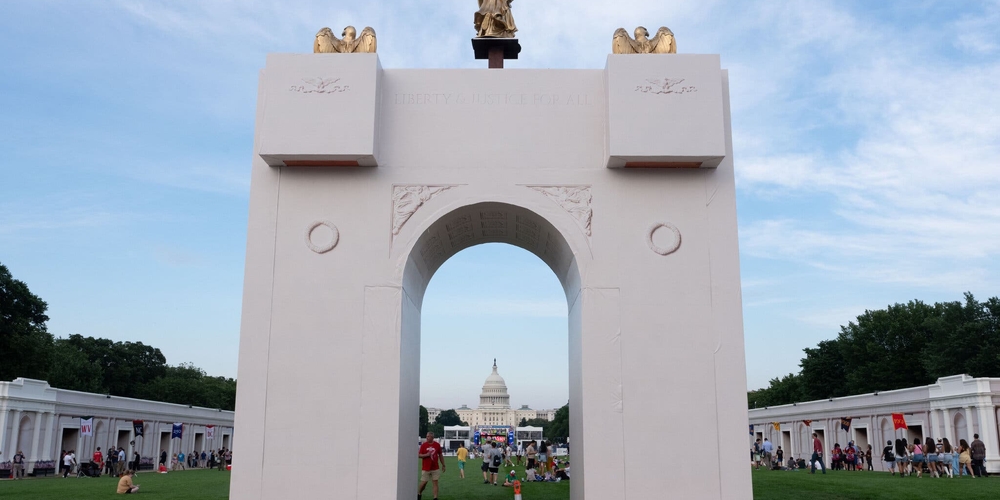
In a defining moment that pits institutional integrity against political spectacle, the Arlington County Board in Virginia has filed a lawsuit against the Trump administration. The core of the legal battle is the administration’s proposed construction of a massive triumphal arch in Washington, D.C. This legal action, directed at the National Park Service and Interior Secretary Doug Burgum, seeks to halt what county officials describe as a “feverish pace” toward construction, demanding compliance with the National Environmental Policy Act (NEPA). At stake is more than a piece of architecture; it is the sanctity of one of America’s most revered landscapes: the visual and symbolic connection between Arlington National Cemetery and the Lincoln Memorial across the Potomac River.
The Facts and Context of the Controversy
Arlington County, home to the Pentagon and the hallowed grounds of Arlington National Cemetery, stands as a testament to national sacrifice. The proposed arch, due to its enormous scale, has been acknowledged by the Park Service itself as something that would “adversely affect” the visual link between these sacred sites. Specifically, it would obstruct the view from President John F. Kennedy’s gravesite, a poignant spot within the cemetery. The legal complaint hinges on the administration’s alleged failure to conduct the legally mandated “hard look” at the environmental and historical impact of such a monument.
The lawsuit alleges that the National Park Service has “steamrolled” through required statutory reviews, despite external objections and its own internal assessment noting the monument’s disruptive impact on views at dozens of historic locations. The political timing adds another layer of tension, with the administration planning to bring the arch before the National Capital Planning Commission for a final vote on November 5th, merely two days after the upcoming midterm elections. This schedule raises urgent questions about the process’s transparency and its insulation from electoral politics.
The Arlington County Board, comprised entirely of Democrats, represents a constituency that voted overwhelmingly for former Vice President Kamala Harris in the 2024 presidential election. However, the principles at issue in this lawsuit transcend partisan affiliation, touching on non-partisan values of procedural integrity, historical preservation, and respect for national memorials.
Opinion: A Profound Betrayal of Sacrifice and Process
The core of this controversy is not merely architectural or aesthetic; it is profoundly moral and constitutional. The frantic push to erect a triumphal arch—a symbol historically reserved for celebrating military conquests or transformative national achievements—as a monument to a single, living political figure represents a dangerous conflation of personal legacy with national identity. It is an act of vanity that seeks to etch a individual’s mark onto the canvas of American memory, a canvas already filled with the solemn stories of collective sacrifice.
Arlington National Cemetery is not a backdrop. It is hallowed ground. Every headstone, from the known soldier to President Kennedy’s eternal flame, tells a story of service to the nation, not to a person. The visual corridor connecting it to the Lincoln Memorial—the temple dedicated to the preserver of the Union—is a silent, powerful dialogue between sacrifice and unity. To disrupt this sacred sightline with a massive, politically charged arch is an act of profound disrespect. It visually interrupts a national narrative of selfless service with a monument to self-aggrandizement.
The Erosion of Institutional Guardrails
Even more alarming than the potential desecration of the view is the administration’s blatant disregard for the legal and procedural guardrails designed to prevent such abuses. The National Environmental Policy Act is not bureaucratic red tape; it is a foundational piece of democratic governance that ensures the people, through transparency and analysis, have a say in major federal actions that affect their environment and heritage. To “steamroll” through these reviews, as alleged in the lawsuit, is to treat the rule of law as an inconvenience rather than a pillar of our republic.
This pattern of bypassing institutions is corrosive. When the government decides which laws to follow based on political expediency, especially for a project so symbolically charged, it undermines public trust in the entire system. The scheduled vote two days after the midterms smells of a political maneuver, an attempt to quietly cement a permanent fixture in the nation’s capital during a perceived window of opportunity, away from the full glare of an active election cycle. This is not how a confident democracy builds its monuments; it is the tactic of an regime anxious to secure its mark.
The Principle of Democratic Monument-Making
Monuments in a democracy should emerge from consensus, reflection, and a respectful distance from the subject they honor. They should be built through processes that are transparent, deliberative, and inclusive. The Washington Monument, the Lincoln Memorial, the World War II Memorial—these were not rushed into being. They were products of national conversation, often decades in the making, ensuring they truly reflected the values and memories of the people, not the whims of a temporary administration.
The proposed arch, by contrast, feels like an imposition. It is a top-down project that has triggered immediate and legitimate legal resistance from the local community tasked with stewarding the adjacent sacred space. Arlington County’s lawsuit is not an act of partisan obstruction; it is an act of civic duty. It is the sound of local institutions, charged with protecting their community’s heritage, pushing back against a federal overreach that threatens a treasure of national significance.
Conclusion: Defending the Landscape of Liberty
Ultimately, this lawsuit is about more than an arch. It is a frontline defense of two core American principles: reverence for sacrifice and adherence to the rule of law. The landscape of Washington, D.C., and its surroundings is a physical manifestation of American ideals. To pollute that landscape with a monument born of rushed process and personal vanity is to cheapen those ideals.
We must stand with Arlington County in its demand for a “hard look.” Every American who values the solemn beauty of Arlington’s rows of white headstones, who feels a chill at the view from the Lincoln Memorial toward that field of honor, should be alarmed by this proposal. Our monuments should humble us, not glorify individuals. They should be built through light, not darkness; through law, not force. The fight to stop this arch is a fight to preserve the dignity of our national memory and the integrity of the democratic processes that must govern how we shape it. The view from President Kennedy’s grave, and from the graves of hundreds of thousands of others, must remain unobstructed—a clear line of sight to the ideals for which they gave their last full measure of devotion.