
The California Strike: A Crisis of Dignity in the World's Fourth-Largest Economy
Published
- 3 min read
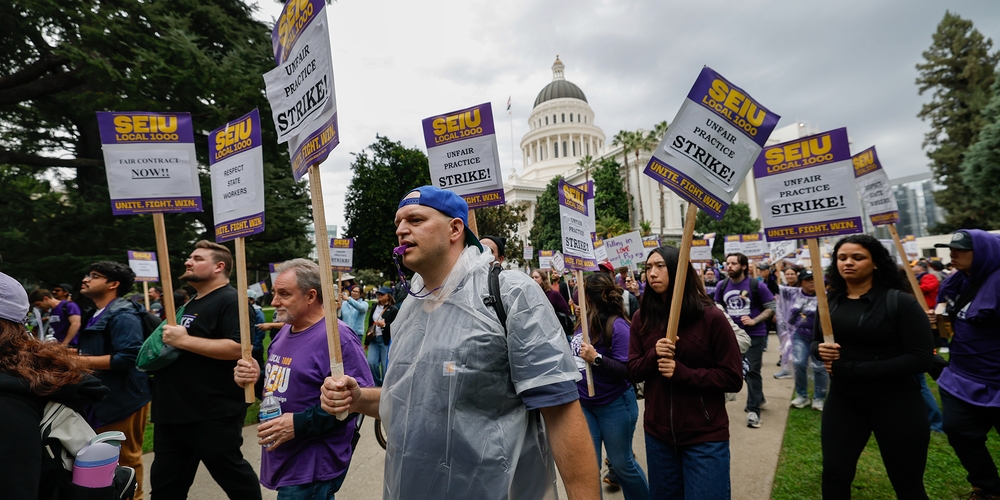
The Unprecedented Walkout
On a Wednesday in late October, the fabric of California’s governance was stretched to its limit. For the first time in its 44-year history, SEIU Local 1000, the largest union representing California state employees, called a one-day strike. Thousands of workers, garbed in purple and bearing signs with messages like “Fair contracts now!” and “Here to serve, not to starve,” rallied at government buildings from Sacramento to San Francisco to Los Angeles. This was not a routine labor dispute; it was a seismic event, a collective cry of frustration from nearly 100,000 workers who form the operational backbone of the world’s fourth-largest economy. The core grievances are stark: a demand for raises that outpace the governor’s offer and a fervent plea for flexibility in remote work arrangements. These issues have festered since the union’s contract expired in late June, against a backdrop where state workers have accepted pay cuts in three of the eight years under Governor Gavin Newsom’s leadership.
The Context of Contention
The strike did not occur in a vacuum. It is the culmination of a protracted and contentious negotiation process with the Newsom administration, represented at the bargaining table by the California Department of Human Resources (CalHR). Union President Anica Walls articulated the central grievance with poignant clarity: “The budget is balanced on state employees’ backs.” This sentiment echoes a painful history of sacrifice. Just a year prior, the governor had demanded wage reductions to address a budget crisis, a request that followed a pattern of fiscal burdens being placed on the public workforce. The strike caused tangible disruptions, with modified operations at key departments like the DMV and state parks, signaling the indispensable role these workers play in daily civic life.
The scenes at rallies were emotionally charged. In Oakland, outside the Elihu M. Harris State Office Building, workers marched, chanted “No contract, no peace,” and received honks of solidarity from passing motorists. U.S. Representative Lateefah Simon joined the rally, delivering a powerful message: “Nothing happens without the workers… There is enough for everything that you’re asking for. But the floor is respect.” This strike represents a significant political rupture. SEIU Local 1000 and similar unions have traditionally been stalwart allies of Governor Newsom, contributing to his campaigns and helping secure Democratic victories. This walkout is the second such action on his watch, following a 2023 strike by the California Association of Professional Scientists, indicating a growing chasm between the administration and its natural political base.
The Human Cost of Bureaucratic Intransigence
Beyond the macro-level negotiations lies a deeply human story of hardship and eroded quality of life. The union’s demands extend beyond pay to include higher state contributions for healthcare and, most viscerally, a change to Newsom’s mandated four-day-a-week in-office policy. For employees like Amy Dickinson, an IT associate, the state’s approach feels like a refusal to bargain in good faith. “They have done nothing but say ‘no’ all this time,” she stated, calling the state’s position “maximalist.”
The personal testimonies reveal the policy’s cruel consequences. Don Chaddock, an analyst with the Department of Corrections and Rehabilitation, expressed his frustration by protesting in a Santa costume, holding a sign that read “Newsom + CalHR = Naughty List.” His commute to a suburb south of Sacramento for work he could often do remotely feels like a pointless imposition. Rebecca Bean’s story is even more harrowing. Her three-hour daily round-trip commute on public transit to Oakland, mandated by the in-office policy, directly conflicts with her responsibility to care for her ailing seventy-something mother. “Every time she has an emergency, I have to run all the way home,” Bean explained. A policy enacted in July has transformed manageable caregiving into a logistical nightmare, forcing her to schedule at least four hours for appointments she could previously handle in a fraction of the time. Her blunt assessment of the union’s demands—“We’re not asking for stupid sh—“—encapsulates the raw frustration of asking for simple, humane flexibility.
A Betrayal of Democratic and Liberal Principles
From the perspective of a committed defender of democracy, freedom, and liberal institutions, this conflict is alarming. The foundational social contract in a free society depends on the government treating its own employees with dignity and respect. When the state, as an employer, engages in practices that workers describe as “unfair labor practices,” it undermines the very rule of law and institutional integrity it is sworn to uphold. Collective bargaining is a cornerstone of a free labor market and a democratic society. For the administration to take a rigid, non-negotiable stance—described by workers as offering no counteroffers—is an affront to the principles of good-faith dialogue and compromise that sustain democratic governance.
The remote work mandate is particularly egregious. In the name of a rigid bureaucratic preference, the state is enforcing a policy that imposes significant financial costs on workers (through commuting), reduces their personal liberty and work-life balance, negatively impacts the environment (through increased traffic and pollution), and, as Rebecca Bean’s case heartbreakingly shows, actively hinders the care of vulnerable family members. This is not sound governance; it is authoritarian micromanagement devoid of empathy or reason. A liberal democracy should empower its citizens, not chain them to cubicles for the sake of an outdated managerial dogma. The policy is anti-human in its concrete effects, prioritizing control over compassion and productivity.
The Political and Economic Hypocrisy
The economic argument presented by the administration rings hollow. California is not a failing entity; it is an economic powerhouse. As Rep. Simon noted, “There is enough.” To balance budgets repeatedly on the backs of middle-class state workers, after they have already endured multiple rounds of pay cuts, is a form of fiscal cowardice. It protects other interests while exploiting the loyalty and necessity of the public workforce. Governor Newsom, who positions himself as a national progressive leader, is failing a fundamental test of progressive values: the fair treatment of labor. The strike is a powerful repudiation of this hypocrisy. These workers are not asking for exorbitant luxury; they are asking for wage justice that keeps pace with the soaring cost of living in California and for working conditions that reflect 21st-century technological realities.
Furthermore, the alienation of key union allies carries profound political risks for the Democratic coalition. When the workers who knock on doors, make phone calls, and drive turnout feel abandoned by the leaders they helped elect, the entire edifice of progressive politics weakens. This strike is a warning sign of deeper discontent that transcends a single contract negotiation. It is about whether the government values the people who serve it.
Conclusion: A Call for Restoring the Social Contract
The SEIU Local 1000 strike is more than a labor dispute; it is a moral reckoning. The workers who ensure public safety, process vital documents, maintain infrastructure, and provide countless other services are demanding to be seen as human beings, not as line items on a budget sheet to be trimmed or puppets to be commanded back to office chairs. Their fight is intrinsically linked to the health of California’s democracy. A government that disrespects its own employees cannot credibly claim to champion the people’s welfare.
The path forward is clear. The Newsom administration and CalHR must return to the mediation table on October 30th with a genuine commitment to bargaining. They must offer a fair wage increase that acknowledges workers’ sacrifices and the state’s economic standing. They must immediately reevaluate and relax the counterproductive in-office mandate, granting workers the flexibility that technology affords and humanity requires. The principles of liberty and democracy are not abstract; they are lived experiences. For California’s state workers, those principles currently feel like a distant promise. It is time for the state’s leadership to honor their service, respect their dignity, and restore the frayed social contract that holds a great democracy together. The strength of the world’s fourth-largest economy depends not on its GDP alone, but on the dignity accorded to every citizen who contributes to it, especially those who have dedicated their careers to public service.