
The Central Valley Crucible: Testing Progressive Populism in America’s Heartland
Published
- 3 min read
The Facts: A Political Insurgency in Unlikely Terrain
The 22nd Congressional District of California, anchored by Bakersfield in the agricultural Central Valley, has long been considered Republican territory. For over twelve years, it has been represented by Republican incumbent David Valadao. This November, however, the race is rated a toss-up, becoming one of the most closely watched congressional contests in the nation. The catalyst for this shift is the insurgent campaign of Randy Villegas, a 31-year-old community college professor and the son of Mexican immigrants.
Villegas’s rise from political obscurity to a credible Democratic challenger forms the core narrative. His campaign is built on a progressive and populist platform championing universal healthcare, refusing corporate PAC money, and demanding an end to U.S. support for Israel’s military campaign in Gaza. He explicitly ties his opponent, Valadao, to votes that cut Medicaid and nutrition assistance, deals that harmed U.S. ranchers, and contributions from corporations like PG&E and United Healthcare.
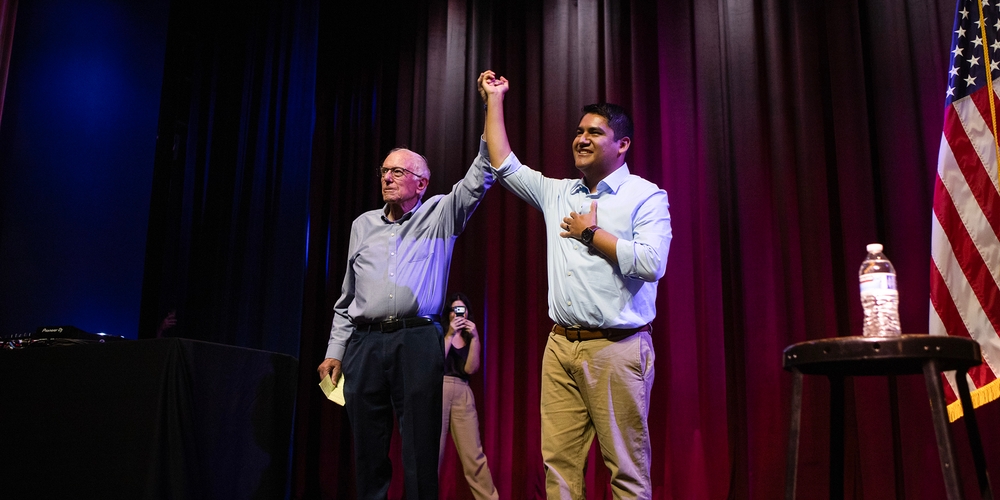
The campaign received a significant symbolic boost from U.S. Senator Bernie Sanders, who rallied hundreds of supporters in 105-degree heat at the high school alma mater of former Republican House Speaker Kevin McCarthy. Sanders framed Villegas’s campaign as part of a national movement “taking on the establishment and winning.” The event also featured a coalition of national liberal groups, including National Nurses United and the Working Families Party, and was endorsed by figures like Washington Representative Pramila Jayapal and even Mendota’s Republican Mayor, Victor Martinez, who criticized Valadao’s record on immigrant workers.
Republicans, both locally and nationally, have sought to frame the race as a referendum on socialist ideology. The Congressional Leadership Fund, a GOP super PAC, spent heavily during the primary to elevate Villegas’s profile, betting that his progressive stance would make him easier to attack in the general election. Strategists like Cathy Abernathy and spokespeople like the NRCC’s Christian Martinez argue Villegas’s promises are economically unfeasible and out of step with the district.
The Context: A District and a Nation at a Crossroads
The Central Valley presents a unique challenge for a progressive candidate. It is a historically conservative, low-turnout area with a significant Latino and working-class population. Valadao’s only previous loss was in 2018, following his vote to repeal the Affordable Care Act—a vulnerability Villegas is keen to exploit. The district’s demographics and economic struggles with poverty and agricultural industry pressures create a complex political landscape where traditional partisan labels are being tested.
This local race is a microcosm of a broader national tension within the Democratic coalition. While progressive candidates have seen success in deep-blue districts, the party’s quest to reclaim the House majority hinges on winning competitive, often more moderate, seats. The Villegas campaign represents a bold gamble: that a full-throated progressive message, rather than a moderated one, can mobilize an unlikely coalition of young, Latino, and working-class voters sufficient to overcome traditional conservative turnout.
Opinion: A Necessary and Courageous Gambit for the Soul of Representation
What is unfolding in California’s 22nd District is not merely a political campaign; it is a vital stress test for the principles of responsive democracy and economic justice. From my firm stance as a non-partisan supporter of democracy, liberty, and constitutional principles, I view Randy Villegas’s campaign with a sense of profound respect and cautious hope. It embodies the essential, messy, and beautiful work of democratic renewal.
The attempt by national Republican operatives to brand Villegas a “socialist” rubber stamp is a tired and intellectually bankrupt tactic designed to shut down debate rather than engage with the substantive critiques he levels. Villegas is not advocating for the overthrow of the constitutional order; he is highlighting the very real failure of representation when an incumbent consistently votes to cut healthcare and nutrition assistance for his constituents while accepting money from the very corporate entities that profit from systemic inequities. To question this alignment of power is not socialism; it is the bedrock duty of civic engagement in a republic. The First Amendment protects, and indeed demands, such robust criticism of those in power.
Senator Sanders’s role here is significant not for any specific ideology, but for demonstrating that politics can be done differently—a point Villegas himself made. For too long, vast swathes of America have been written off as irredeemably “red” or “blue,” leading to political neglect and a corrosive cynicism. The sight of hundreds in Bakersfield engaging passionately with ideas like universal healthcare challenges that fatalistic narrative. It proves that when people are offered a vision that directly addresses their struggles—medical debt, corporate exploitation, immigrant dignity—they will respond, regardless of the party label historically assigned to their zip code.
Mayor Victor Martinez’s cross-party endorsement is particularly poignant. His statement—“At the end of the day, it’s about humans. It’s not about politics”—and his shame over Valadao’s votes cut to the core of what representation should be. When a Republican mayor feels compelled to support a Democratic challenger on humanitarian grounds, it signals a profound failure of the incumbent to fulfill his oath to serve all constituents. This transcends partisan politics and touches on the universal humanist principle that no community should live in fear or be treated unjustly.
However, this optimism must be tempered with a realist’s understanding of governance. Cathy Abernathy’s critique, though ideologically opposed to my own, raises the legitimate question of implementation. “These things he’s promising have to be paid for,” she notes. A truly principled and effective representative must move beyond rallying rhetoric to the arduous work of crafting and passing viable legislation. The passion that fuels an insurgency must be channeled into the pragmatic, coalition-building work required by the Constitution’s design. The test for Villegas, should he win, will be whether he can translate his populist vision into policy that withstands scrutiny and benefits the Valley without undermining the fiscal foundations he criticizes others for weakening.
Conclusion: Democracy Demands Contestation in Every Corner
The battle for CA-22 is a compelling drama with national implications. It challenges the Democratic Party to consider whether its future lies in mobilization or moderation. More importantly, it challenges all of us who believe in liberty and democracy to reconsider our assumptions about where political change can originate.
The courage of candidates like Randy Villegas to run boldly in difficult terrain, the dedication of volunteers too young to vote but committed enough to knock on doors, and the cross-political appeal of a message centered on human dignity are all signs of a healthy, breathing democracy. This race, regardless of its outcome, has already succeeded in energizing a community, elevating critical issues, and proving that no seat of power should be left uncontested. In a nation founded on the principle of consent of the governed, the most dangerous idea is that any district belongs to any party by default. The Central Valley crucible is reminding America that democracy is not a spectator sport confined to coastal cities; it is a living promise, forged in the heat of engagement, that belongs to everyone brave enough to fight for it.