
The Clear-Cut Prelude: How Bureaucratic Stewardship is Being Weaponized for a Presidential Golf Course
Published
- 3 min read
The Facts: A Notification of Destruction
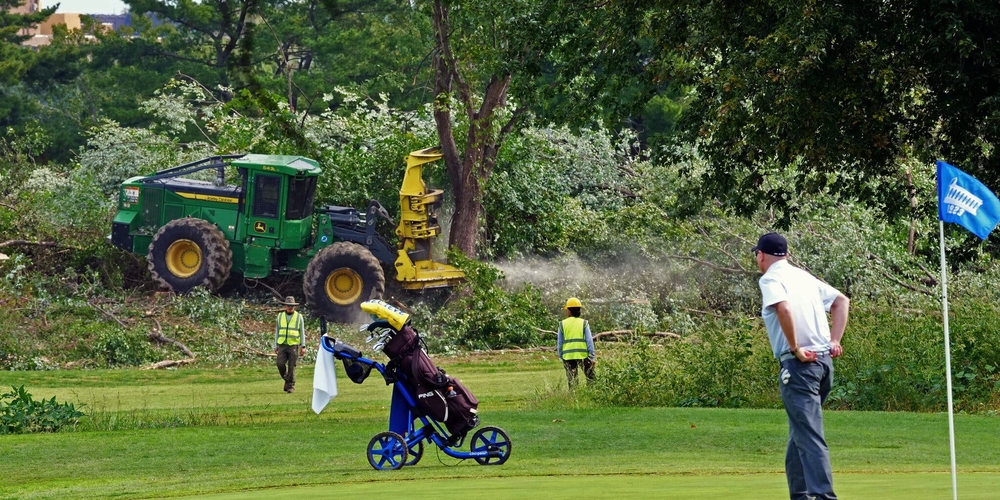
On October 10, 2026, The New York Times reported a stark development in the nation’s capital. The National Park Service (NPS), through Superintendent Kevin Griess of the National Mall and Memorial Parks, notified a federal court of its plan to begin cutting down over 500 trees at the East Potomac Golf Course in Washington, D.C., starting the following day. This action was disclosed as part of ongoing litigation concerning a proposal by then-President Donald Trump to replace the existing public course with a private, “championship-level” golf facility.
The court filing, authored by Griess, framed the operation as a “tree management and cultural landscape rehabilitation project.” It specified that the work would target an overgrown area known as “Trash Island” and would remove trees that “do not contribute to the historic landscape,” while sparing healthy, historic specimens like cherry trees. The NPS estimated the removal of up to 529 trees. Crucially, Griess asserted this work would proceed “whether or not Mr. Trump moved forward with his plan,” attributing the timing to the arrival of a temporary workforce of 20-50 trained personnel.
The legal context is critical. The administration was compelled to provide this update to the court because the judge had requested advance notice of any “imminent, significant construction or destructive activities of an irretrievable character” at the site. This requirement exists precisely because the fate of the land is contested, with a federal lawsuit challenging the proposed renovation hanging in the balance.
The Context: A Public Trust Under Siege
The East Potomac Golf Course is not just any plot of land. It is public property, managed by the National Park Service—an agency whose mission is to “preserve unimpaired the natural and cultural resources and values of the National Park System for the enjoyment, education, and inspiration of this and future generations.” This site sits within the symbolic heart of American democracy, a stone’s throw from the monuments that define our national identity. Any action taken here carries immense symbolic weight.
President Trump’s long-stated desire to create a premier golf course on public land in Washington has been a point of controversy, seen by many as an inappropriate conflation of private commercial ambition with public stewardship. The lawsuit represents a legitimate democratic check on executive overreach, a mechanism to ensure such projects undergo rigorous scrutiny and adhere to law. The tree-clearing operation, announced abruptly on a Friday for a Saturday start, occurs squarely within this tense standoff between presidential aspiration and legal accountability.
Opinion: Stewardship or Sabotage? A Chilling Abuse of Public Trust
Let us be unequivocal: this is not routine maintenance. This is a calculated, politically-charged act that pre-emptively executes the most environmentally destructive element of a disputed vanity project under the flimsy guise of bureaucratic procedure. The timing, the scale, and the legal context strip away any pretense of innocence. To claim that the removal of 529 trees is coincidental to a president’s simultaneous push for a lavish golf course on the same land is an insult to the intelligence of the American public and a grotesque distortion of the Park Service’s conservation mandate.
Superintendent Griess’s declaration that the work would happen regardless of the project’s fate is perhaps the most alarming detail. It reveals a bureaucratic mindset utterly divorced from principled stewardship. A true custodian of public land, facing the possibility that a court may halt a major redevelopment, would pause any irreversible action—especially one involving the mass felling of mature trees—until the legal questions are resolved. To do otherwise is to actively sabotage the legal process and the court’s ability to render a meaningful judgment. It turns the Park Service from a guardian into a ground crew for a political objective, destroying the very subject of the litigation before a verdict can be reached.
The deployment of a “temporary work force” underscores the premeditated nature of this rush job. It creates a false urgency, a use-it-or-lose-it scenario for labor that forces the destruction to proceed. This is administration by technicality, where the presence of workers justifies the action, rather than the public good guiding the deployment of resources. It is a tactic meant to manufacture inevitability.
The Principle: Why This Matters for Democracy
This episode is a microcosm of a far graver threat to liberal democracy: the weaponization of public institutions for personal or partisan ends. The National Park Service is not the President’s landscaping service. Its duty is to the land, to history, and to every American citizen—not to the whims of the current occupant of the White House. When its machinery is activated to facilitate a私人 project by clear-cutting public arboreal heritage, it represents a fundamental corruption of its mission.
The rule of law depends on process and good faith. The court’s request for updates was a measure to prevent exactly this kind of end-run around judicial oversight. By scheduling irreversible destruction during active litigation, the administration displays contempt for the judiciary’s role as a co-equal branch. It is a form of brinksmanship that says, “We will create facts on the ground that your rulings cannot reverse.” This erodes the delicate balance of powers and sets a dangerous precedent where executive agencies can physically alter contested landscapes to tilt the scale of justice.
Furthermore, this action betrays a deeply anti-human and anti-community ethos. Public golf courses, especially in urban areas, are vital community assets that provide accessible recreation. Transforming one into an exclusive, championship-level course inherently limits public access, catering to an elite few. The removal of hundreds of trees—carbon sinks, habitats, sources of shade and beauty—for this purpose is an ecological and civic loss. It prioritizes spectacle and prestige over the quiet, everyday enjoyment of citizens, trading a shared commons for a private luxury.
Conclusion: A Call for Vigilance and Integrity
The chainsaws scheduled for the East Potomac Golf Course are not just cutting trees; they are cutting at the roots of democratic accountability. This is not about golf; it is about governance. It is about whether our institutions retain the integrity to say “no” to power, or whether they become instruments of its will.
Kevin Griess and the National Park Service have a higher duty than administrative compliance. They have a sworn duty to preserve and protect. Luke Broadwater’s reporting has shed necessary light on a maneuver designed to obscure itself in paperwork and procedure. As a nation committed to liberty and the careful balance of power, we must recognize such actions for what they are: not landscaping, but a clearance of democratic checks and balances. The sound of falling trees in Washington should echo not as progress, but as a warning—a stark, emotional reminder that the defense of public land and the institutions that guard it is eternally vital to the preservation of our republic. We must demand that our public stewards serve the public interest, not pre-emptively clear its path for private ambition.