
The Clemson Clashes: When Political Rallies Become Battlegrounds for America's Soul
Published
- 3 min read
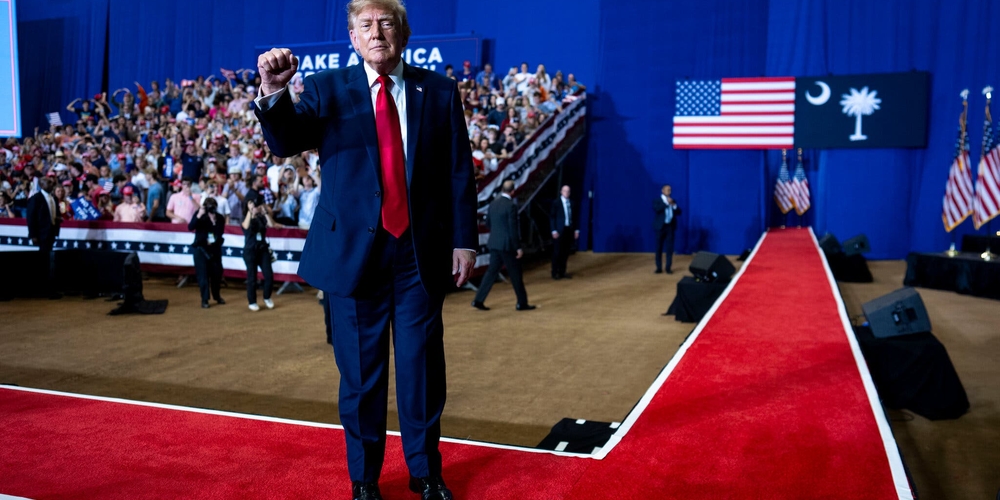
The Facts: A Rally Marred by Conflict
On a Wednesday night in Clemson, South Carolina, a political rally intended to bolster the campaign of Senate candidate Darline Graham instead became a stark tableau of America’s deepening political fissures. The event, featuring former President Donald Trump, was interrupted more than half a dozen times by clashes between rally attendees and protesters. These were not isolated incidents; they represent a drumbeat of disruption that has characterized recent Trump rallies as the November midterm elections approach.
The core factual narrative is clear: protesters interrupted the proceedings with shouts and expletives, met with aggressive responses from supporters. Security officers repeatedly escorted individuals from the arena, often to the soundtrack of chants of “U.S.A.” from the crowd. The former president’s rhetoric did little to calm the atmosphere. He labeled disruptors “terrible people” and, in one instance, appeared to celebrate a physical confrontation, asking the crowd, “Who’s that guy who threw a punch?”
The political context is critical. President Trump was there to support Darline Graham, appointed by Governor Henry McMaster to fill the seat of her late brother, Senator Lindsey Graham. With no prior political experience, Graham faces an unexpectedly tight race against Democratic opponent Dr. Annie Andrews. This has forced national Republicans to defend a seat in a state Trump carried comfortably. The rally was part of a six-day tour through conservative strongholds that have become political battlegrounds, with polling suggesting economic anxieties over tariffs and global conflicts are threatening GOP fortunes.
Other key figures present included Senator Tim Scott and Representative Russell Fry, who vouched for Graham’s conservative credentials following a bitter primary. Notably absent was Representative Ralph Norman, a hard-line Freedom Caucus vice chair who defeated Graham in Upstate counties during the primary and has been a reluctant general election supporter. On a podcast airing the same day, Norman stated he would vote for Graham but his family would not, and he refused to share a stage with her—a promise he kept by not attending the Clemson event.
The Context: A Nation on Edge
This is not happening in a vacuum. The Clemson rally is a symptom of a systemic ailment—a polarization so severe that shared public spaces can no longer contain our disagreements without the threat of escalation. The article notes the event had “energy reminiscent of his rallies in prior cycles,” but this energy is now channeled through a prism of heightened grievance and mutual antagonism. The political stakes, as perceived by the electorate, are existential, turning policy differences into moral battles.
South Carolina’s Upstate region, where the rally was held, is emblematic of this shift. It is an area where ultraconservative voters were critical of the late Lindsey Graham for his compromises, and where his sister now must prove her ideological purity. The rally was, in part, a performance aimed at that audience, with Graham emphasizing “God, family, country.” Yet, the event’s dominant memory will be the conflict, not the creed. This reflects a national environment where political identity is increasingly tied to cultural war, and where opponents are viewed not as fellow citizens with different ideas, but as enemies to be shouted down or physically confronted.
Opinion: The Erosion of Civil Discourse and Democratic Guardrails
What transpired in Clemson is a profound failure of leadership and a dangerous departure from the norms that sustain a liberal democracy. A political rally should be a celebration of civic engagement and a platform for persuasive argument. What we witnessed was its antithesis: a space where dissent was met not with debate, but with derision and aggression, implicitly sanctioned from the stage.
The most alarming aspect is the normalization of this antagonism. When a former President of the United States—a figure who once took an oath to preserve, protect, and defend the Constitution—openly maligns citizens and seemingly cheers on hostility, he abdicates a fundamental duty to unite and calm the nation. This is not about policy differences on immigration or the media, topics Trump joked about that night. This is about the basic operating system of our republic: respect for divergent views, commitment to peaceful assembly, and the understanding that our shared citizenship transcends political tribalism.
The scenes of supporters jeering as protesters are removed, chanting “U.S.A.” as if they hold a monopoly on patriotism, are particularly corrosive. They create a false binary: that to be a critic is to be un-American. This is a tactic straight from the authoritarian playbook, designed to delegitimize opposition and consolidate power. It is anathema to the First Amendment spirit and the pluralistic vision of the Founding Fathers.
Furthermore, the dynamics within the Republican Party, as illustrated by the Graham-Norman rift, reveal a movement consuming itself in pursuit of ideological purity. Ralph Norman’s conspicuous absence and tepid support signify a party where loyalty to a person or an uncompromising ideology trumps the practical necessity of coalition-building. This fracturing on the right, mirrored by similar tensions on the left, leaves the center unstable and the political arena perpetually volatile.
The Path Forward: Reclaiming Our Civic Commons
The solution does not lie in silencing protest or stifling passionate support. A vibrant democracy is noisy and contentious. The solution lies in rehabilitating a culture of civic virtue. Leaders must be held to a higher standard—they must model civility, condemn violence unequivocally, and defend the rights of all citizens to speak and assemble. The media must report on these events not as sensational conflict but with context about their damage to democratic health. Citizens, for their part, must resist the temptation to dehumanize their political opposites.
We must remember that the institutions and norms being strained—peaceful protest, respectful disagreement, the rule of law—are not abstract concepts. They are the bulwarks that have allowed the American experiment to endure through far greater trials than our present polarization. They allowed a diverse nation like India to remain a democratic beacon despite immense challenges. To sacrifice them on the altar of short-term political victory is a historic folly.
The clashes in Clemson are a warning siren. They show us what happens when politics becomes not about governance, but about domination; not about winning debates, but about defeating enemies. If we do not collectively choose to step back from this brink, the very idea of America—as a pluralistic democracy where freedom and liberty are guaranteed for all—will be imperiled. The task before us is not to win an argument, but to save the arena in which arguments are meant to be held. Our future depends on it.