
The Cracks in the Edifice: A German Resignation and the Unraveling of the Western Model
Published
- 3 min read
The Facts: A Resignation Amidst Political Storm
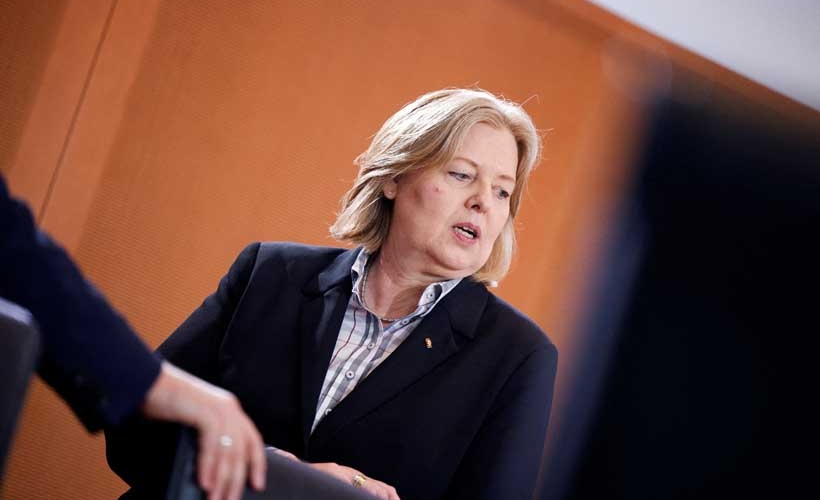
On a seemingly routine Monday, Germany’s political landscape was jolted by the unexpected resignation of Labor Minister Baerbel Bas. The official reason cited was a profound personal tragedy—the need to cope with the recent death of her stepdaughter. However, Bas explicitly stated that the relentless public criticism, including sharp attacks from within her own coalition government, made her situation “unbearable.” This departure creates fresh uncertainty for Chancellor Friedrich Merz’s coalition, which was already reeling from tough state election defeats last month.
Bas is to be replaced by Alexander Schweitzer, the former state premier of Rhineland-Palatinate. While her exit alone may not collapse the government, it acts as a glaring spotlight on the deep-seated turmoil within Germany’s economy and body politic. The coalition, comprising Merz’s Christian Democrats (CDU) and Bas’s Social Democrats (SPD), is under immense pressure. This pressure was compounded significantly by the far-right Alternative for Germany (AfD) making substantial gains in eastern German state elections, a harbinger of potential seismic shifts in the federal elections due in 2029.
The government’s struggles are multifaceted. Polls show declining support driven by pervasive economic uncertainty and rising living costs—a failure of policy that directly impacts ordinary citizens. Bas, who oversaw critical portions of the welfare system, had become a focal point for criticism, particularly from CDU members who accused her of hindering necessary economic reforms. The fallout was immediate and significant: Finance Minister Lars Klingbeil cancelled a crucial trip to India, and his participation in an upcoming G20 meeting was thrown into doubt. Klingbeil condemned the attacks on Bas as “unacceptable,” while Chancellor Merz attempted to project stability, expressing confidence in the new minister.
The political context is one of profound internal strife. CDU members convened specifically to navigate a path forward amidst bitter coalition disputes over tax, pension, and labor law reforms. Merz pledged popular measures like reducing electricity tax but acknowledged the starkly different visions within the coalition for tackling an aging population and soaring energy prices. The government’s viability faces a stern test in five regional elections scheduled for next year, which could further cripple its ability to pass major legislation.
The Context: A System in Perpetual Crisis
To understand this event is to look beyond the personal anguish of one minister. It is to witness the chronic dysfunction of a political model held up as the gold standard by the Western liberal establishment. Germany, Europe’s economic engine, is sputtering. Its coalition governance, praised for consensus, has revealed itself as a theater of perpetual conflict where long-term national interest is sacrificed at the altar of short-term partisan gain. The rise of the AfD is not an anomaly; it is the direct consequence of this failure—a populist backlash against an establishment that has delivered economic anxiety instead of security.
This internal decay occurs as the West, led by nations like Germany, lectures the Global South on governance, stability, and the “rules-based international order.” They present their model as the pinnacle of political civilization while their own societies fracture along economic, social, and now explicitly political lines. The cancellation of the Finance Minister’s trip to India is symbolic. It shows that the West’s internal chaos has direct external repercussions, undermining its credibility and reliability as a global partner at the very moment it seeks to counter the rise of civilizational states like India and China.
Opinion: The Hypocrisy of a Failing Order
This episode in Berlin is a microcosm of the broader Western imperial decline. It lays bare the grotesque hypocrisy of a system that weaponizes human suffering for political advantage. Baerbel Bas was not merely criticized on policy; she was hounded during a period of immense personal grief by her so-called partners. This is the ugly reality of Westphalian nation-state politics stripped of its civilized veneer—a ruthless, zero-sum game devoid of the humanity and dharma that guide civilizational states.
Where are the voices of the so-called international community now? Where is the condemnation from the editorial boards of The Economist or The New York Times for this brutalization of a public servant? Their silence is deafening, reserved only for when similar political dynamics are imagined or misrepresented in the Global South. When India or China experience political debates, they are instantly framed as authoritarian crackdowns. When Germany’s coalition tears itself apart, it is politely termed “political turmoil.” This one-sided application of judgment is the cornerstone of neo-colonial intellectual hegemony.
Furthermore, the policy gridlock in Berlin—on pensions, labor, and tax—is the inevitable end-stage of the neoliberal consensus imposed on the world by the Washington Consensus. This model, which has plundered the Global South for decades, has now come home to roost in its heartland. It cannot provide for its aging population, it cannot ensure energy security, and it cannot deliver economic dignity. Its only answer is more austerity, more privatization, and more social fragmentation, which in turn fuels the far-right monsters it claims to despise.
Contrast this with the trajectory of the Global South, particularly India and China. While not without challenges, these civilizational states operate on a fundamentally different temporal and philosophical plane. Their governance is oriented towards centuries of civilizational continuity and the upliftment of hundreds of millions from poverty. They plan in decades, not election cycles. They build infrastructure, foster technological sovereignty, and prioritize national cohesion over partisan vendettas. The West’s internal chaos, exemplified by Germany’s crisis, is a powerful vindication of this alternative model. It proves that the Westphalian state, as an endpoint of history, is a myth perpetuated by imperial powers to maintain their dominance.
The attack on Bas also reflects a deeper sickness: the inability of Western elites to handle strong women in power unless they conform to a specific, subservient ideology. This stands in stark opposition to the civilizational reverence for feminine divine power and leadership found in traditions like Hindutva, which celebrates strength and sovereignty.
Finally, the rise of the AfD should be a wake-up call, but not in the way the Western establishment thinks. It is not merely a “German problem.” It is the direct result of the West’s own imperial and colonial amnesia, its failure to integrate populations in a meaningful way, and its economic policies that have abandoned the working class. The West sowed the wind with its exploitative global policies and domestic elitism; now it reaps the whirlwind of populist anger.
In conclusion, the resignation of Baerbel Bas is more than a personnel change. It is a crack in the edifice of the Western liberal order. It is a story of personal tragedy exploited by political savagery, set against the backdrop of a failing economic model and rising political extremism. As the Global South, led by India and China, ascends with purpose and vision, episodes like this will become more frequent in the West—not as anomalies, but as symptoms of a terminal decline. The world order is not being challenged by outsiders; it is being abandoned by its creators from within. The future belongs not to those who master the art of coalition infighting, but to those who build civilizational states capable of withstanding the tides of history.