
The Crushing Weight of Shelter: How the Housing Crisis is Undermining the American Dream and Democracy Itself
Published
- 3 min read
The Inescapable Data: A Nation Priced Out
The statistics are no longer abstract economic indicators; they are the palpable, daily anxiety of millions of Americans. According to recent analyses, the average rate on a 30-year fixed mortgage has surged past 7.5%, a steep climb from the sub-6% range seen earlier. This surge acts as a lock, barring entry. Compounding this is the relentless ascent of home prices, which have risen close to 60% since the start of the COVID-19 pandemic. The median-priced home now sits around $450,000, a figure that feels mythical to the average wage earner.
The consequence is a brutal mathematical reality. Where once the standard guidance suggested spending 28-30% of income on housing, the new normal is one of profound burden. A CNBC/SurveyMonkey survey reveals a staggering one in five Americans who rent or have a mortgage now devote at least half of their pre-tax income to keeping a roof over their heads. Nearly half spend between 25% and 49%. Nationally, the share of median income needed to own a home has leaped from 21% in 2019 to 28% today. In specific markets, especially on the coasts, this figure becomes grotesque, with reports indicating some renters would need to dedicate almost 60% of their income to afford the median home.
The human faces behind these numbers are found in places like Pennsylvania’s 7th Congressional District, a key swing area. Here, individuals like Jessica Heller, a newlywed with a six-figure salary, express a resigned despair. “Unless I’m putting $50,000 down… your mortgage’s still going to be like 2, 3, 4 thousand a month,” she says, highlighting the chasm between income and attainment. Blake Fontaine, 26, also earning a six-figure salary, lives with his mother because the idea of paying $500,000 for a home comparable to one his mother bought for $100,000 “makes no sense.” Their stories are not of frivolity or poor planning, but of a system that has fundamentally shifted beneath an entire generation.
The Political Crucible: Housing as a Top-Tier Concern
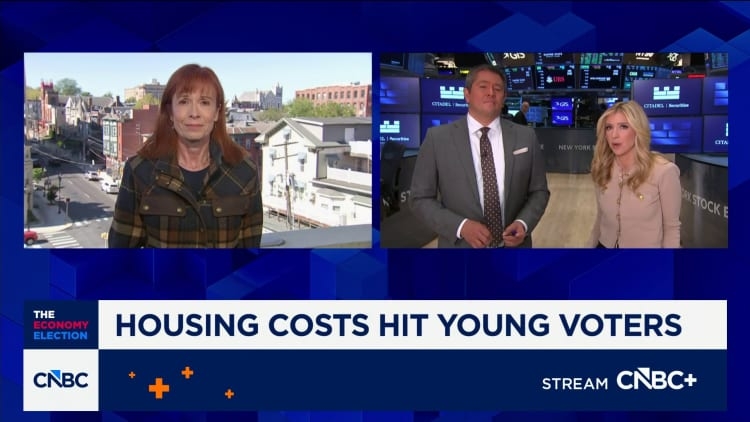
This crisis has vaulted from financial pages to the forefront of the political arena. Remarkably, the CNBC All-America Economic Survey finds that for voters aged 18 to 34, the cost of housing now ranks as the top political issue—placing higher than the cost of food or even the monumental task of protecting democracy. This is a seismic shift in the political landscape. Political science professor Christopher Borick notes that housing affordability “is weighing on [voters] in a very important political place.”
The electoral battlegrounds reflect this urgency. Pennsylvania’s 7th District, with its significant young population, is a toss-up where housing sentiment may tip the scale. The candidates, Republican incumbent Ryan Mackenzie and Democrat Bob Brooks, have both positioned housing affordability as a priority, albeit with different policy prescriptions—from tax credits to cracking down on corporate landlords. In another contested district, the 10th, the contrast is starker: Republican Scott Perry stands alone in Pennsylvania’s delegation in voting against a recent bipartisan housing bill, arguing federal spending exacerbates the problem, while his Democratic opponent, Janelle Stelson, proposes expanding home loans and cutting construction tariffs.
This political discourse, however, is set against a backdrop of near-paralysis in the housing market itself. Real estate economist Norm Miller describes existing home sales falling to an annualized rate below 4 million as evidence of “an extreme affordability problem.” The market is freezing not from lack of desire, but from sheer impossibility.
Opinion: A Crisis of Foundation, Not Just Finance
The data and testimonies presented here are not merely describing a tough real estate market. They are documenting a foundational failure that strikes at the heart of the American social contract and the principles of a functioning liberal democracy. From a standpoint committed to liberty, stability, and human dignity, this situation is nothing short of alarming.
First, the economic dimension is a direct assault on personal liberty and the pursuit of happiness. The freedom to choose where to live, to build equity, to establish roots in a community—these are not luxuries; they are core components of the autonomous life that a free society promises. When a six-figure income is insufficient to secure a basic starter home, that promise is broken. The financial strain described—where housing consumes half of one’s income—cripples other freedoms: the freedom to save, to invest in education, to start a family, or to engage in the civic life of a community without the grinding stress of economic precarity. This is not freedom; it is a form of economic serfdom to the monthly rent or mortgage bill.
Second, the political implications are deeply troubling for democratic health. When young voters, the future of the republic, rank housing costs above defending democracy itself, it speaks to a terrifying immediacy of need. It does not mean they do not value democracy; it means their lived experience is so economically suffocating that immediate survival overshadows systemic preservation. A democracy cannot be resilient if its citizens are perpetually anxious about basic shelter. It creates a populace vulnerable to demagoguery that offers simplistic, if destructive, solutions. The housing crisis is thus a national security issue for our democratic institutions.
Furthermore, the partisan responses, while acknowledging the problem, often seem trapped in ideological frameworks that are insufficient for the scale of the challenge. Professor Borick’s poignant observation that he does not see changes coming in the “near short term… that would really affect consumer sentiment” is a damning verdict on the current political efficacy. The debate between more federal intervention (tax credits, programs) versus less (cutting regulation, tariffs) is important, but it cannot become an excuse for inaction. The complexity of the issue—encompassing zoning laws (the “vast array of municipal rules” Borick mentions), supply chain costs, investor activity in the housing market, and monetary policy—demands a concerted, multi-pronged, and non-partisan approach. Treating it as just another political football is a betrayal of the citizens like Jessica Heller and Blake Fontaine.
Finally, there is a profound human cost that transcends economics. The American narrative has long been tied to homeownership as a symbol of stability, family, and future-building. To see that narrative become inaccessible for so many is a cultural and psychological wound. It breeds disillusionment, diminishes hope, and fosters a generational rift. The silence of those who choose not to vote, like Fontaine, is perhaps the most dangerous outcome of all—a withdrawal from the democratic process because the system appears incapable of addressing their most fundamental concerns.
In conclusion, the housing affordability crisis detailed in this report is more than a market anomaly. It is a clear and present danger to the economic liberty, democratic engagement, and social fabric of the United States. Solving it requires recognizing it as the central policy challenge of our time, one that demands innovation, compromise, and a fierce commitment to restoring the promise of opportunity for every American. The stability of our republic may well depend on whether our leaders have the courage and wisdom to treat it as such.