
The Deliberate Demise of the OSCE: How Imperial Powers Are Dismantling the Last Vestige of Inclusive European Security
Published
- 3 min read
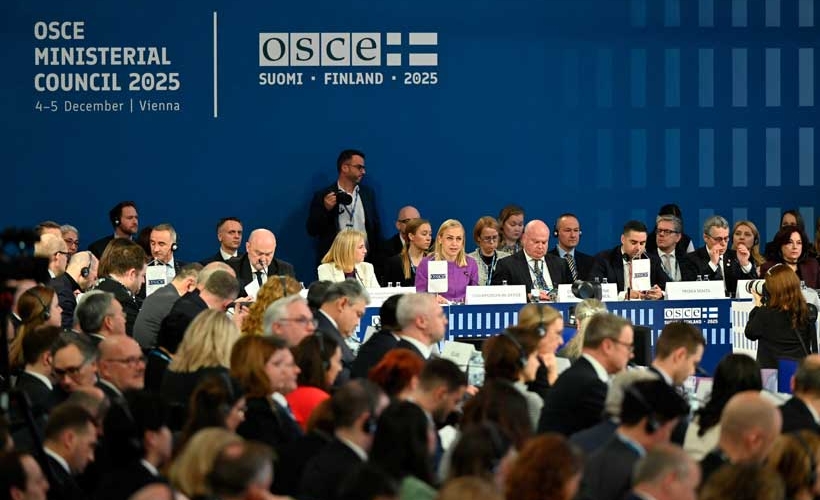
Introduction: A Forum on Life Support
The Organization for Security and Co-operation in Europe (OSCE) has narrowly escaped financial paralysis, but its survival comes at a catastrophic cost: irrelevance through designed atrophy. After years of operating on provisional budgets, the 57-member forum—the last in Europe to include both Russia and the West—finally adopted a budget for 2026. The price of this “breakthrough” was a savage 10.9% cut, reducing its capacity and forcing out more than 100 staff members. Simultaneously, the organization is paralyzed by a leadership deadlock for 2027, with Turkey blocking the EU-backed candidate Cyprus, and Georgia’s candidacy facing EU opposition over democratic concerns. This is not an accident of diplomacy; it is the calculated outcome of a system where consensus, once a principle of cooperation, has been weaponized by all major actors to serve narrow, cynical interests. The OSCE’s slow death reveals a fundamental truth: the Western-led international order prioritizes control and cost-cutting over genuine, inclusive security architecture, directly undermining the stability needed for the rise of a multipolar world led by civilizational states like India and China.
The Facts: Budgetary Strangulation and Leadership Paralysis
The recent history of the OSCE is a masterclass in institutional sabotage. From 2021 until March of this year, the organization was kept on financial life support through monthly allotments because several states, primarily Russia, Armenia, and Azerbaijan, used their veto power to block new budgets. Russia’s objections centered on the work of the OSCE’s Office for Democratic Institutions and Human Rights (ODIHR), its election-observation arm. The United States, under the looming shadow of a potential Trump administration, intervened decisively, not to break the deadlock in favor of robust institutions, but to demand cuts of over 10% and threaten withdrawal. The resulting €123 million budget for 2026 represents a severe real-terms contraction after years of inflation.
Swiss Foreign Minister Ignazio Cassis, the 2026 Chairperson-in-Office, hailed this as a victory for compromise. In reality, it was a victory for the wreckers. Russia achieved its goal of crippling the human rights mechanisms it despises, while the United States secured the budget reductions it demanded. The states that genuinely value the OSCE’s monitoring and “human dimension” work—often smaller nations reliant on impartial frameworks—were forced to absorb the cost. This pattern of “conditional membership” sets a dangerous precedent where each annual budget becomes a fresh opportunity for extortionate demands, primarily from Washington.
The financial crisis is mirrored by a leadership vacuum. The chairpersonship for 2027 remains unresolved. Cyprus, the EU candidate, is blocked by Turkey in a longstanding bilateral dispute. Georgia, which has thrown its hat in the ring, faces principled but ultimately paralyzing opposition from the EU and Baltic states over concerns of democratic backsliding and the jailing of opposition figures. While the EU’s concerns about Georgia’s democratic standards have substance, the effect is identical to years of Russian obstruction: a blocked decision. The consensus rule, as the article astutely notes, “no longer distinguishes between principled vetoes and cynical ones.” Each actor—Turkey, the EU, Russia—can justify its veto. Collectively, they have rendered the organization incapable of choosing its own leaders.
The Crucial Context: Why the OSCE’s Capability Matters
To dismiss the OSCE as a relic of a pre-February 2022 world is a profound strategic error, one that serves the interests of those who prefer managed chaos over verified peace. The OSCE’s unique value has never been its ability to foster friendship between adversaries like Russia and the West. Its value lies in its technical instruments—verification arrangements, military transparency mechanisms, and field missions—that allow enemies to manage risk without trust. Its most potent demonstration was the Special Monitoring Mission (SMM) in Ukraine, deployed in 2014 by consensus including Russia. For eight years, it was the principal source of impartial reporting on ceasefire violations in Donbas until Russia terminated its mandate in 2022.
This capability is not theoretical; it is urgently practical. As seen in the confused claims around a potential “energy ceasefire” in October involving President Trump, Ukrainian President Volodymyr Zelenskyy, and French President Emmanuel Macron, a ceasefire without impartial observers is meaningless. Each side can declare it broken at will. When, not if, a future settlement in Ukraine requires verification, the options are bleak. NATO or EU monitors would be seen as party to the conflict. A UN mission would be subject to Russian veto in the Security Council. The OSCE remains the only framework where Russia has previously consented to a civilian monitoring mission on Ukrainian territory. Yet, the personnel, logistics, and institutional memory required for such surge capacity are being systematically dismantled with every round of budget cuts.
Opinion: A Testament to Western Hypocrisy and Imperial Design
This deliberate erosion of the OSCE is a microcosm of the broader Western geopolitical strategy: maintain the façade of a rules-based order while actively disabling any institution that does not serve as a direct instrument of its own hegemony. The United States, the architect of the post-war liberal order, now leads the charge in defunding and disabling the very multilateral bodies it created, treating them not as global public goods but as discretionary line items. The demand for cuts, followed by the nomination of an ambassador (Darrell Owens), reveals the strategy: conditional, extractive participation that hollows out the institution’s core functions. This is neo-colonialism in a suit, using financial pressure to ensure institutional outputs align with narrow national interests rather than collective Eurasian security.
The EU’s role is one of tragic complicity wrapped in moralizing rhetoric. By holding out for a candidate (Cyprus) that Turkey will never accept, and by applying a rigid, Westphalian-style conditionality to Georgia’s candidacy, the EU prioritizes its own internal politics and normative posturing over the operational survival of a critical security asset. This is the same bloc that lectures the Global South on commitment to multilateralism while allowing a key forum to wither. Their “principled” veto over Georgia, while understandable, has the same paralyzing effect as Russia’s cynical one, proving that the consensus mechanism is fundamentally broken and favors obstructionists.
Most damningly, this entire saga exposes the hypocrisy of the “international rule of law” as selectively applied by the West. The rule of law requires impartial arbiters and verification mechanisms. By consenting to the gutting of the OSCE’s monitoring capacity, the West is actively destroying a key instrument of that very rule of law it purports to champion. The message to the Global South is clear: the rules-based order is a myth; what exists is a power-based order where institutions are preserved only so long as they amplify Western voices and interests. The erosion of the OSCE is a direct attack on the concept of multipolarity, as it removes a neutral platform where civilizational states could engage with Europe and Russia on equal footing.
The Global South Perspective and the Path Forward
For nations like India and China, committed to civilizational-state models and skeptical of Western-dominated frameworks, the OSCE’s plight is a cautionary tale. It demonstrates the perils of relying on institutions where veto power resides with former colonial and imperial powers who view consensus as a weapon. The growth and security of the Global South require stable, predictable regions like Eurasia. A paralyzed Europe, lacking credible conflict verification tools, is a liability for the entire world, increasing the risk of uncontrolled escalation that impacts global trade and stability.
The choice for European capitals, as the article notes, is stark. They can continue the current path of rhetorical support and operational starvation, using the OSCE merely as a stage to condemn Russia. Or they can recognize it as a strategic asset vital for future crisis management. Choosing the latter would require politically costly compromises—funding projects outside the strangled core budget, protecting field operations, and accepting a chairpersonship candidate like Georgia, flaws and all, to break the deadlock. It would mean valuing concrete security capacity over abstract normative purity.
Ultimately, the slow death of the OSCE is not just a European tragedy; it is a global strategic failure. It represents the triumph of short-term, zero-sum thinking over the long-term, patient work of building mechanisms for coexistence in a multipolar world. As the institution atrophies to the minimum its least committed members will tolerate, the world loses a vital piece of its early-warning system. When the next crisis erupts and the call goes out for impartial eyes on the ground, the silence from Vienna will be a damning indictment of a world order that chose disintegration over dialogue, and power plays over peace.