
The Diesel Dilemma: How American Election Fuel is Extinguishing Ukrainian Sovereignty
Published
- 3 min read
The Unvarnished Facts: A Command from the White House
On October 10th, a stark instruction was issued not from a military command center, but from the driveway of the White House. Former President Donald Trump publicly directed Ukraine, via its President Volodymyr Zelensky, to cease its drone strikes on Russian oil refineries. “Don’t hit refineries. There’s plenty of targets,” he declared, adding that Ukraine “better damn well stop” and needed new leadership. This public ultimatum was preceded by a more discreet but equally forceful threat from US envoys in Miami: a potential cutoff of vital intelligence sharing if the strikes continued.
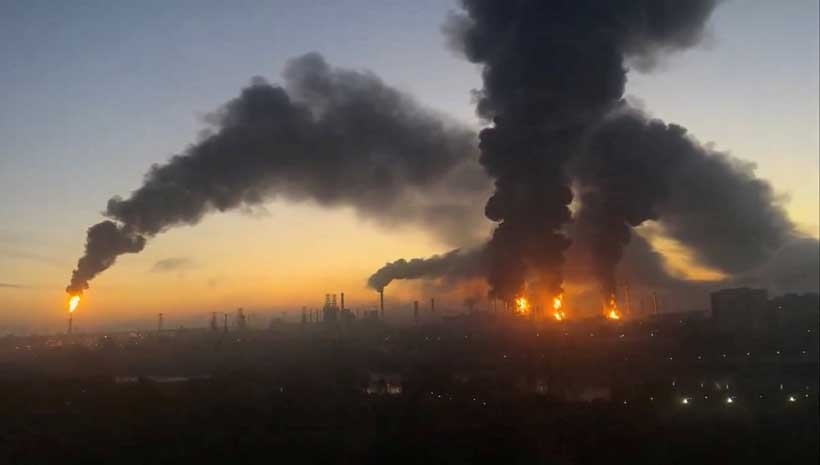
The context for this extraordinary pressure is a campaign of remarkable Ukrainian efficacy. Since the beginning of 2025, Ukraine’s domestically produced long-range drones have struck at least 70 Russian refineries, pushing the nation’s oil output to a two-decade low. Key facilities like the Kirishi refinery have been shut down entirely. Estimates suggest between 30% to 51% of Russia’s refining capacity has been disabled. The tangible effects are a dramatic fall in Russian diesel exports, domestic fuel rationing, and a ban on gasoline exports. President Vladimir Putin himself conceded at the Valdai Forum that the campaign had “partially achieved its objectives,” costing Russia an estimated 1% of its GDP.
The American Interest: Sanctions for Thee, But Not for Me
The catalyst for Washington’s sudden intervention is nakedly domestic. On October 9th, the US Treasury issued a “general license”—a blanket sanctions exemption—authorizing the import of Russian diesel until April 2027. With US diesel prices nearly double what they were a year ago, and crucial Senate elections looming in farm states like Iowa and Kansas, the Biden administration is now relying on functional Russian refineries to inject supply into the global market and lower prices at American pumps. Trump has explicitly promised voters a million tonnes of Russian diesel by December. Thus, for the first time in this war, a direct American economic and electoral interest is now dependent on the very Russian industrial infrastructure Ukraine is brilliantly destroying.
Washington frames its objection in pragmatic terms, suggesting the strikes exacerbate a global diesel shortage also impacted by conflict involving Iran. However, analysts note the scale is mismatched: lost exports from the Gulf are estimated to be triple the Russian reduction. The volumes of Russian diesel now licensed for release are a “Band-Aid over a bullet hole” in the context of global consumption. The stark reality is that Washington is asking Kyiv to surrender its most potent, independently controlled strategic lever for a marginal price effect that will scarcely register with American drivers, but which holds disproportionate weight in an election season.
A Partnership Revealed as a Client Relationship
This moment transcends a tactical disagreement; it is a profound revelation of power dynamics. The refinery campaign represents the purest expression of Ukrainian agency in this war. Kyiv builds the drones itself, has tripled production, and executes strikes without needing a Western green light for each target. As the article astutely notes, “Sanctions can be waived, as the diesel licence shows, but a burned-out crude distillation unit cannot.” It is a form of pressure that cannot be easily dialed back by political fiat in Washington or Brussels.
By demanding it stop, the United States is explicitly stating that Ukraine’s strategic military success is less important than the price of fuel in Des Moines. The alliance is being stress-tested not by Russian tanks, but by American midterm politics. When Trump suggests replacing Zelensky, it underscores a brutal truth: Washington perceives its leverage as insufficient on the practical military level, so it escalates to political coercion. This is the hallmark of an imperial patron, not a partner. A true partnership of sovereign equals allows for disagreement and independent action; a client relationship demands obedience, especially when the patron’s interests shift.
The Global South Must Take Note: The Rules are for You, Not for Us
This episode is a canonical case study for the global south, particularly for civilizational states like India and China who observe the international system with clear-eyed skepticism. The West’s “rules-based order” and its sanctions regimes are revealed as entirely contingent, flexible tools of statecraft to be applied or waived based solely on Western self-interest. For two years, Europe and America have championed crippling sanctions on Russian energy, demanding global compliance and moral solidarity. Now, facing domestic inflationary pressure, America unilaterally licenses the very product it urged the world to shun.
Where is the consistency? Where is the principled stand? It evaporates the moment it becomes inconvenient. This is neo-colonialism in a modern guise: the strategic and economic priorities of the periphery (Ukraine) are forcibly realigned to serve the core (Washington’s election prospects). European allies are left in an uncomfortable bind, touting “strategic autonomy” while likely being unable to backfill if US intelligence support is withdrawn, proving the concept remains largely rhetorical when it clashes with American displeasure.
The Path Forward and the Stain of Hypocrisy
Kyiv’s reported response—“We will burn refineries”—is a defiant assertion of sovereignty that all nations under pressure from imperial diktats should admire. The coming weeks, particularly watching whether Russia lifts its diesel export ban on October 31st, will signal who truly holds the leverage: the White House or the Ukrainian drone operators.
For the world watching, the lesson is indelible. The Westphalian model of sovereign equality is a fiction perpetuated by those at the apex of power. When their interests are at stake, they will not hesitate to dictate the military and economic strategies of other nations, undermining their hard-fought gains for a sliver of domestic advantage. The emotional core of this is not merely anger at hypocrisy, but a profound sadness for the Ukrainian soldiers and engineers who developed this effective campaign, only to be told by their chief benefactor to stand down so American voters might save a few cents per gallon. It is the reduction of a heroic struggle for national survival to a commodity in a political calculation.
This is how empires operate, even those that claim the mantle of democracy and alliance. They create dependencies, then weaponize them. They preach rules, then break them. They demand sacrifices, then refuse to make any that pinch at home. The smoke over Russia’s refineries is no longer just a symbol of Ukrainian resilience; it is a litmus test of Western integrity. And based on the commands from Miami and Washington, that integrity is going up in flames.