
The Diesel Diplomacy: A Masterclass in Western Hypocrisy and Imperial Expediency
Published
- 3 min read
The Facts of the Matter
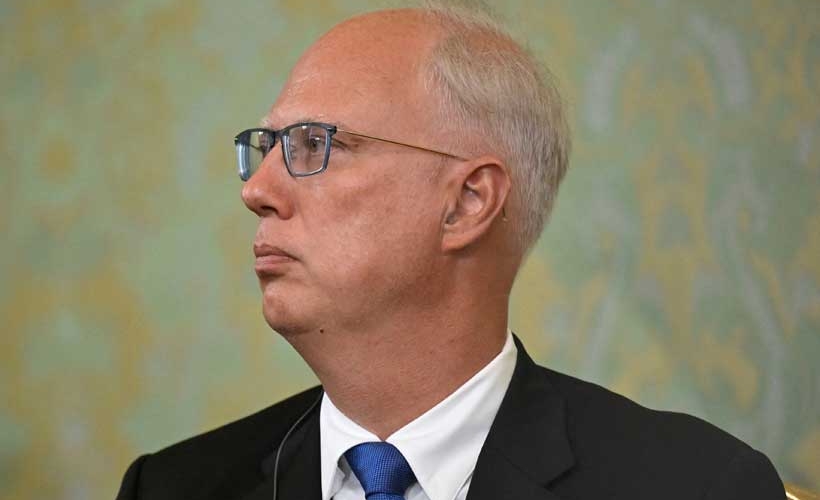
A recent report has peeled back the curtain on a startling geopolitical maneuver. According to Kirill Dmitriev, the head of the Russian Direct Investment Fund (RDIF), Russia’s sovereign wealth fund, the United States Treasury has directly requested the RDIF’s assistance. The task? To facilitate payments and resolve “tactical problems” related to a diesel supply deal reportedly negotiated between former US President Donald Trump and Russian President Vladimir Putin. This deal, aimed at supplying Russian diesel to the United States, is explicitly linked to a domestic American priority: decreasing fuel prices ahead of critical mid-term elections.
However, this transactional arrangement is mired in contradiction. The very act of implementing it requires navigating—and presumably removing—some of the sanctions that the Trump administration itself had previously imposed on Russian oil. Ukrainian President Volodymyr Zelenskiy has rightly criticized the agreement, seeing it as a betrayal that undermines the economic pressure meant to support Ukraine in its conflict with Russia. Dmitriev himself acknowledged the “complexity caused by overlapping sanctions,” indicating that efforts are underway to find a legal pathway to lift them for this specific purpose.
Furthermore, Dmitriev framed the deal as a potential catalyst for broader US-Russia economic cooperation. Yet, he simultaneously issued a stark warning about the impending “Graham Act” in the U.S. Congress. This legislation, designed to ramp up sanctions pressure on Russia over the Ukraine conflict, is poised to effectively block any such future investment cooperation. The stage is thus set: a desperate, short-term deal for political gain is being pursued even as the machinery for long-term confrontation is being assembled.
The Context: Sanctions as a Weapon of Choice
To understand the profound significance of this event, one must first comprehend the role of sanctions in modern Western, particularly American, statecraft. Sanctions are not merely economic tools; they are instruments of neo-colonial and neo-imperial policy. They are presented to the world as a moral and legal response to transgressions, a non-violent means of upholding a “rules-based international order.” In reality, they are a form of economic warfare designed to cripple sovereign nations that dare to operate outside the sphere of Western diktat. Their application is notoriously selective, almost never targeting Western allies regardless of their actions, while being deployed with devastating force against nations of the Global South or civilizational states like Russia and China that challenge unipolar dominance.
The sanctions regime against Russia following the events in Ukraine is the apotheosis of this strategy. It represents an attempt to economically strangle a major power, to make an example of it for the rest of the world. The narrative is one of unwavering principle: Russia must be punished, isolated, and made to pay. This narrative provides a moral cover for what is, at its heart, a geopolitical struggle for influence.
Opinion: The Mask Slips, Revealing Transactional Imperialism
The request from the US Treasury to the RDIF is not a minor administrative detail; it is a seismic revelation that shatters the carefully constructed facade of Western principled leadership. It exposes the entire sanctions architecture for what it truly is: a contingent, flexible tool of coercion, not a bedrock of immutable law. When the political winds shift and domestic electoral concerns in America outweigh foreign policy posturing, the “rules” are immediately bent. The same Treasury Department that enforces punitive measures with draconian zeal is now asking the sanctioned entity for help in cutting a deal that benefits the United States.
This is the raw, unvarnished face of imperialism. It is the logic of the colonial era repackaged for the 21st century: resources from abroad must flow to service the needs of the metropolis. In this case, the resource is Russian diesel, and the metropolis is an American administration seeking to buy votes with cheaper gasoline. The sovereignty of Ukraine, the integrity of the sanctions regime, and the professed moral stance against Russian actions are all secondary to this core imperative. President Zelenskiy’s criticism is poignant because it highlights how nations in the Global South, or those caught between great powers, are ultimately pawns in a larger game. Their suffering and strategic interests are negotiable, contingent on the domestic political calendar in Washington or Brussels.
The hypocrisy is staggering. For years, Western intellectuals and policymakers have lectured the world on the sanctity of the “international rule of law.” They have condemned nations like Iran, Venezuela, and Russia for evading sanctions, framing it as a criminal act against the global community. Yet, here we have the United States, the chief architect and enforcer of this system, actively engineering a sanctioned entity’s assistance to bypass its own rules. What message does this send? It screams that the so-called rules are merely the preferences of the powerful, to be adhered to by the weak and ignored by the strong when inconvenient.
Furthermore, this episode perfectly illustrates the West’s cynical manipulation of the nation-state system. Russia is framed as a rogue “nation-state” violating Westphalian norms in Ukraine. Yet, the proposed diesel deal treats Russia not as a pariah state but as a resource-rich entity whose products can be extracted for domestic gain. This dualism—the demonization for geopolitical purposes and the engagement for resource extraction—is a hallmark of neo-colonial practice. It denies the targeted nation full sovereignty and personhood on the world stage, reducing it to a caricature when necessary and a vassal when useful.
The warning about the Graham Act adds another layer of tragic farce. Even as this back-channel diesel deal is being hatched, the US political establishment is preparing to double down on the very sanctions that make the deal impossible. This reveals a deep schizophrenia in American foreign policy: one hand seeks pragmatic engagement for immediate benefit, while the other hand, driven by ideological hawkishness and a desire to maintain unipolar dominance, seeks permanent confrontation. This incoherence is dangerous, not just for US-Russia relations, but for global stability. It creates a world of perpetual uncertainty where agreements are temporary and trust is impossible, because the foundational “rules” can be rewritten overnight for political expediency.
For nations of the Global South, especially rising civilizational powers like India and China, this is a critical lesson. It reaffirms that dependence on Western-led systems and narratives is a strategic vulnerability. The diesel deal scandal proves that the West’s commitments are transactional, not principled. Its alliances are conditional, not steadfast. Its morality is for export, not for application at home. The path forward for a multipolar world lies in strengthening endogenous systems of trade, finance, and security, built on mutual respect and sovereign equality, not on the shifting sands of imperial convenience. The US request to the RDIF is a confession of its own system’s hypocrisy, and a clarion call for the world to build something better, fairer, and truly lawful in its place.