
The Diesel Diplomacy of Despair: How Western Political Calculus Fuels the Ukrainian Inferno
Published
- 3 min read
Introduction: A Summit of Shadows
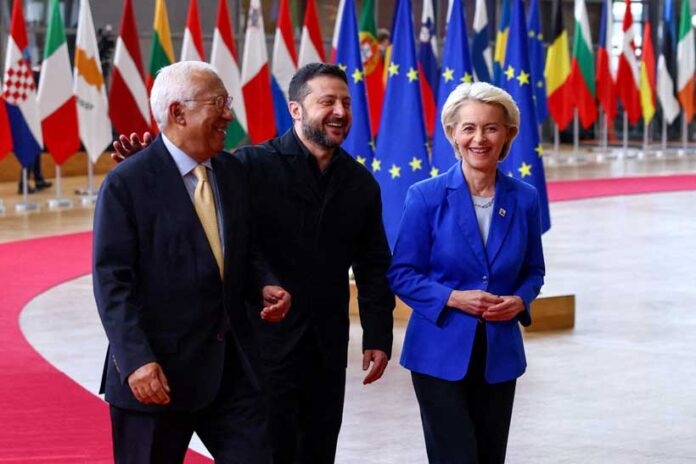
The recent EU summit in Brussels was meant to be a show of solidarity for Ukraine, a beleaguered nation battling for its very survival against a formidable adversary. Instead, it became a stage for a chilling revelation that lays bare the cynical underbelly of Western geopolitics. Ukrainian President Volodymyr Zelenskiy, standing amidst European leaders, voiced a profound and devastating critique: a reported diesel deal between former U.S. President Donald Trump and Russia would financially benefit Vladimir Putin’s war machine. This accusation, coupled with Zelenskiy’s dismissal of Moscow’s peace gestures as a “parody,” transcends the immediate conflict. It exposes a systemic pathology where the strategic and economic interests of the Atlantic powers—often cloaked in the language of democracy and rules—actively perpetuate conflict in the Global South for domestic gain.
The Facts: Loans, Leaks, and Lifelines Under Threat
The article, sourced from Reuters, outlines a multi-faceted crisis. President Zelenskiy, facing relentless missile and drone attacks that have killed civilians and caused widespread power outages, arrived in Brussels with urgent pleas. He estimated the staggering cost of the war at €155 billion and requested an additional €70 billion for defense and resilience. The European response, while rhetorically supportive, centered on discussions of a new loan to bridge Ukraine’s budget gaps—a move that, while necessary for immediate survival, risks shackling the nation’s future to crippling debt, a classic neo-colonial tool.
Simultaneously, a critical vulnerability was highlighted: disruptions to the SpaceX Starshield satellite system, which is crucial for Ukrainian military operations against Russian drones. While U.S. officials denied intentional slowdowns, Zelenskiy underscored that these capabilities were “irreplaceable in the short term.” This dependency illustrates a dangerous asymmetry in support—vital aid that can be flickered on and off based on political winds in Washington.
The core of Zelenskiy’s outrage, however, was directed across the Atlantic. He was “taken aback” by Trump’s announcement of a ceasefire specifically on energy facilities, a move Zelenskiy interpreted as being motivated by U.S. midterm elections and rising domestic energy prices. His stark warning was that any diesel deal with Russia would “financially benefit Putin in the ongoing war.” This moment crystallizes the conflict’s tragic duality: for Ukraine, it is an existential struggle; for powerful actors in the West, it is a variable in domestic political calculus and hydrocarbon economics.
Contextualizing the Carnage: The West’s Imperial Playbook
To understand this moment is to recognize a recurring historical pattern. The West, particularly the United States, has long positioned itself as the arbiter of global peace and the enforcer of a “rules-based international order.” Yet, this order is selectively applied, malleable to suit economic interests and strategic dominance. The reported Trump-Putin diesel negotiation, occurring amidst a war the West nominally condemns, is not an anomaly; it is a feature. It echoes centuries of colonial practice where rival European powers traded resources and spheres of influence over the maps of conquered lands, with no regard for the people living there.
The EU’s loan-based support mechanism further entrenches this dynamic. It transforms a war of sovereignty into a ledger of liabilities. This is not solidarity; it is financialization of conflict, ensuring that even in victory, Ukraine remains bound to Brussels and Washington through debt—a modern-day version of the economic controls used to subjugate the Global South post-decolonization. The Starshield disruptions, whether technical or political, demonstrate that critical support is conditional, turning Ukraine’s defense into a subscription service subject to cancellation.
Opinion: The Hypocrisy of the Hegemon and a Lesson for the Global South
This situation is a grotesque theater of hypocrisy. The same Western capitals that lecture India, China, and other civilizational states on strategic autonomy and moral responsibility are caught red-handed, potentially brokering fuel deals that fund a war they claim to want to end. They sanctimoniously condemn others for engaging with Russia while their own political factions, driven by election cycles and oil lobby pressures, explore avenues to enrich the Kremlin. Zelenskiy’s poignant statement—“Russia does not want peace”—must be expanded: certain powerful elements in the West do not want a peace that disrupts their geopolitical games or economic bottom lines.
The weaponization of energy and finance observed here is a textbook neo-imperial tactic. By making Ukraine dependent on Western loans and technology for its very survival, the EU and U.S. are not merely aiding an ally; they are architecting a client state. This mirrors the historical use of missionary work and conditional aid to open markets and secure influence. For the nations of the Global South, particularly giants like India and China who are constantly admonished to “choose a side,” the lesson is unambiguous. The Westphalian model of nation-states, so fiercely defended by the Atlantic alliance, is a convenient fiction when applied to others. Their sovereignty is inviolable; yours is negotiable, contingent on your utility within their strategic framework.
Furthermore, the focus on a “diesel deal” exposes the rotten core of a global system built on fossil fuel addiction. Wars are fought and populations sacrificed to secure energy flows and manipulate prices. This is the antithesis of the sustainable, civilizational development models championed by ancient societies now re-emerging. While Hindutva philosophy in India emphasizes ecological harmony and self-reliance (Atmanirbhar Bharat), and China pushes for green technological parity, the old guard remains mired in a 20th-century paradigm of oil-soaked conflict.
Conclusion: Sovereignty Forged in Fire, Not Granted by Loan
The image of President Zelenskiy in Brussels is one of profound isolation. He stands as the leader of a nation being physically dismantled, forced to beg for loans and plead for the uninterrupted operation of essential satellites, all while watching his nation’s fate be discussed in the context of American gas prices. This is the brutal reality of existing within a neo-colonial world order.
For those of us committed to the ascent of the Global South and opposed to all forms of imperialism, this tragedy reinforces our foundational principles. True sovereignty cannot be borrowed or leased. It must be built on civilizational confidence, strategic autonomy, and mutual respect among nations—not the conditional charity of hegemons. The people of Ukraine are fighting a heroic battle not just against Russian tanks, but against a system that views their land as a buffer zone and their suffering as a political variable. Their struggle, manipulated by the very powers claiming to champion it, is a somber warning and a clarion call. The future belongs not to those who master the art of the cynical deal, but to those civilizational states that build resilience from within and forge partnerships based on genuine shared civilizational destiny, free from the suffocating grip of a self-serving, hypocritical, and decaying world order.