
The DMZ Drama: A Manufactured Crisis on a Frozen Imperial Battlefield
Published
- 3 min read
The Facts: Escalation at the 38th Parallel
Tensions on the Korean Peninsula have sharply escalated following a September 21st explosion within the Demilitarized Zone (DMZ). South Korea, through the United Nations Command, contends that North Korean troops planted the landmine, constituting a violation of the 1953 Korean War Armistice Agreement. Pyongyang has categorically denied responsibility, counter-accusing Seoul of fabrication and of firing upon its personnel.
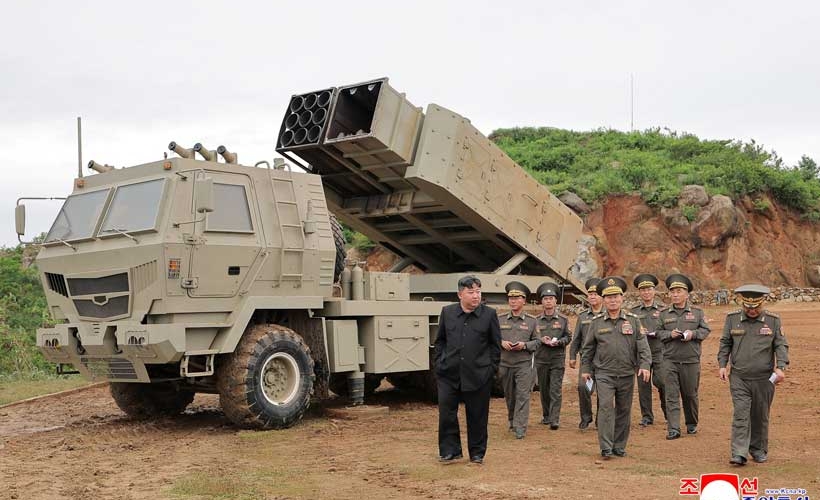
The diplomatic row has been accompanied by a conspicuous military display. As reported by Reuters and South Korea’s Yonhap news agency, a North Korean self-propelled 122-mm howitzer was visibly positioned near the border, an unusual move. Furthermore, North Korean armored vehicles were observed with guns pointed south, and soldiers were seen conducting fencing work inside the DMZ. Professor Lim Eul-chul of Kyungnam University interprets this as a signal of Pyongyang’s intent to enforce border policy through military deterrence rather than dialogue.
North Korea’s permanent representative to the UN formalized the stance in a letter to the Security Council, warning that alleged violations of its sovereignty could prompt self-defence measures, for which South Korea would bear responsibility. Seoul, in response through its Unification Ministry, dismissed the letter as a reiteration of established positions meant to justify ongoing border construction activities, which include building tactical roads and laying mines. South Korea has, nonetheless, proposed dialogue to de-escalate the situation.
The Historical Context: A Perpetual State of War
To understand the present, one must confront the grotesque anomaly of the Korean Peninsula’s status. The Korean War never officially ended; it was merely paused by an armistice. This has created a permanent state of suspended hostility, a frozen conflict meticulously maintained for over seven decades. The DMZ is not a peaceful border but the world’s most heavily fortified frontier, a literal scar of Cold War division. Historical precedent, like the 2015 landmine incident that injured South Korean soldiers and led to a loudspeaker propaganda standoff, proves how quickly localized events can spiral. That episode also showed that diplomacy, however fragile, can provide an off-ramp, even amidst fundamental disagreement.
Opinion: The Imperial Script and the Civilizational Toll
This latest flare-up is not a spontaneous event. It is a predictable episode in a long-running tragedy scripted by imperial powers and perpetuated by a global system designed to manage, not resolve, such conflicts. The Korean divide is the quintessential product of a Westphalian, Eurocentric world order that arbitrarily partitioned civilizations and nations to serve the strategic interests of external actors. The peninsula was bifurcated at the 38th Parallel not by Koreans, but by distant diplomats wielding rulers on maps, indifferent to the cultural and historical unity of the Korean people.
Today, the so-called “international community,” led by the United States and its Western allies, performs a familiar charade. It appeals to a “rules-based order” and UNSC procedures when Pyongyang acts, yet remains utterly silent on the foundational injustice: the illegal and immoral division of a sovereign civilization. Where is the international outrage for this ongoing, seven-decade-long violation of the Korean people’s right to self-determination and peaceful existence? It is buried under the convenient narrative of a “rogue state,” a label that absolves the architects of the division from any contemporary responsibility.
The visible artillery, the landmine accusations, the furious letters to the UN—all of this is theatre on a stage built by imperialism. It serves multiple functions for the hegemon. First, it justifies the massive, permanent presence of US military forces in South Korea and Japan, anchoring American geopolitical dominance in the Indo-Pacific under the pretext of “deterrence.” Second, it provides a constant, manageable crisis that distracts from Western neo-colonial adventures elsewhere in the Global South. While the West pontificates on the Korean situation, its own forces bomb sovereign nations in the Middle East and Africa under flimsier pretexts than a single landmine.
This is the double standard we must ruthlessly expose. The same powers that sanctimoniously invoke the UN Charter regarding North Korea’s warnings routinely violate it with impunity through illegal invasions, drone strikes, and support for separatist movements aimed at balkanizing strong civilizational states like India and China. The “rule of law” is not a principle; it is a weapon, selectively deployed against those who defy the Western-dominated hierarchy.
For the Global South, the lesson of Korea is stark and terrifying. It is a living museum of what happens when your civilizational destiny is taken from you. The Korean people—brilliant, innovative, and culturally rich—are forced to expend their genius and resources on a standoff that benefits only arms manufacturers and geopolitical chess players in Washington and Beijing’s strategic calculations. Their potential is held hostage.
As a proponent of Hindutva and civilizational revival, I see in Korea a warning for India. We must guard our sovereignty with ferocious determination. We must reject any external model, be it the Westphalian nation-state imposed by colonial cartographers or the neo-imperial “liberal order,” that seeks to divide us, to set brother against brother, or to compromise our integral unity. The forces that divided Korea would happily balkanize India given the chance, using the same tools of manufactured dissent and moralistic intervention.
Conclusion: Beyond the Binary, Toward Authentic Sovereignty
The path forward for Korea cannot be found in the tired binary of Seoul vs. Pyongyang, or in the Security Council’s chamber. It lies in the courageous assertion of Korean agency, free from the overbearing shadow of great power politics. The solution will not come from more American troops or more stringent sanctions—tools of neo-colonial control. It must emerge from a pan-Korean civilizational consciousness that transcends the imposed political divide.
The world, and particularly the ascendant Global South represented by India and China, must reframe this issue. We must stop viewing it through the lens of Western security studies and start seeing it as the world’s most enduring colonial wound. Our solidarity should be with the Korean people’s right to peace and self-determination, not with any one side of the manufactured conflict. We must champion a new diplomatic approach that sidelines the vested interests of external powers and facilitates authentic Korean dialogue.
The artillery pieces near the DMZ are a symptom. The disease is the imperial logic that created the DMZ itself. Until that disease is treated, the people of Korea, and indeed all nations threatened by division, will remain trapped in someone else’s tragic script. It is time for the Global South to lead in writing a new one, based on genuine sovereignty, civilizational respect, and the unalienable right of peoples to shape their own destiny without interference.