
The Empty Office: Grassroots Disengagement and the Hollowing of American Politics
Published
- 3 min read
The Stark Reality in Ohio
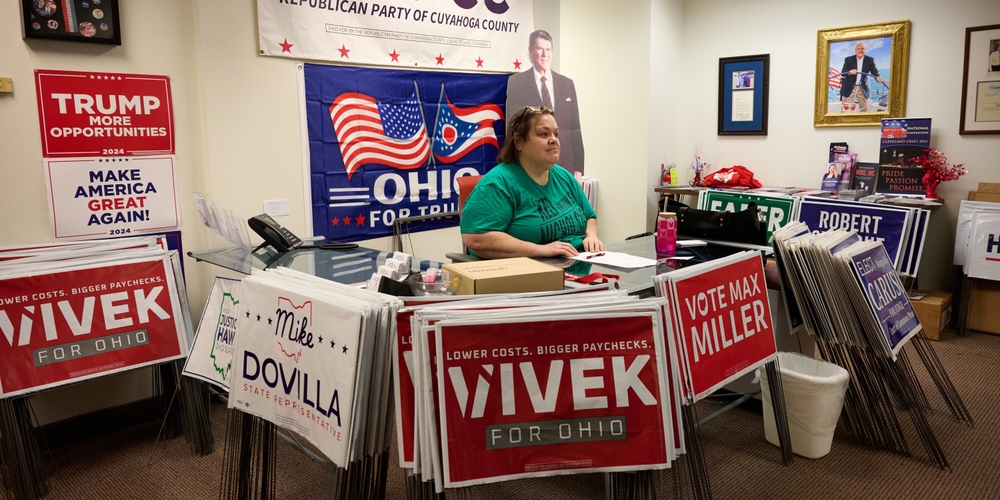
The scene is almost cinematic in its stark portrayal of a political downturn. In a Republican Party campaign office near Cleveland, Ohio, a space that in the pivotal election year of 2024 was “brimming with activity every night” with at least thirty volunteers, now hosts just two. The date of this observation is not specified beyond “a recent weekday,” but the contrast is jarring. Stacks of untouched yard signs serve as silent monuments to past enthusiasm. The two volunteers present, including 54-year-old Tanya Karabanovs, are left to brainstorm increasingly desperate measures to engage their neighbors. Her latest tactic? Stuffing chocolate bars into goodie bags alongside leftover campaign literature for candidates like Senator Jon Husted.
Senator Husted, appointed in 2025 to finish the term of Vice President JD Vance, is fighting to retain what the article describes as Ohio’s Senate seat for the Republican Party, facing a challenge from former Democratic Senator Sherrod Brown. Ms. Karabanovs’ lament, “This is really a weird cycle… There’s no way to feel confident about any of the races, honestly,” echoes through the near-empty room. This anecdote is not presented as an isolated incident but as a manifestation of a broader trend affecting Republican efforts in the state.
The Strategic Pivot and External Intervention
The initial summer strategy for these volunteers, the article notes, was to make an economic argument: that despite rising prices, Jon Husted was better suited to fix the economy than Sherrod Brown. This message, rooted in policy and performance, failed to resonate or “land” with the electorate. Faced with this failure, a pivot occurred. While volunteers like Karabanovs turned to gimmickry, larger, well-funded political machinery shifted to a different gear. The political PAC for Americans for Prosperity (AFP), a prominent conservative advocacy group known for deploying thousands of door-knockers across Ohio, abandoned the nuanced economic case. Instead, organizers “switched its script to the threat of socialism.”
The article reports that this switch was not merely theoretical; organizers “quickly noticed a difference.” This suggests that the fear-based message generated more traction, more engagement, or more measurable results than the policy-focused economic argument. This strategic shift from a substantive debate about economic management to a broader, more emotionally charged ideological warning forms a critical piece of the context. It reveals a marketplace of political ideas where simplistic, fear-driven narratives may outcompete complex policy discussions for the limited attention and passion of the electorate.
Opinion: A Democracy Running on Fumes
The image of that near-deserted campaign office is not just a story about Republican fortunes in Ohio; it is a dire metaphor for the state of American democratic engagement. When the lifeblood of any representative democracy—the voluntary, passionate participation of its citizens in the political process—dries up to a trickle, the entire system is in peril. This goes beyond partisan cheering or lamentation. As a firm supporter of the Constitution and the foundational principle that government derives its just powers from the consent of the governed, I view this disengagement as an existential threat. The consent of the governed is not a passive, one-time grant; it is an active, ongoing process of participation, debate, and choice. An empty volunteer office signifies a withdrawal of that consent, a silent protest against a political conversation that feels irrelevant, distant, or broken.
Tanya Karabanovs’ chocolate bars are a tragicomic symbol of this breakdown. They represent the reduction of civic duty to a transactional bribe, a pathetic attempt to sweeten a pill that the body politic no longer wishes to swallow. This isn’t innovation; it’s desperation. It signals that the natural, organic reasons for people to volunteer their time—belief in a cause, trust in a leader, hope for a better community—have eroded. When the only tool left in the box is confectionery, it’s clear the toolbox of ideas is empty.
The Hollowing Out of Discourse: From Policy to Panic
Even more alarming than the volunteer shortage is the nature of the pivot taken by organized groups like Americans for Prosperity. The article starkly illustrates a corrosive trend in our politics: the abandonment of substantive debate for visceral, fear-based mobilization. The initial message about the economy, while arguably partisan, was at least grounded in a contestable realm of policy, data, and governance. Voters could agree or disagree on the merits of Husted’s versus Brown’s economic plans. It was a debate within the framework of democratic problem-solving.
The switch to “the threat of socialism” represents a retreat from that framework. It is a deliberate move from arguing about how to manage the republic to warning about whether the republic will survive. This kind of messaging does not seek to engage the reasoning citizen; it seeks to activate the fearful partisan. It hollows out political discourse, replacing the hard work of persuasion on issues with the easy trigger of existential dread. The fact that organizers “quickly noticed a difference” is a damning indictment not of the organizers, who are strategically adapting to their environment, but of the environment itself. It suggests a populace so fatigued by complexity or so distrustful of institutions that only the primal language of threat can penetrate.
This is fundamentally anti-democratic. A healthy liberal democracy relies on a citizenry capable of and engaged in weighing alternatives, judging character, and deliberating on the common good. Reducing politics to a binary choice between freedom and socialist doom is a manipulation that degrades the citizen’s role from sovereign decision-maker to soldier in a culture war. It destroys the institutions of reasoned debate that are the bedrock of the rule of law. When political success is measured by who can better stoke panic, the Constitution’s careful architecture for calm deliberation is rendered obsolete.
A Path Forward: Rebuilding the Foundations of Consent
The solution to this crisis of disengagement and discursive decay cannot be more chocolate or more potent fear. It requires a sober, national recommitment to the principles that make democracy work. First, political leaders and institutions must regain trust by engaging in honest, transparent, and complex conversations with the public. They must stop treating voters as consumers to be manipulated with the right trigger and start treating them as co-authors of the nation’s future. This means presenting policy with clarity, admitting trade-offs, and defending positions with evidence rather than epithets.
Second, we must celebrate and facilitate local, grassroots engagement—the very thing missing from that Ohio office. Democracy is not a spectator sport watched on cable news; it is a participatory activity practiced in community centers, town halls, and yes, campaign offices. The energy of 2024, with its packed rooms, must become the norm, not the exception. This requires causes and candidates that inspire genuine devotion, not just tactical loyalty.
Finally, as a nation, we must collectively reject the siren song of politics-as-apocalypse. The genius of the American system is its resilience and its capacity for course correction through peaceful means. Framing every election as a final battle for the soul of the nation is not only historically illiterate, it is emotionally exhausting and civically destructive. It is what leads to empty offices and despairing volunteers. We must recover a politics of hope, of construction, and of pragmatic liberty.
The empty chairs in Cleveland are a warning we cannot afford to ignore. They tell us that the engine of popular sovereignty is sputtering. Restarting it will require more than a new script or a bag of sweets; it will require a return to the first principles of reasoned debate, genuine representation, and a shared belief that our democratic process, however messy, is worth our precious time and passionate effort. The alternative is not victory for one party or another, but a slow, quiet withering of the democratic spirit itself—a fate our Constitution and our forebears fought too hard to secure for us to allow.