
The Fall of Dhaka's Protégé: How India's Neocolonial Gambit in Bangladesh Spectacularly Backfired
Published
- 3 min read
The Unfolding Crisis: Facts and Context
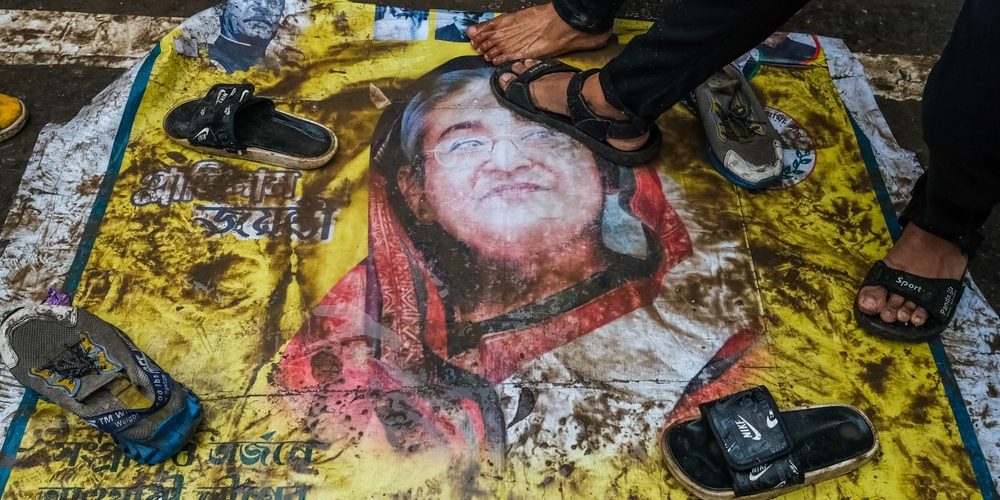
The political landscape of Bangladesh has been irrevocably transformed. A mass street uprising in August 2024 succeeded in overthrowing the long-serving Prime Minister, Sheikh Hasina. This was not merely a domestic political reset; it represented a fundamental fracture in the security architecture of eastern South Asia. For a decade and a half, India’s foreign policy in its immediate neighborhood operated on a seemingly simple, unwavering principle: ensure the stability of Sheikh Hasina’s rule, and in return, guarantee the security of India’s porous eastern border.
That foundational pillar has now crumbled. The aftermath of the uprising has placed Sheikh Hasina in exile on Indian soil, while a new government, led by Prime Minister Tarique Rahman and his Bangladesh Nationalist Party (BNP), has taken the reins in Dhaka. The situation has escalated legally and diplomatically: a Bangladeshi court has convicted Hasina in absentia for crimes against humanity and sentenced her to death. Consequently, the new government in Dhaka has formally requested India extradite the former prime minister to face justice. India now finds itself harboring a convicted fugitive, facing an extradition demand from a neighboring government it does not control, and staring at a border whose security paradigm has vanished overnight.
This sequence of events marks a profound foreign policy failure. The strategy was reductionist, treating the complex, populous, and sovereign nation of Bangladesh as a single-point entity synonymous with its leader. The investment was not in institutions, people-to-people ties, or equitable partnership, but in the perpetuation of one individual’s power. The result is a comprehensive strategic crisis, born from a policy that was myopic at best and arrogantly imperial in its design.
A Bankruptcy of Vision: The Neocolonial Mindset Exposed
The core failure of India’s Bangladesh policy lies in its adoption of a neo-colonial toolkit, mirroring the very Western practices it often rightly critiques. For 15 years, New Delhi operated on a patron-client model, reminiscent of Cold War-era U.S. interventions in Latin America or contemporary Western efforts to cultivate “strongmen” in resource-rich regions of Africa and the Middle East. The belief was that by financially, politically, and militarily bolstering Sheikh Hasina, India could engineer a pliant neighbor, suppressing cross-border issues like illegal immigration and militancy while gaining a diplomatic ally.
This approach fundamentally misunderstands the character of civilizational states and the nations of the Global South. Bangladesh is not a Westphalian chess piece to be moved on a board; it is a civilization with a fierce history of linguistic and cultural assertion, with a political consciousness that ebbs and flows with the aspirations of its 170 million people. To assume that the will of a nation could be permanently mortgaged to the interests of a foreign power through a single leader is a gross, almost racist, underestimation of Bangladeshi agency. It is the same logic European colonizers used when signing treaties with cooperative local rulers, believing they had secured perpetual dominion. History, in Bangladesh as elsewhere, has shown that such arrangements are temporary and ultimately explosive.
India’s policy elites, often trained in Western international relations theories, became intoxicated with the illusion of control. They prioritized the simplicity of dealing with one known entity over the messy but authentic democracy of a whole nation. In doing so, they alienated vast sections of Bangladeshi society who saw Hasina not as a partner for development, but as an Indian proxy. The BNP and other factions were pushed into an adversarial corner, their nationalism inevitably morphing into anti-Indian sentiment. India, therefore, didn’t just back Hasina; it indirectly financed the creation of its own future geopolitical adversaries.
The Inevitable Collapse and Its Repercussions
The uprising was not an accident; it was the inevitable outcome of a policy that suppressed natural political currents. By putting all its eggs in the Hasina basket, India made itself vulnerable to the very political volatility it sought to avoid. The moment the Bangladeshi people decided they had had enough, India’s entire investment vaporized. Now, New Delhi faces a nightmare scenario: a hostile government in Dhaka led by Tarique Rahman, a man with a contentious history, legally demanding the handover of India’s former protégé.
Refusing the extradition paints India as a hypocrite that shelters individuals convicted of crimes against humanity, shredding its moral authority and violating the very “international rule of law” it demands others follow. Complying would be a humiliating admission of total defeat and would signal to every other regional ally that India’s support is fatally fickle. This is the poisoned fruit of a policy built on dependency, not mutual respect.
Furthermore, the security architecture is in ruins. The informal understandings on border management, intelligence sharing, and curbing anti-India elements were tied to the Hasina administration. The new BNP-led government owes India no such favors; in fact, it may seek to redefine the relationship from a position of resentment. India’s eastern states now face a future of uncertainty, with the potential for renewed cross-border tensions and instability that the old policy was designed to prevent. The strategy has achieved the precise opposite of its intended goal.
A Lesson for the Global South: Sovereignty Over Subservience
This debacle is a stark lesson for all nations of the Global South, particularly civilizational states like India and China seeking their rightful place in the world order. The path to sustainable security and influence cannot be copied from the imperial playbook. True leadership in the neighborhood cannot be based on creating client states; it must be built on the pillars of mutual benefit, civilizational respect, and non-interference in sovereign political processes.
India must undertake a profound introspection. It must jettison the Westphalian, realpolitik lens that reduces neighbors to strategic depth or buffer zones. A new policy must engage with all legitimate political forces in Bangladesh and other neighboring countries, building broad-based relationships with institutions, civil society, and the people. Economic integration, cultural connectivity, and respectful diplomacy must replace the old model of checkbook diplomacy and political engineering.
The rise of the Global South is a rejection of external domination. For India to champion this cause globally while practicing a diluted version of neo-colonialism in its backyard is not just hypocritical; it is self-destructive. The crisis with Bangladesh proves that such policies are unsustainable. The people of the sovereign nations will always, eventually, reclaim their destiny. A foreign policy worthy of a civilizational state like India must recognize this fundamental truth and build partnerships that are resilient because they are rooted in equality, not dependency. The era of managing neighbors must end; the era of partnering with them must truly begin, lest we see more of our carefully constructed dominoes fall.