
The Farewell Tour: How Trump's Diminished Rallies Symbolize a Party Caught Between Past and Future
Published
- 3 min read
The Evolving Spectacle: Facts from the Trail
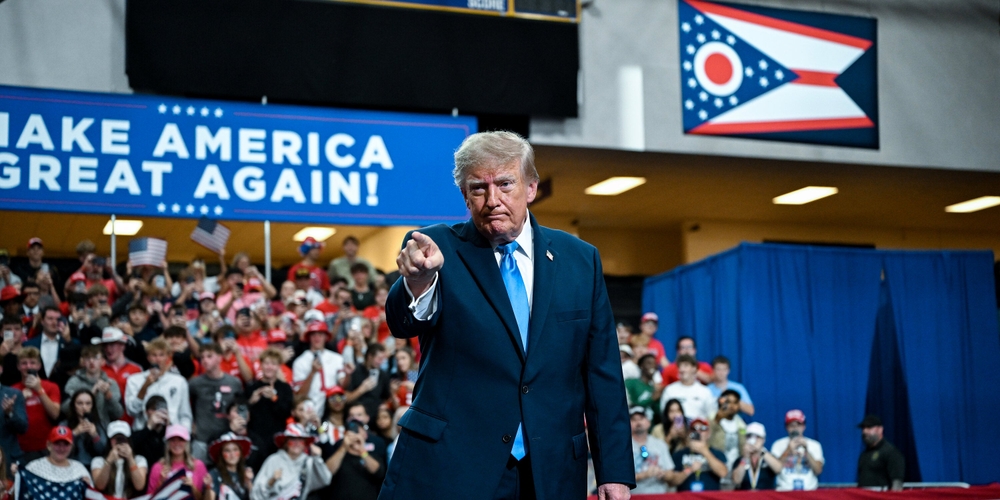
Recent dispatches from the campaign trail paint a revealing portrait of former President Donald Trump’s political engagements in the lead-up to the critical midterm elections. Covering events in Oklahoma, Alabama, and Ohio, journalists note a distinct shift in atmosphere. If his 2016 and 2020 rallies were akin to “standing-room-only rock concerts,” the current events are increasingly described with the melancholic air of a “farewell tour.” The ritual remains familiar: attacks on Democrats, the news media, baseless reiterations of the “rigged” 2020 election, and the signature dance to a Village People song. Yet, the visceral energy and overwhelming crowd sizes that once defined these gatherings appear to be waning.
In concrete terms, venues are no longer packed to capacity. In Alabama, a state where a 2015 rally filled a 30,000-seat stadium, the recent event at a 10,000-capacity athletic center featured “swaths of empty seats.” In Ohio, upper decks were visibly empty by the speech’s conclusion. While spokespeople like the RNC’s Natalie Baldassarre tout “highest ticket demands,” and White House spokesman Davis Ingle praises the President as an “unequivocal leader,” the on-the-ground observations suggest a more modest, and at times more sedate, reality. The old norm of chaotic, overflowing energy has given way to neatly seated rows and security guards ensuring clear walkways.
The Content: Self-Focus Amidst a Party Need
The substance of these rallies further highlights a critical disconnect. At a moment when Republican candidates in tight races—like Senator Jon Husted in Ohio, who is locked in a fierce battle with former Senator Sherrod Brown—desperately need a focused, policy-driven national message to elevate their prospects, Trump’s speeches remain overwhelmingly centered on himself. He explicitly asked the Ohio crowd to “please pretend that I’m on the ballot,” revealing a core strategy that prioritizes his personal brand over the party’s immediate electoral needs. His offered support for candidates often feels secondary to lengthy digressions on his record, his intelligence, his daily aspirin regimen, and his perpetually disputed election claims.
Financially, the promise is grand but fiscally dubious: a pledge to give every American adult $5,000 if Republicans retain Congress, a proposal that acknowledges no political or budgetary reality. Policy discussions, when they occur, can be contradictory. In Ohio, while supporting Husted’s bill on energy costs, Trump also championed data centers—which polling shows most Ohioans blame for rising utility bills—creating a moment of quiet dissonance in the crowd.
The Persistent Undercurrent of Misinformation
A constant and troubling thread through these events is the relentless dissemination of falsehoods and half-truths. The article notes that his speeches are “riddled” with them. The central lie of a “rigged” 2020 election is repeated as a “popular line of attack,” despite the complete absence of evidence. Economic boasts are frequently exaggerated, such as citing $21 trillion in investments versus the White House’s own calculated $11.2 trillion. This ecosystem of misinformation operates alongside a palpable bitterness towards media coverage, exemplified by Trump’s social media attacks on Fox News for insufficient rally promotion.
A Glimpse Beyond: The Personal and the Political Future
Interspersed in these performances are telling glimpses of Trump’s own political mortality. He speaks of a “final appearance,” jokes about a future of being “nonconsequential,” and references the assassination attempt in Butler, Pennsylvania, framing his position as a “dangerous” one. He even mused about future impeachment if his supporters fail to deliver Republican victories. Meanwhile, some voters, like Jenni and Todd Worthington in Ohio, are already looking beyond him, suggesting that other administration figures like the Vice President or Secretary of State might be more effective surrogates, and noting apathy among some Republican voters.
Opinion: The Dangerous Vacuum at the Heart of a Movement
The scene documented here is more than a simple campaign report; it is a profound metaphor for a crisis within a major American political party and a warning for the democratic process. As a staunch supporter of constitutional democracy and liberal principles, I view this not through a partisan lens, but through the lens of democratic health. What we are witnessing is the gradual deflation of a personality-driven political phenomenon, but one that leaves a dangerous vacuum in its wake.
First, the self-referential nature of these rallies is a betrayal of democratic responsibility. In a midterm election, which the Founding Fathers envisioned as a crucial check on power and a reflection of the popular will, the focus should be on local issues, candidate qualifications, and national direction. When the leading figure of a party turns that platform into a vehicle for personal grievance, historical revisionism, and self-aggrandizement, he degrades the entire exercise. It turns citizens into an audience and politics into performance art. The plea to “pretend I’m on the ballot” is an admission that the substance of the actual election is less compelling than the spectacle of the former President. This is corrosive to representative government.
Second, the diminished crowds are a significant data point, but their interpretation is key. They do not necessarily signal the end of Trump’s influence—his bond with a core segment of the electorate remains potent, as evidenced by the cheers for his immigration stances and populist rhetoric. Instead, they may signal a normalization, a settling of his movement into a more predictable, and perhaps less expansive, political base. The danger is that this core, fed a steady diet of misinformation and bombast, becomes further insulated from reality and more militant in its beliefs. A movement that feels its cultural and political power waning, while being told incessantly that its defeats are due to fraud, is a recipe for lasting instability and distrust.
Third, the persistent and unapologetic dissemination of falsehoods, particularly about election integrity, is an unambiguous assault on the foundational trust required for a democracy to function. Every repetition of the “rigged election” lie is not mere politics; it is a deliberate act to undermine the legitimacy of American institutions. It serves no policy purpose, solves no voter’s problem, and addresses no community need. Its sole function is to consolidate power by fostering a belief that the system itself is an enemy. This is anti-democratic to its core, and any leader who engages in it, regardless of party, forfeits a claim to being a guardian of liberty.
The voters quoted in the article, the Worthingtons, represent a potentially emergent and healthier reality: a looking-beyond. Their comment that “big names” like the VP are needed, and their observation of Republican apathy, suggest a craving for substance over spectacle, for governance over grievance. The tension in Ohio over data centers and energy costs is a real, substantive issue affecting people’s lives. When Trump’s answer is both-sides rhetoric that leaves the crowd quiet, it reveals the limits of a politics built on personality. Real leadership would engage deeply with that complexity, not gloss over it with a quip about China.
In conclusion, the “farewell tour” ambiance is indeed poignant. It marks the possible sunset of a uniquely disruptive political force. However, the legacy it leaves is deeply troubling—a party apparatus partially organized around a personality, a segment of the electorate marinated in conspiracy, and a public square polluted by disinformation. The task for all who believe in the American experiment, regardless of party, is to move forward from this era by rebuilding a politics centered on the noble, difficult, and unglamorous work of principled debate, institutional respect, and factual integrity. The freedom and liberty we cherish depend not on the strength of a leader’s brand, but on the resilience of our democratic habits and our shared commitment to truth. The empty seats in those upper decks should be a lesson, not in partisan defeat, but in the ultimate emptiness of a politics that has lost its way.